




Nursing students Turn to VR to Manage Aggressive Patients
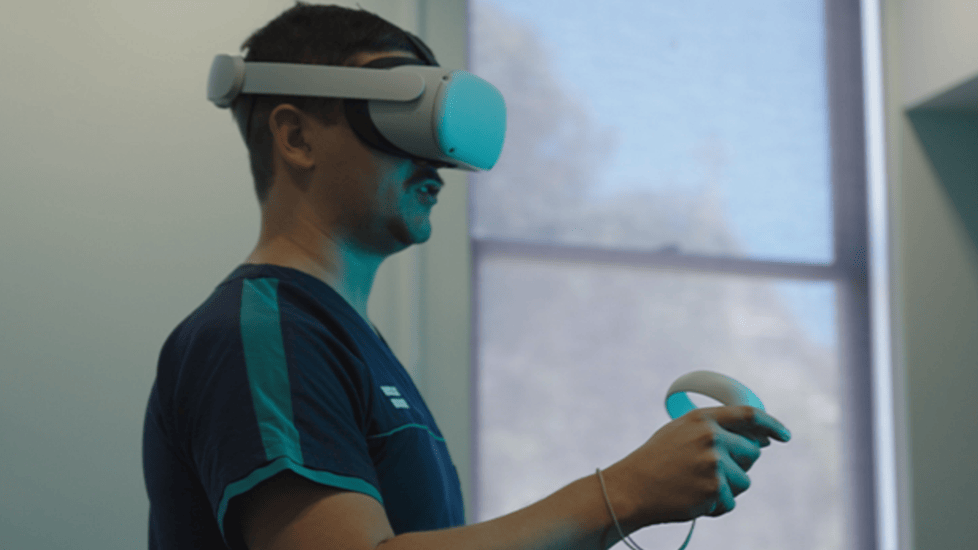
- Edith Cowan University in Perth, Australia, has developed a Virtual Reality program designed to help students manage aggressive patients.
- Researchers found that when students utilized the VR technology for a minimum of 20 minutes, they saw significant improvement in students' confidence.
- The VR system, or I-VADE, was co-designed with hospital work health and safety managers, workplace violence trainers, and frontline healthcare workers.
As reports of aggression and violence against hospital staff increase, educators at Edith Cowan University (ECU) in Australia have developed an immersive VR training program, I‑VADE (Immersive Violence and Aggression De‑escalation Experience), to give students realistic practice before they start working in hospital units. The program places users in a simulated hospital room with “Derek,” a hostile patient who uses coarse language and may become physically violent depending on how the interaction unfolds.


Source: Image from VR technology
Inside the I‑VADE simulation
Wearing a VR headset or using a desktop computer, students navigate scenarios in which they choose verbal and non‑verbal responses to Derek in real time. Each decision steers one of six possible outcomes, from Derek calming down and engaging safely to escalating into a dangerous confrontation with threats and simulated physical aggression. The scenario is driven by best‑practice de‑escalation guidelines and brought to life using motion‑capture performances to heighten realism and emotional impact.
New study shows confidence boost
In a recent study, 221 undergraduate nursing students from ECU completed a single 20‑minute I‑VADE VR session focused on aggression and violence de‑escalation. Students worked in groups of 20, each wearing an individual headset, with support from as few as two trained facilitators who guided the session and led structured debriefs afterward.
Researchers reported a statistically significant improvement in students’ confidence to manage patient aggression, with most participants also indicating that VR is a suitable option for this type of training. Students expressed desires to have more VR‑based de‑escalation education in the future.
Scaling up a new kind of safety training
The I‑VADE program was co‑designed with hospital work health and safety managers, workplace violence trainers, and frontline clinicians to ensure scenarios reflect real‑world risk and practice standards. Designed for scalability, it can be delivered to large cohorts with limited faculty time, and is now being used at multiple sites across Australia to train both students and practicing healthcare workers.
ECU’s Simulation and Immersive Digital Technology Group has also advanced I‑VADE through CSIRO’s ON Accelerate innovation pathway, positioning the platform for broader commercial rollout and potential adaptation to other high‑risk sectors such as retail, hospitality, and social services.
“No longer optional” for frontline staff
PhD candidate Joshua Johnson, who led the effectiveness study, warns that many clinicians still enter the workforce feeling underprepared for violent or aggressive encounters, despite the personal and professional toll of repeated exposure to such incidents. “Training in aggression and violence de-escalation and management can effectively assist in preparing both students and clinicians to manage hostile patients,” he said.

Source: I-VADE Team (L-R): Tyron Lopes (ECU), Dr. Brennen Mills (ECU), Sara Hansen (Alpha Immersion), Associate Professor Alex Rassau (ECU), and David Hollands (Alpha Immersion)
Associate Professor Brennen Mills argues that recognizing, de‑escalating, and safely managing aggression is now an essential, non‑negotiable skill set for health professionals, and says I‑VADE offers a practical, standardised way to build those skills before the stakes are real.
"The ON Accelerate program presents an unparalleled opportunity for us to bring I-VADE closer to real-world implementation. This progression not only highlights the innovation at ECU but also the potential of I-VADE to revolutionise aggression and violence management healthcare training," said Dr Mills.
By allowing staff to “practise before it’s real,” the ECU team believes VR‑based training can help reduce harm, improve staff wellbeing, and ultimately make hospitals safer places for both workers and patients.
🤔Nurses, what do you think about using VR technology to learn how to de-escalate patients? Share your thoughts below.
If you have a nursing news story that deserves to be heard, we want to amplify it to our massive community of millions of nurses! Get your story in front of Nurse.org Editors now - click here to fill out our quick submission form today!