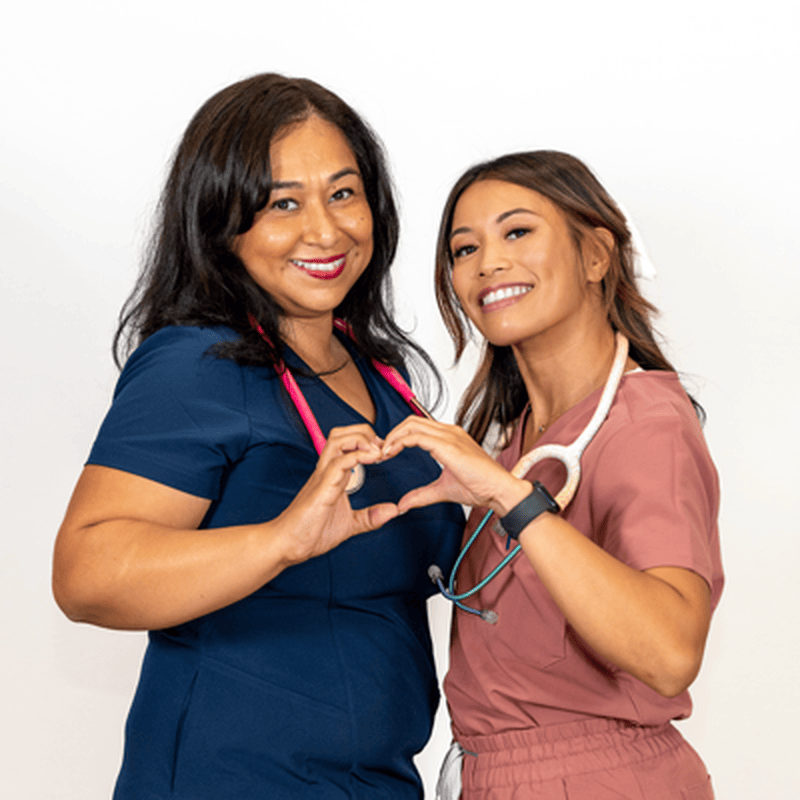



How to Become a Psychiatric Nurse Practitioner (PMHNP)

A Psychiatric Mental Health Nurse Practitioner (PMHNP) is an advanced practice RN who diagnoses and treats mental health conditions. PMHNPs earn a median salary of $129,210/year, require an MSN or DNP degree, and take 6-7 years of education and experience to become.
In this guide, we’ll explain how to become a psychiatric nurse practitioner, what they do, the average psychiatric nurse practitioner's salary, and more.
What is a Psychiatric Mental-Health Nurse Practitioner (PMHNP)?
Psychiatric mental health nurse practitioners (PMHNPs), also known as psychiatric nurse practitioners, are nurse practitioners who specialize in mental health treatment. They help patients suffering from mental illnesses, disorders, or substance abuse problems by assessing, diagnosing, and providing treatment plans to them.
Degree Requirements
MSN or DNP Degree
How Long to Become
6-7 years
Learn in-depth practices in how to provide comprehensive psychiatric mental health care at Purdue Global’s School of Nursing. Grow your skills in the assessment, diagnosis, treatment, and management of a variety of psychiatric mental health disorders across the lifespan of patients. Enrollment: Nationwide, but certain programs have state restrictions. Check with Purdue for details. Chamberlain University is the #1 largest school of nursing with a community of more than 177,000 students, faculty, and alumni. The school offers MSN-NP programs online and has a long history of successfully delivering top quality education. Chamberlain's Commitment to Completion Grant helps RNs earn advanced degrees with savings up to $9,100. Enrollment: Nationwide except CT, NY, RI Earn your nursing degree from one of the largest nursing education providers in the U.S. Walden University’s BSN, MSN, post-master’s APRN certificate, and DNP programs are accredited by the Commission on Collegiate Nursing Education (CCNE). Get enhanced practicum support with our Practicum Pledge. Enrollment: Nationwide, excluding CT, ND, NY and RI. Certain programs have additional state restrictions. Check with Walden for details. GCU's College of Nursing and Health Care Professions has a nearly 35-year tradition of preparing students to fill evolving healthcare roles as highly qualified professionals. Enrollment: Nationwide Enrollment: NationwidePopular Online Psychiatric-Mental Health Nurse Practitioner (PMHNP) Programs

 CCNE
CCNE
 Online
 RN Required
 CCNE
Online
RN Required
CCNE
Online
RN Required
 CCNE
Online
RN Required
CCNE
Online
RN Required
 CCNE
Online
RN Required
CCNE
Online
RN Required
 ACEN
Online
RN Required
ACEN
Online
RN Required
How to Become a Psychiatric Mental-Health Nurse Practitioner
Becoming a PMHNP requires a graduate-level nursing degree, clinical experience, and national certification. Most nurses complete the process in 6 to 8 years from the start of their undergraduate education. Here's a step-by-step breakdown.
-
Earn Your Nursing Degree (4 years)
You'll need a Bachelor of Science in Nursing (BSN) to qualify for most PMHNP graduate programs. While some nurses start with an Associate Degree in Nursing (ADN), nearly all PMHNP programs require a BSN for admission. ADN-prepared nurses can complete an RN-to-BSN bridge program (typically 1 to 2 years) before applying.
If you don't have a nursing background at all, direct-entry PMHNP programs accept non-nursing bachelor's degree holders and combine foundational nursing coursework with the graduate PMHNP curriculum. These programs typically take 3 to 4 years. -
Pass the NCLEX-RN and Get Licensed
After completing your nursing degree, you'll take the NCLEX-RN exam to become a licensed registered nurse. You must hold an active, unencumbered RN license before applying to PMHNP graduate programs. Most state boards process applications within 4 to 6 weeks of passing. -
Gain Clinical Experience (1-2 years)
Most PMHNP programs require 1 to 2 years of RN experience for admission, though requirements vary. Psychiatric or behavioral health experience is preferred but not always required. Working in settings like inpatient psych units, crisis stabilization, community mental health centers, or substance abuse facilities gives you an advantage in both admissions and clinical preparation.
Some accelerated programs waive or reduce the experience requirement, particularly for BSN-prepared nurses with strong academic records. -
Complete a PMHNP Graduate Program (2-4 years)
You'll need either a Master of Science in Nursing (MSN) or a Doctor of Nursing Practice (DNP) with a PMHNP specialization. Program length depends on your entry point:
• BSN to MSN (PMHNP): 2 to 3 years, typically 500 to 700 clinical hours• BSN to DNP (PMHNP): 3 to 4 years, typically 1,000+ clinical hours• Post-master's certificate: 1 to 2 years for nurses who already hold an MSN or NP in another specialty• RN to MSN bridge: 3 to 4 years, combines BSN and MSN coursework
Most programs are available fully online with in-person clinical rotations arranged in your local area. Tuition ranges from approximately $8,000 for the most affordable certificate programs to over $60,000 for top-ranked university MSN programs.
Your program must be accredited by either CCNE (Commission on Collegiate Nursing Education) or ACEN (Accreditation Commission for Education in Nursing). Graduating from an accredited program is required to sit for the certification exam.
→ Compare program options by pathway, cost, and length in our best online PMHNP programs guide. -
Earn PMHNP-BC Certification
After graduating, you'll take the Psychiatric-Mental Health Nurse Practitioner Board Certification (PMHNP-BC) exam through the American Nurses Credentialing Center (ANCC). The exam covers:
• Psychiatric assessment and diagnosis• Psychopharmacology• Psychotherapy modalities• Ethics, legal considerations, and professional practice• Crisis intervention and risk assessment
The exam fee is $395 for ANA members and $500 for non-members. Certification is valid for 5 years and requires 75 hours of continuing education and 1,000 practice hours within the renewal period. -
Obtain State APRN Licensure and Begin Practicing
With your PMHNP-BC in hand, apply for Advanced Practice Registered Nurse (APRN) licensure in your state. Requirements vary significantly by state — some states grant full practice authority, allowing PMHNPs to diagnose, treat, and prescribe independently, while others require a collaborative agreement with a physician.
Prescriptive authority for controlled substances (including Schedule II medications commonly used in psychiatric care) also varies by state and may require a separate DEA registration.
→ For state-specific requirements, see PMHNP programs by state.
Learn in-depth practices in how to provide comprehensive psychiatric mental health care at Purdue Global’s School of Nursing. Grow your skills in the assessment, diagnosis, treatment, and management of a variety of psychiatric mental health disorders across the lifespan of patients. Enrollment: Nationwide, but certain programs have state restrictions. Check with Purdue for details. Chamberlain University is the #1 largest school of nursing with a community of more than 177,000 students, faculty, and alumni. The school offers MSN-NP programs online and has a long history of successfully delivering top quality education. Chamberlain's Commitment to Completion Grant helps RNs earn advanced degrees with savings up to $9,100. Enrollment: Nationwide except CT, NY, RI Earn your nursing degree from one of the largest nursing education providers in the U.S. Walden University’s BSN, MSN, post-master’s APRN certificate, and DNP programs are accredited by the Commission on Collegiate Nursing Education (CCNE). Get enhanced practicum support with our Practicum Pledge. Enrollment: Nationwide, excluding CT, ND, NY and RI. Certain programs have additional state restrictions. Check with Walden for details. GCU's College of Nursing and Health Care Professions has a nearly 35-year tradition of preparing students to fill evolving healthcare roles as highly qualified professionals. Enrollment: Nationwide Enrollment: NationwidePopular Online Psychiatric-Mental Health Nurse Practitioner (PMHNP) Programs
CCNE
Online
RN Required
CCNE
Online
RN Required
CCNE
Online
RN Required
CCNE
Online
RN Required
ACEN
Online
RN Required
PMHNP Duties
Your duties as a PMHNP will vary depending on several factors, including your workplace and PMHNP specialty, if you choose to pursue one. The following is a nonexhaustive list of duties you may perform in this role:
- Conduct comprehensive psychiatric evaluations and mental health assessments.
- Diagnose mental health disorders using clinical tools like DSM-5.
- Prescribe, manage, and monitor psychiatric medications.
- Provide psychotherapy (e.g., CBT, supportive therapy) within scope of practice.
- Educate patients and families on diagnoses, treatments, and self-care.
- Order and interpret lab tests or diagnostic studies.
- Develop and adjust individualized treatment plans.
- Document patient care, treatment progress, and ensure regulatory compliance.
- Respond to psychiatric crises and assess risk of harm.
- Refer patients to specialists or inpatient care when needed.
- Collaborate with interdisciplinary teams (e.g., primary care, social work).
- Participate in on-call rotations or telehealth services as required.
- Stay current with continuing education and evolving best practices.
- Advocate for mental health awareness and reduce stigma.
Illnesses and Disorders that Psychiatric Nurse Practitioners Treat
- Anxiety
- Depression
- Bipolar, manic-depressive states
- Eating disorders
- Obsessive-Compulsive Disorder
- Attention deficit hyperactivity disorder
- Substance abuse
- Panic Disorders
- Dementia
- Autism Spectrum Disorder
- Schizophrenia
- Personality disorders
- Trauma, PTSD, adjustment disorders
Day in the Life of a PMHNP
1. Receiving a Sign-Out From the Overnight Team
You can expect to start your day by receiving a sign-out from the overnight team on the patients and any changes that may have occurred over the previous shift.
2. Make the Rounds
The PMHNP will join the rest of the medical team for rounds on the patients. The team will vary but may consist of a psychiatrist, psychologist, social worker, and case manager.
3. Visit Patients
After morning rounds, most PMHNPs will physically go and see their patients as well as update them on plans for the day.
Depending on the type and severity of mental health illness, the patients might be seen in a common room or in their own room. They will also discuss progress in their treatment plans and any news of discharge of facility placements.
4. Place Orders
Once a PMHNP completes morning rounds, it's time to place orders. These orders reflect any change in the day's plan of care.
5. Tend to Patients
PMHNPs will continue to tend to their patients throughout their shifts, making any necessary changes to their medication regimen. In fact, PMHNPs, while specializing in mental health disorders, are also generally responsible for the overall health and well-being of their patients.
Psychiatric Nurse Practitioner Salary
Nurse practitioners in the US earn a median salary of $129,210 per year, per the US Bureau of Labor Statistics (BLS) in May 2024. However, the BLS does not differentiate between nurse practitioner specialties.
Psychiatric mental health nurse practitioners are among the highest-paid NP specialties. Indeed reports that the average PMHNP salary is $143,387 as of January 2026.
PMHNP Continuing Education Requirements
PMHNP continuing education units (CEUs) will vary based on the state of licensure. Individuals must complete CEUs in each state where they hold a license.
General Requirements:
- Minimum 75 contact hours in psychiatric nursing
RN License Maintenance:
- PMHNPs must also maintain their RN license
- Typically requires:
- Application renewal
- Additional CEUs
- Small renewal fee
Important:
- Every state has different rules
- Always check with your state board of nursing before renewing to stay compliant
PMHNP Career Outlook
Demand for psychiatric mental health nurse practitioners remains strong in 2026. The Bureau of Labor Statistics projects nurse practitioner employment to grow by 35% (much faster than average) over the next decade, and PMHNPs are positioned to absorb much of that growth as the nation's psychiatrist shortage deepens.
Over 137 million Americans currently live in mental health professional shortage areas, according to the Health Resources and Services Administration (HRSA). While some urban markets like New York and Miami have become more competitive for new graduates, rural counties and underserved communities still face critical provider gaps. The distinction between national supply and local saturation matters — the overall job market for PMHNPs is far from oversaturated.
Telehealth has further expanded the market. PMHNPs can now practice across state lines in many cases, opening up opportunities in underserved areas without requiring relocation.
→ For a full analysis of the 2026 PMHNP job market, including regional demand data and how to position yourself competitively, see our PMHNP job market outlook article.
Is Becoming a PMHNP Worth It?
If you’re thinking about becoming a Psychiatric Mental Health Nurse Practitioner (PMHNP), there’s a lot to like. Demand is high, salaries are strong, and in many states, you can practice with a high level of autonomy. Only 6.5% of nurse practitioners specialize in mental health, highlighting just how needed this role is.
Nurse.org's Expert's Advice
"PMHNPs can enjoy a competitive salary, so considering a career as a psychiatric mental health nurse practitioner is a compelling choice. Especially given the critical need for mental health providers today."

- Pros: You’ll have the ability to diagnose and treat mental health conditions, often combining therapy with medication management, which makes the work both meaningful and varied.
- Cons: At the same time, it’s important to go in with clear expectations. The role can be emotionally intense, and getting there requires a graduate degree and certification, which takes time and commitment.
For nurses who feel drawn to mental health, though, the impact you can make in patients’ lives is significant, and many find that the rewards far outweigh the challenges.
Learn in-depth practices in how to provide comprehensive psychiatric mental health care at Purdue Global’s School of Nursing. Grow your skills in the assessment, diagnosis, treatment, and management of a variety of psychiatric mental health disorders across the lifespan of patients. Enrollment: Nationwide, but certain programs have state restrictions. Check with Purdue for details. Chamberlain University is the #1 largest school of nursing with a community of more than 177,000 students, faculty, and alumni. The school offers MSN-NP programs online and has a long history of successfully delivering top quality education. Chamberlain's Commitment to Completion Grant helps RNs earn advanced degrees with savings up to $9,100. Enrollment: Nationwide except CT, NY, RI Earn your nursing degree from one of the largest nursing education providers in the U.S. Walden University’s BSN, MSN, post-master’s APRN certificate, and DNP programs are accredited by the Commission on Collegiate Nursing Education (CCNE). Get enhanced practicum support with our Practicum Pledge. Enrollment: Nationwide, excluding CT, ND, NY and RI. Certain programs have additional state restrictions. Check with Walden for details. GCU's College of Nursing and Health Care Professions has a nearly 35-year tradition of preparing students to fill evolving healthcare roles as highly qualified professionals. Enrollment: Nationwide Enrollment: NationwidePopular Online Psychiatric-Mental Health Nurse Practitioner (PMHNP) Programs
CCNE
Online
RN Required
CCNE
Online
RN Required
CCNE
Online
RN Required
CCNE
Online
RN Required
ACEN
Online
RN Required
FAQs
Nurses Helping Nurses: Why You Can Trust Nurse.org
As the leading educational website for nurses by nurses, Nurse.org is committed to editorial integrity and data-driven analysis.
✔ Content written by 80+ licensed, practicing nurses who are experts in their respective specialties. Learn more about our nurse contributors.
✔ Transparent, trusted data sources from the U.S. Bureau of Labor and Statistics (BLS), Payscale, ZipRecruiter, and Glassdoor. Learn more about our data sources.
✔ Consistent article updates to ensure they are as relevant and accurate as possible, utilizing the latest data and information when it becomes available.