



From the ER to Congress: Why This Nurse Is Running for Office | Opinion

- Nurses already possess the leadership, ethical grounding, and policy insight needed to serve in elected office.
- The number of nurses in state legislatures has declined over the past decade.
- Increasing nurse representation in politics could improve health equity, gender representation, and evidence-based policymaking.
Podcast Episode
>>Listen to "From the ER to Congress: Why This Nurse Is Running for Office (With Nancy Mannion)"


Disclaimer: This is an opinion piece. The views shared here are the author’s own and do not necessarily reflect those of Nurse.org.
Our Political System Needs Nurses
We’ve elected the same people for close to 250 years; it’s not working. We must look elsewhere; we must look to nurses.
A Political Awakening
I believe nursing is political and that as nurses, we are uniquely qualified to hold elected office. Earlier this year, that belief led me to drive seven hours from Philly to Durham, North Carolina, to spend three jam-packed days learning how to run for office. It was a roller coaster of exhaustion and elation; of uncertainty and conviction; of inspiration and overwhelm — all brought together by the Healing Politics Campaign School for Nurses and Midwives.

Leaving the campaign school after those three days cemented my belief that as nurses, we not only have a responsibility to lead within healthcare but in all facets of life, including public office. It also highlighted what nurses need to hear: that we already have more than enough of the skills needed to do so effectively and successfully.
As the co-founders of Healing Politics have stated:
“Nurses possess many skills and qualities that make them well suited to elected office, including the ability to build and lead teams, conflict management, negotiation, evidence-based thinking, and listening and communication skills.”
Why Nurses Are Built for This
Moreover, nursing is rooted in science, health, and public health. As nurses, we focus on the social determinants of health, the factors that impact the health and well-being of an individual. Heck, the third provision of the American Nurses Association (ANA)’s Nursing Code of Ethics states that the “nurse promotes, advocates for, and protects the rights, health, and safety of the patient.” How better to promote, advocate, and protect the rights, health, and safety of individuals than by actively engaging in our democratic political system?
My professional focus in nursing for the past seven years has been on the use of a human-centered, equity-centered design process, grounded in leading with empathy: listening and co-collaborating with your end users, whether that is your patients and communities, your staff and colleagues, or your constituents.
The goal is to gain true insights, develop a deeper understanding of problems and needs, and create solutions that meet those needs together. A central part of the human-centered design process focuses on equity: understanding our own biases and assumptions, calling out unequal power dynamics and structural injustices, being aware of whose voices are being raised and whose are being silenced, and making sure we are not pushing our own agendas.
Aren’t these the traits we should expect from our elected officials? Is this how our elected officials should be running and leading this country? But it is not; not always, anyway.
Which is why having more nurses who believe in fact-based, data-driven science and who believe in empathy and equity serving in public office and engaging in political advocacy is not only better for our patients, our communities, and our profession, but even more so for our country.
The Decline in Nurse Representation
A study from Columbia University’s School of Nursing found that the number of nurses holding state elected office has decreased over the past ten years. As of January 2023, out of 7,382 elected state legislators nationwide, there were 72 nurses in office in 36 states in 2023, compared to 97 nurse legislators in 39 states in 2013. This is concerning, and as the authors stated, this should “be a call to action for nursing organizations to support nurses in the political process.”
Organizations Stepping Up
I was glad to see nursing organizations supporting the campaign school, including:
- The American Organization for Nursing Leadership
- The American Nurses Association
- The American Nurses Foundation
- The National Association of School Nurses
- DNPs of Color
The more nurses see organizations supporting and encouraging civic engagement and the political process within the nursing profession, the more normalized and expected it will become. Just recently, the President of the American Nurses Association wrote an article encouraging nurses to get involved in political advocacy.
She stated:
"Here’s the thing: advocacy doesn’t just happen in our statehouses and on Capitol Hill. It also takes place around kitchen tables, in coffee shops, and at grocery stores. Neighbor-to-neighbor and coworker-to-coworker conversations in these and other places can shed light not only on the important work you do but also on why some policies require change or new ones need to be created. This is how our democracy advances and works for us all."

Nurses Running for Office
Even though we have seen a decrease in nurses running for office in the last decade, there are still those taking up the charge.
Within my cohort was:
- Nancy Mannion, DNP, RN, CEN, FAEN, FAAN
Candidate for U.S. Congressional District PA-11 - Andrea Cazales, PhD
Candidate for Durham City Council Ward 1
There were others in the group actively planning their run for office as well.
Dr. Mannion is an emergency nurse and international healthcare leader. As it states on her campaign website:
“With over 40 years of experience as a registered nurse, her swift action, decision-making, and tenacity have saved lives during her patients' most challenging moments.”
She wants to take the skills and knowledge formed over her distinguished nursing career and use them to infuse care and create real change in Washington, DC. Please make sure to support her campaign.
The faculty also included nurses who currently hold elected office:
- Senator Gale Adcock (North Carolina)
- Senator Liz Boldon (Minnesota)
- Senator Kristin Roers (North Dakota)
- Former Governor and Lt. Governor Dr. Bethany Hall-Long (Delaware)
Nurses leading by example. Stepping up. Doing the work.
And don’t be fooled, it is hard work that very few even consider.

Who Actually Runs for Office?
Of all the people in America, only 2% have ever run for elected office.
Among those who run:
- The majority are white men
- Women make up only a quarter of candidates
- Women hold:
- 20% of U.S. Senate seats
- 18% of House seats
- 10% of governorships
- 24% of state legislator roles
This disparity is even greater when looking at race:
- 82% of those who’ve run for office are white
- 5% identify as non-Hispanic Black
- 6% identify as Hispanic
The Gender Opportunity in Nursing
There are close to 5 million registered nurses in the U.S.
- 89% are women
- 11% are men
- 0.3% identify as non-binary or “other”
- 80% are white, non-Hispanic
- The median age is 46 years
If more nurses ran for office, think about the gender and age equality that could occur.
A Different Lens on Policy
We’ve elected the same people for close to 250 years; it’s not working. We must look elsewhere; we must look to nurses.
Imagine if all of the policies and laws created went through the lens of a nurse. The vast difference that would make for the health and welfare of all who live in this country.
Our patients and communities need politicians who understand how important the social determinants of health are and who will act accordingly to protect the programs that keep our patients and communities healthy and safe, including:
- Medicaid
- Research funding
- Food assistance programs
- Environmental Protection Agency regulations
Fired Up and Moving Forward
I recently gave a talk on advocacy, activism, civic engagement, and social media. My charge was to get this particular group of nurses “fired up!”
There is a lot to be fired up over, and there will continue to be over the next few years. Which is why I encourage you all to fight for health equity, stand up for justice, lead with action by running for elected office, and apply to the 2026 Healing Politics Campaign School. It will take all of us being fired up to get this country back on track.
Resources
Want to keep the conversation going?
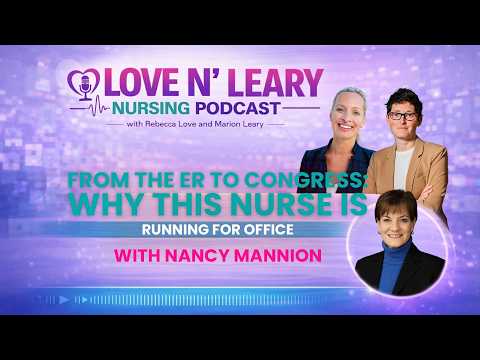
- Listen to the Love n’ Leary podcast episode with Nancy Mannion.
- Hear directly from some of the nurses I spent the weekend with at the 2025 Healing Politics Campaign School on the Love n’ Leary podcast.
- Tune in to my reflections on why a healthy democracy depends on civically engaged nurses in another Love n’ Leary episode.
- Read the article I wrote for The Nursing Beat on why civic engagement in nursing is not partisan.
🤔Nurses, how would healthcare policy change if more elected officials had clinical experience? Share your thoughts in the discussion forum below!