



Nurse Builds AI Patient Advocacy App Inspired By Her Own Misdiagnosed Brain Condition
- Rachel Dumas endured nine pregnancy losses and was dismissed by doctors over a neurological condition that was misdiagnosed as a stomach virus.
- She went on to need two brain surgeries and almost lost her life.
- The nurse was inspired by her experience to create an AI-powered patient advocacy platform to help patients navigate the healthcare system and advocate for their symptoms.
"HEARD is deeply rooted in my own experience," founder Rachell Dumas says. "I had a neurological condition that was initially dismissed and misdiagnosed as a stomach virus."
If you've ever waited weeks or even months for a doctor's appointment, headed into the day feeling anxious yet ready to address your symptoms and get some answers, maybe even prepping a list of questions to address, only to be completely dismissed by a provider who would barely look your way, Rachell Dumas has a solution for you.
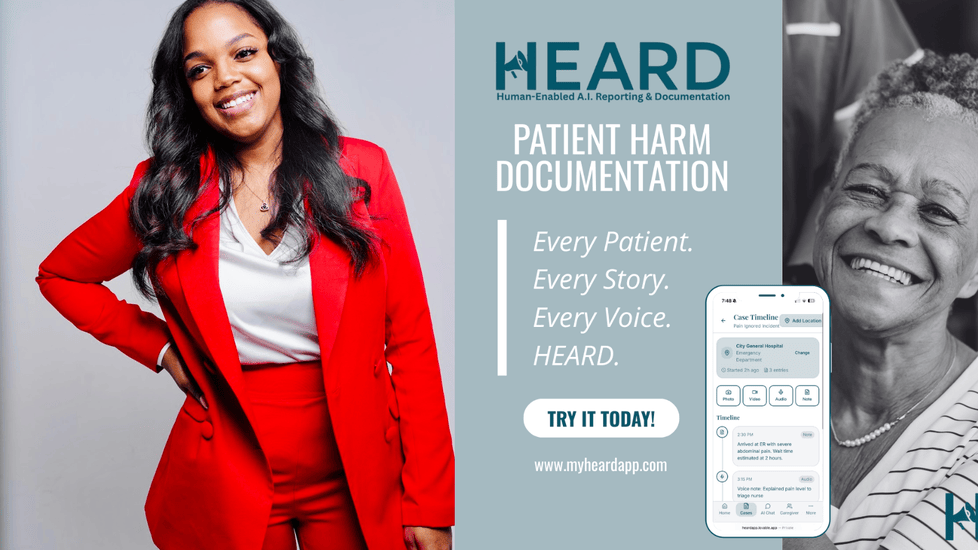
After being ignored by doctors herself while experiencing nine pregnancy losses and dealing with a neurological condition that eventually required two brain surgeries and nearly took her life, Dumas, RN, MSN, DNP(c), founded the HEARD platform. HEARD stands for Human Enabled AI Reporting and Documentation, and it's a platform designed to help patients navigate a healthcare system while advocating for themselves when it matters.
"I almost lost my life because my voice didn't matter," Dumas says. "HEARD exists to make sure every patient's voice is impossible to ignore."
Why HEARD App
"I almost lost my life because my voice didn't matter," Dumas says. "HEARD exists to make sure every patient's voice is impossible to ignore."

MSN, RN & Founder (HEARD App)
From Film to Fighting for Patients
Dumas didn't start out to become a patient advocate. She actually started school as a film and video major. But after taking an anatomy and physiology course and completing an internship in a critical care ICU, she says, "everything shifted."
"I saw the intensity, the humanity, and the impact of being present in someone’s most vulnerable moments," Dumas explains. "I fell in love with the work and knew it was my calling."
As a nurse, Dumas would go on to work in multiple high-acuity and systems-level environments, including trauma, neuro, critical care, and COVID ICU. She also traveled to New York City during the peak of the pandemic to support overwhelmed health systems on the frontlines. Her other specialities include perioperative services, long-term care, and nursing education.
Her unique background—along with her advanced education in nursing informatics—made her the perfect person to create an AI-powered platform to empower patients.

"My range of experience has given me a unique lens into how patients move through the healthcare system and where breakdowns most often occur, especially in high-stress, high-risk settings," she explains.
What is HEARD?
HEARD, Dumas explains, is a "real-time" patient advocacy platform designed to help patients and caregivers document their:
- Care
- Communicate effectively with providers
- Escalate concerns when necessary
That means that you don't have to stress about remembering to let the doctor know about that one weird symptom you had, or do the 3 AM Googling to find what to ask your doctor based on your symptoms, because the app will interpret the symptoms, guide you for what to ask your doctor, and even spot patterns in your health timeline you may have missed.
The app also documents every conversation and interaction, so you have proof and the ability to go back and revisit your notes, what the doctor said, and what you said—because trying to remember everything in the moment while you're stressed and scared can be very difficult.
HEARD is so powerful because Dumas knows herself what it's like to be dismissed and misdiagnosed by doctors.
"It is deeply rooted in my own experience," she shares. "I had a neurological condition that was initially dismissed and misdiagnosed as a stomach virus. That delay led to worsening symptoms and ultimately multiple brain surgeries."

Along the same timeline, when she was dealing with doctors misdiagnosing a dangerous neurological condition, she was also dealing with great personal loss, enduring nine pregnancy losses where she says she repeatedly experienced "dismissal, delays, and a lack of clear communication."
If Dumas could have such a sobering and challenging time navigating the healthcare system, she knew she had to do something to help other patients, especially those without a healthcare background. Because, as nurses are taught, patients very often know when something is wrong, but may not have the ability to express that in the "right" way to providers.
"What I realized is that patients often know something is wrong, but the system is not structured to respond quickly enough to their concerns," she explains. "HEARD was created to bridge that gap."
>>Listen to The Latest Nurse News Podcast
How HEARD Works

HEARD provides a structured way for patients to advocate in real time. Users can:
- Document symptoms, events, and care interactions with timestamps
- Upload notes, photos, or videos to track changes over time
- Receive guided prompts and scripts on how to communicate concerns clearly with providers
- Generate professional escalation messages to hospital leadership or patient advocacy teams when needed
- Share information with caregivers to keep everyone aligned
The platform also includes tools for navigating healthcare environments and tracking care journeys, helping reduce confusion during complex medical experiences. The built-in AI will interpret your data and ask you prompting questions to explore further.
It will also provide you with a list of questions and next steps to ask your doctor or provider clearly and professionally, designed to ensure your voice is heard. A patient dealing with vision changes, for instance, might be provided with a list of questions to ask their neurologist, such as:
- "Have you considered checking for increased intracranial pressure?"
- "Could these symptoms be related to my medication changes?"
- "What imaging would help rule out structural causes?"
"For patients, HEARD creates clarity, confidence, and a sense of control in moments that are often overwhelming," Dumas explains. "It helps them articulate concerns more effectively and ensures important details are not lost."
Another interesting feature of the app is that it provides live navigational tools. So if you're a patient going to a new hospital or doctor's office on a multi-level building, for instance, the app can guide you, turn-by-turn and step-by-step, to the location. Navigation updates are enabled to allow family and caregivers to "watch" and get notified when you have safely reached your destination.
Even the seemingly "smallest" things can make a huge difference when you're dealing with a health crisis.
And lastly, if something does happen and you're unfortunately dismissed by your provider, HEARD provides the next steps. The app can draft a professional email to the patient advocacy department, using your documented evidence and timeline.
Maternal Health in Mind

As a Black woman who dealt with reproductive health challenges, Dumas knows firsthand how Black women face a higher risk of maternal morbidity and reproductive health complications.
"Women, particularly Black women, are more likely to have their symptoms dismissed or minimized, contributing to disparities in outcomes, especially in maternal health," Dumas notes.
So the app also has a specific feature for maternal health as well, allowing pregnant women to track symptoms and recognize if a problem may be occurring, such as preeclampsia. The app can also be used once the baby arrives, too, to document the mother's and baby's health.
Some specific maternal health features include:
- Postpartum warning sign alerts
- Preeclampsia symptom tracking
- Birth preferences documentation
- Newborn care coordination
Why HEARD Helps Patients Be Heard

Who Is HEARD App Made For?
So, who is the HEARD app good for? Anyone who interacts with healthcare, whether that's for themselves or for a family member. It can be especially impactful for:
• Patients with complex or chronic conditions
• Individuals experiencing unclear or worsening symptoms
• Pregnant and postpartum patients
• Caregivers supporting loved ones
• Patients who feel unheard, dismissed, or unsure of next steps
"It is also valuable for employees balancing work while managing their own or a family member’s healthcare, allowing them to stay engaged without needing to step away entirely," Dumas points out.
Dumas is passionate about helping patients navigate the healthcare system, as a nurse and a patient who endured it herself.
"Preventable harm in healthcare is a major issue, and much of it stems from delayed diagnosis, communication failures, and dismissal of patient concerns," she notes.
Dumas adds that studies have shown that diagnostic errors affect an estimated 1 in 20 adults annually, and communication breakdowns are one of the leading contributors to adverse events in healthcare settings.
"HEARD addresses these issues by giving patients structure, language, and tools to advocate effectively in real time, not after harm has already occurred," she says.
HEARD is not live yet, but anyone interested in trying the app can sign up to join the Beta testing program.
Images courtesy of Rachell Dumas
 Nurses, what do you think of HEARD? Have you ever had your healthcare symptoms dismissed? Share your thoughts in the discussion forum below.
If you have a nursing news story that deserves to be heard, we want to amplify it to our massive community of millions of nurses! Get your story in front of Nurse.org Editors now - click here to fill out our quick submission form today!