



Bedside to Tech: Microsoft’s Chief Nursing Information Officer
Originally published on The Nursing Beat, March 28, 2025
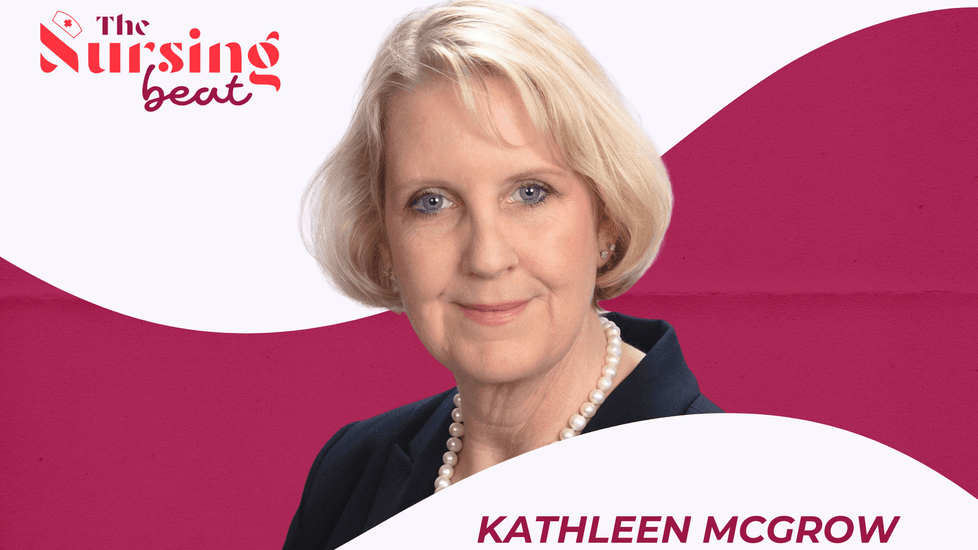
Before she was the Chief Nursing Information Officer at Microsoft, Kathleen McGrow, DNP, MS, RN, PMP, FHIMSS, FAAN saved lives in a trauma unit. One night, she cared for an 18-year-old whose arm had been crushed in a motor vehicle accident. The patient needed surgery fast, but McGrow was stuck navigating a clunky computer system designed by people who had never worked at the bedside. “Why didn’t they ask us what we wanted? Who are the people building systems that impact us without our input?” she wondered.
That question changed her career. Years later, it became one that she’s helping Microsoft to answer. Read on to learn more about McGrow’s nursing career, how she ended up at Microsoft, and her advice to nurses hoping to venture into tech and innovation roles.
Q: What is Your Nursing Background?
A: My background is as a trauma care nurse. I live in Baltimore, and I worked at Johns Hopkins in the SICU. I also worked at the University of Maryland Shock Trauma Center, in the Trauma Resuscitation Unit, so I was very heavily focused on acute care. I loved taking care of patients when doing hands-on bedside care. Later, one of my coworkers told me that the University of Maryland had a nursing informatics program, and it was literally across the street. So, I thought I would try it out.
But, in all honesty, I didn't know if it was going to work out. Like a typical nurse, I was very pragmatic. Even when I had a full-time corporate job, I still worked one shift every other Saturday from 7 pm to 3:30 a.m., and I did that for five years. It really helped me, because I could bring that clinical knowledge into that vendor and think more holistically.
Once I had been there for five years, someone reached out to me with a new job opportunity. And that job was actually at Microsoft. I was in the Health Solutions Group in Microsoft Research for a period of time in the late 2010s, and everything snowballed from there. I also got very good advice from a manager who said if I ever wanted to be Chief Nursing Information Officer at Microsoft, I should pursue a doctoral degree, and then he said he would encourage and support me in doing that. I took that advice and eventually got my DNP.
Popular Online Doctor of Nursing Practice (DNP) Programs

Whether you’re taking the first steps toward a nursing degree, seeking to advance as a nurse or want to hone your craft with specialized study, there’s a path for you at Purdue Global’s School of Nursing. Our programs were designed so that you can easily balance your lives at home and work with school - without sacrificing the rigor and cutting-edge curriculum of a quality nursing education.
 CCNE
CCNE
 Online
 RN Required
Enrollment: Nationwide, but certain programs have state restrictions. Check with Purdue for details.
Chamberlain University is the #1 largest school of nursing with a community of more than 177,000 students, faculty, and alumni. Chamberlain offers BSN, MSN, NP and DNP programs online and has a long history of successfully delivering top quality education.
CCNE
Online
RN Required
Enrollment: Nationwide except CT, NY, RI

Earn your nursing degree from one of the largest nursing education providers in the U.S. Walden University’s BSN, MSN, post-master’s APRN certificate, and DNP programs are accredited by the Commission on Collegiate Nursing Education (CCNE). Get enhanced practicum support with our Practicum Pledge.
CCNE
Online
RN Required
Enrollment: Nationwide, excluding CT, ND, NY and RI. Certain programs have additional state restrictions. Check with Walden for details.

The Berkley School of Nursing at Georgetown University is one of the world’s leading academic and research institutions, and the university has been delivering graduate nursing programs in a distance-learning environment since 2011. The university's online programs allow students to learn from wherever they are while they pursue an accredited, mission-driven nursing education that will allow them to deliver high-quality care.
CCNE
RN Required
Enrollment: Nationwide, excluding NY and WA.

Elevate your nursing journey with The Ohio State University’s renowned College of Nursing—where academic excellence meets flexible, evidence-based learning. Whether you're a practicing RN ready to earn your BSN through the online RN-to-BSN program, or aiming to pursue advanced practice and leadership through online MSN or DNP programs with specialty certification, Ohio State empowers you to lead and innovate across healthcare settings.
CCNE
Online
RN Required
Enrollment: Nationwide, but certain programs have state restrictions. Check with Ohio State for details.
Q: Why Does Microsoft Have a Nursing Executive?
A: I've worked very hard at Microsoft to have nurses recognized and the voices amplified. There are many clinicians and researchers at Microsoft who bring forth a specialized point of view to the work we’re doing to improve how care is provided. The nursing workflow is unique, and any solutions developed for nurses must be purpose-built to integrate with the way in which they work.
That’s why we placed the voice of nurses at the center of our ongoing work to design and develop technologies that augment nurses’ daily workflows. We’re trying to make it better for all healthcare providers; when we make it better for the providers, we make it better for the patients.
Q: What’s Your Best Career Advice For Nurses?
A: My top career advice for nurses is:
- Invest time in yourself to get educated about something. It will always benefit you.
- Network. Build your network and make great connections. Make sure you maintain that network with credibility and humility. Don’t ever burn any bridges.
- Be good to people, and they’ll be good to you. When people ask me for something, I try to respond. I believe in giving back.
- Have a good mentor. Someone who gives you very honest feedback.
- Learn tech. If you want to get into tech, try to get involved at your organization if there is an innovation center, or if there are any kind of technology advancements, and learn more about that. Think of what your skill set is and what you have to offer.
- Pursue education. I have my master’s and my doctorate, so I’m a proponent of formal education. Getting a degree can be very helpful. But if formal education is not an option, look for other opportunities for learning. Be a ‘learn it all’.
Popular Online Master of Science in Nursing (MSN) Programs
Chamberlain University is the #1 largest school of nursing with a community of more than 177,000 students, faculty, and alumni. Chamberlain offers BSN, MSN, NP and DNP programs online and has a long history of successfully delivering top quality education.
CCNE
Online
RN Required
Enrollment: Nationwide except CT, NY, RI
Whether you’re taking the first steps toward a nursing degree, seeking to advance as a nurse or want to hone your craft with specialized study, there’s a path for you at Purdue Global’s School of Nursing. Our programs were designed so that you can easily balance your lives at home and work with school - without sacrificing the rigor and cutting-edge curriculum of a quality nursing education.
CCNE
Online
RN Required
Enrollment: Nationwide, but certain programs have state restrictions. Check with Purdue for details.
The Berkley School of Nursing at Georgetown University is one of the world’s leading academic and research institutions, and the university has been delivering graduate nursing programs in a distance-learning environment since 2011. The university's online programs allow students to learn from wherever they are while they pursue an accredited, mission-driven nursing education that will allow them to deliver high-quality care.
CCNE
RN Required
Enrollment: Nationwide, excluding NY and WA.

Earn your nursing degree from one of the largest nursing education providers in the U.S. Walden University’s BSN, MSN, post-master’s APRN certificate, and DNP programs are accredited by the Commission on Collegiate Nursing Education (CCNE). Get enhanced practicum support with our Practicum Pledge.
CCNE
Online
RN Required
Enrollment: Nationwide, excluding CT, ND, NY and RI. Certain programs have additional state restrictions. Check with Walden for details.
The University of Texas at Arlington’s online MSN programs are designed to help nurses advance their careers with specialized graduate-level education. With flexible, fully online coursework, UTA’s Master of Science in Nursing programs are built to fit into your busy schedule while preparing you for leadership, education, or advanced practice roles.
CCNE
Online
RN Required
Enrollment: Nationwide
-
MSN - Family NP
-
MSN - Pediatric Primary Care NP
-
MSN - Pediatric Acute Care NP
-
MSN - Adult Gerontology Primary Care NP
-
MSN - Adult Gerontology Acute Care NP
-
MSN - Nursing Education
-
MSN - Nursing Administration
-
RN-to-MSN - Family NP
-
RN-to-MSN - Pediatric Primary Care NP
-
RN-to-MSN - Pediatric Acute Care NP
-
RN-to-MSN - Adult Gerontology Primary Care NP
-
RN-to-MSN - Adult Gerontology Acute Care NP
-
RN-to-MSN
Q: Where Do You See The Future of Nursing?
A: We need to address the problems we are facing. With fewer nurses graduating and more patients getting sicker, keeping up is challenging. We’ll need to use technology to help nurses provide better care. Artificial Intelligence (AI) plays a significant role in healthcare. For instance, there is an abundance of patient data that exceeds what a single individual can process.
AI can assist in summarizing and aggregating this data to enhance our understanding of patients. Additionally, technology is likely to facilitate solutions such as ambient voice documentation for nurses to help improve workflow efficiency. The real challenge isn’t the technology itself, but implementing it and managing the change. Change is tough, but involving nurses early in the process and incorporating their feedback can make it successful.
Q: What Is a Day In the Life of the CNIO of Microsoft?
A: I am very heavily clinical. I have a ton of years of clinical experience, and I say, “I have enough information technology to be dangerous!” My role is to bridge the gap between clinical and information technology, which involves these tasks:
- I talk with clinicians within their organizations, whether an education organization or a hospital healthcare organization.
- I identify what problems clinicians are trying to solve.
- Based on what clinicians share, I determine what solution within the Microsoft portfolio would be the right fit.
- I work with multidisciplinary departments; someone from legal, someone from marketing, or product management internally—it just depends on the day.
- I also do a lot of speaking engagements and try to amplify the voice of nurses..
Ultimately, my goal is to make healthcare better for the patients. I also evangelize internally to folks who don't have a lot of healthcare background and share what’s going on with nurses.
Rapid Fire Round
Final Thoughts
Nurses play a crucial role in shaping the future of healthcare daily, yet they often do not fully recognize their potential to drive change. According to McGrow, nurses are inherently problem solvers. In essence, managing a patient’s care is a significant undertaking because nurses oversee all aspects of it. While many nurses may hesitate to identify as “innovators,” they are indeed engaging in innovation whenever they solve problems in their practice. McGrow encourages nurses to confidently acknowledge the power and skillset they possess. As a nursing innovator, staying ahead of the trends means you’ll always be part of the conversation.