




Wisconsin Reintroduces ‘Nurse Staffing & Patient Protection Act’: What Nurses Should Know
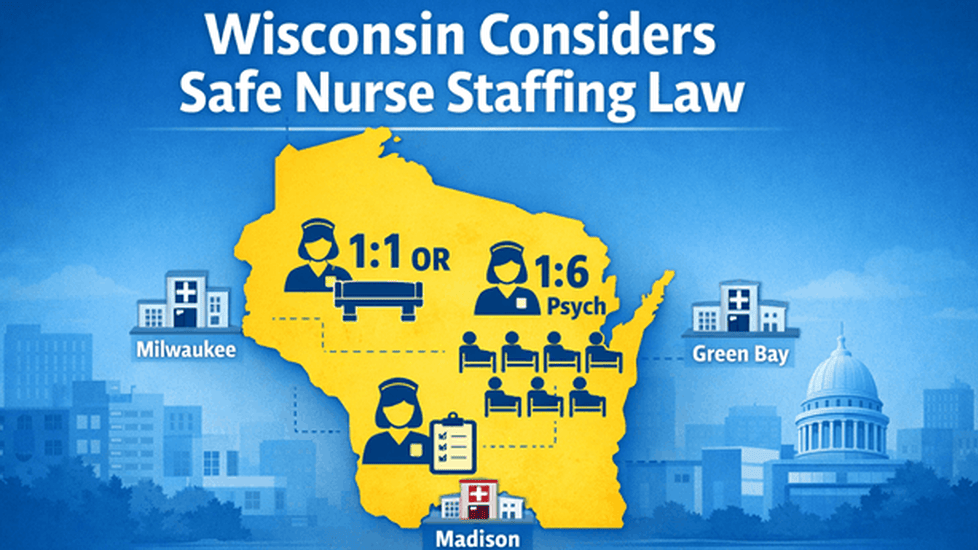
- The bill sets unit-specific minimum ratios (e.g., 1:1 OR, 1:6 psych), requires staffing committees led by direct-care RNs, and bans mandatory overtime.
- Supporters like the Wisconsin Federation of Nurses cite burnout driving 71% of RNs to consider leaving; hospitals oppose it as overly rigid.
- Nurses can help advance the bill by contacting co-sponsors like Sens. Larson and Ratcliff through the Wisconsin Legislature site.
A newly reintroduced bill in Wisconsin aims to tackle one of the most pressing issues facing the nursing profession today: safe staffing. Lawmakers and frontline nurses are once again pushing for the Nurse Staffing and Patient Protection Act, legislation designed to establish enforceable nurse-to-patient ratios, ban mandatory overtime, and give nurses greater authority to advocate for patient safety. The bill builds on prior efforts like Senate Bill 470 from 2023.
Supporters say the measure could improve patient outcomes, reduce burnout, and stabilize the state’s healthcare workforce. Opponents argue it could create operational challenges for hospitals already grappling with workforce shortages.
Here’s what nurses should know about the proposed legislation.

Background: A Renewed Push for Safe Staffing in Wisconsin
On February 25, 2026, Wisconsin legislators joined direct-care nurses at the State Capitol to announce the introduction of the “Nurse Staffing and Patient Protection Act.” The bill is being led by Sen. Chris Larson, Sen. Melissa Ratcliff, Rep. Francesca Hong, and Rep. Lisa Subeck.
The legislation would establish minimum nurse-to-patient ratios in hospitals, alongside additional workplace protections for nurses.
According to Larson, the proposal is directly tied to patient safety and workforce retention. “Safe staffing saves lives — unsafe staffing ruins lives and ends careers.”
The push for legislation comes amid mounting concern over staffing shortages in the state. Workforce projections suggest Wisconsin could face a shortage of up to 19,000 nurses by 2040, according to the Wisconsin Department of Workforce Development.
Advocates say staffing shortages are not only about recruitment but also retention. Larson noted that 138,000 nurses nationwide left the profession between 2022 and 2024, with the top reasons being “stress and burnout, workload, and understaffing.” He says: “Our bill addresses all 3.”
What the Bill Would Do
The Nurse Staffing and Patient Protection Act would introduce several changes to how hospitals staff nursing units.
- Establish Minimum Nurse-to-Patient Ratios: The bill would create unit-specific staffing ratios in Wisconsin hospitals. For example: 1:1 ratio in operating rooms, up to 1:6 ratio in psychiatric units. These standards would serve as minimum staffing levels to ensure nurses are not responsible for unsafe patient loads.
- Require Hospital Staffing Plans: Hospitals would be required to submit an annual staffing plan to the Wisconsin Department of Health Services. Each facility must also establish a nurse staffing committee, with a majority of members being non-supervisory direct-care registered nurses. These committees would help determine staffing plans based on patient acuity, support staff levels, and unit needs.
- Ban Mandatory Overtime for Nurses: The proposal also includes workplace protections for nurses. Among them:
- Banning mandatory overtime, except in limited circumstances
- Limiting mandated shifts to 12 hours in a 24-hour period
- Allowing nurses to refuse assignments that could compromise patient safety or their license
- Protecting nurses from retaliation when exercising those rights
Supporters say these provisions are meant to improve work-life balance and prevent burnout.
Why Supporters Say Wisconsin Needs the Law
Nurses and labor organizations argue that staffing conditions have worsened since the COVID-19 pandemic and remain unsustainable in many hospitals.
At a press conference announcing the bill, Connie Smith, president of the Wisconsin Federation of Nurses and Health Professionals, said: “Wisconsin’s health care system is stretched to a breaking point… nurses across the state are carrying impossible workloads, patients are sicker, needs are higher and staffing is thinner than ever. This isn’t a secret. It’s not a surprise. It’s a crisis we can measure."
Advocates say the legislation could help stabilize the workforce. In one survey cited by supporters, 71% of Wisconsin RNs said they were considering leaving the bedside due to staffing levels, but 91% said safe staffing legislation would increase their likelihood of staying.
Proponents argue that improving working conditions could help retain experienced nurses and attract new ones to the profession.
Opposition and Concerns from Hospitals
Not everyone agrees that mandated ratios are the right solution.
Hospital leaders have warned that strict staffing laws could limit flexibility and create additional operational challenges. The Wisconsin Hospital Association has argued that staffing decisions should remain in the hands of clinical leaders rather than lawmakers.
Ann Zenk, senior vice president for workforce and clinical practice at the association, told Becker’s: “Federal and state regulations already require Wisconsin hospitals to maintain appropriate staffing levels.”
Critics say staffing requirements vary widely depending on patient acuity, hospital size, and regional workforce availability.
How Wisconsin Compares to Other States
Wisconsin is far from alone in considering nurse staffing legislation. In recent years, safe staffing bills have been introduced across the country as nurse shortages persist.
- California: remains the only state with comprehensive, legislatively mandated nurse-to-patient ratios across hospitals, a law first implemented in the 1990s. The state sets minimum ratios depending on the care setting—for example, ICU nurses typically care for no more than two patients.
- Oregon: In 2023, Oregon passed House Bill 2697, becoming the second state to adopt hospital nurse staffing ratio requirements. The law establishes minimum ratios and enforcement mechanisms for hospitals that fail to comply.
- Other Approaches: Other states use different models to address staffing concerns, including:
- Mandatory staffing committees
- Public reporting requirements for staffing levels
- Hospital-specific staffing plans
The ANA says sixteen states have some form of regulation addressing hospital nurse staffing (Wisconsin is not one of the states).
What Happens Next
The Nurse Staffing and Patient Protection Act is in the co-sponsor circulation phase and has not yet been formally introduced or assigned a bill number, unlike its predecessor Senate Bill 470 from 2023. Supporters are actively seeking additional legislative backers before it advances.
Supporters say the issue is unlikely to go away. Safe staffing has become a major policy topic nationwide as hospitals continue to deal with workforce shortages and rising patient acuity.
For nurses in Wisconsin, the legislation represents a potential shift toward stronger legal protections for both patient safety and working conditions.
🤔Nurses, what do you think about this bill? Share your thoughts below.
If you have a nursing news story that deserves to be heard, we want to amplify it to our massive community of millions of nurses! Get your story in front of Nurse.org Editors now - click here to fill out our quick submission form today!