




3K+ Nurses Have Spoken Up During the DoED Public Comment Period—Here’s What They’re Saying
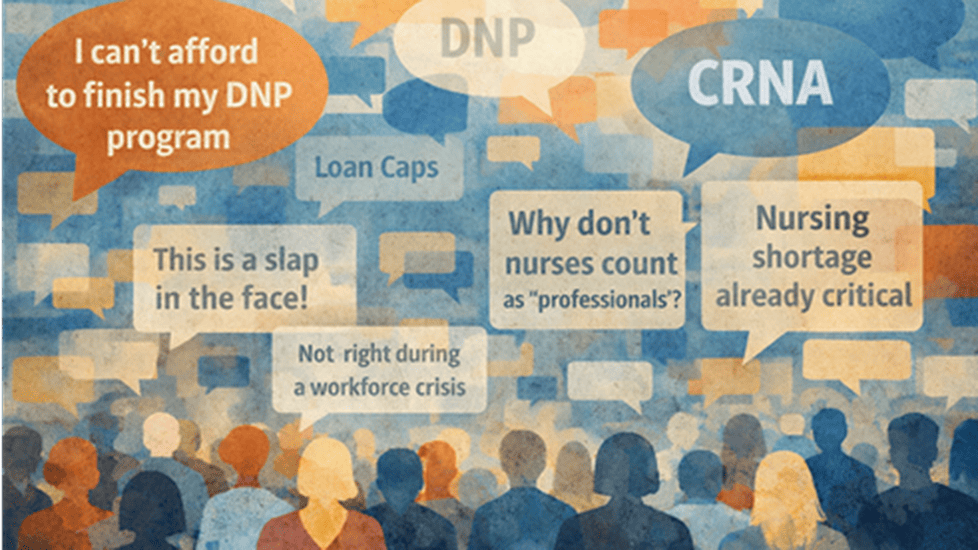
- Over 12,971 comments submitted: ~3,800+ reviewed show ~70% appear to be from nurses/students focused on professional recognition.
- Proposed caps: $50K/year for 11 professional degrees vs. $20.5K/year for nursing MSN/DNP programs.
- Common themes: Financial barriers to clinical training and risks to addressing nursing shortages.
If you feel like nursing just got a demotion, you aren't alone. In an unprecedented wave of digital activism, the official docket shows that 12,971 comments have been submitted to the Department of Education (DoED) in response to a proposed rule that would officially classify graduate nursing as a "non-professional" degree for federal loan purposes. Not all of the comments are indexed and searchable yet due to a “processing lag” to screen comments for PII before posting them publicly, but we reviewed the 3,880 that are.
While the DoED claims this is just administrative housekeeping, the nursing community is calling it a gut punch.

The "Professional" Label: Who’s In and Who’s Out?
Under the new RISE proposed rule, the government has created a specific classification for "Professional" degrees. If you are in one of 11 "professional" fields—like Law, Medicine, or even Theology—you can borrow up to $50,000 per year with a lifetime limit of $200,000.
If you’re a nurse pursuing an MSN or DNP? You are eligible for "Graduate" category loans, which caps your federal borrowing at $20,500 per year with a lifetime limit of $100,000.
Breaking Down the Backlash
You don't need a degree in data science to see what is happening in the federal register right now. After scanning the thousands of comments currently visible on the docket and tracking specific keywords, a clear picture emerges. This isn't a random assortment of taxpayers—it is a coordinated mobilization dominated by one profession.
Who is Commenting?
- Nurses & Nursing Students (60-70%): Identified by keywords like "DNP," "CRNA," and "Bedside." This is largely driven by coordinated campaigns from the AACN (American Association of Colleges of Nursing) and ONS (Oncology Nursing Society) who are concerned about the exclusion of APNs from the "Professional" list.
- Social Workers & Therapists (15-20%): Some of these groups appear to be using templates from the APTA (American Physical Therapy Association) regarding the DPT degree cap.
- Financial Aid Administrators (5-10%): These groups are concerned with implementing the "Tiered Standard" repayment plan by July 1, 2026, potentially resulting in students receiving their aid late during the fall semester because software systems can't be updated that fast.
- Parents (~5%): Concerned specifically with the new $20,000 cap on Parent PLUS loans, leaving them to bridge tuition gaps.
What Nurses Are Feeling
- 99% Negative / Opposed: The feedback is almost universally against the "Professional" vs. "Graduate" reclassification.
- Primary Emotion: Disrespect. The most common sentiment is not just financial fear, but professional insult—that the government does not view nursing as a "profession" on par with dentistry or law.
- Secondary Emotion: Fear. Specifically regarding the ability to complete clinical rotations (which often require quitting a full-time job) without full federal funding.
What Nurses Are Saying
While thousands of comments are still being processed, major nursing organizations and individuals have already gone on the record.
- New Loans are "Insufficient": The Oncology Nursing Society (ONS), representing over 100,000 nurses, submitted a formal comment arguing that the government’s math is dangerously wrong: "The graduate loan caps of $20,500 annually and $100,000 in aggregate are insufficient for many nursing students enrolled in year-round programs... Policies that restrict access to affordable financing for nursing education risk reducing enrollment, exacerbating workforce shortages, and limiting patient access to care." (ED-2025-OPE-0944-1214)
- "Patient Safety" is at Risk: This isn't just about bank accounts; it's about lives. Dr. Jennifer Mensik Kennedy, President of the American Nurses Association (ANA), warned that these cuts will ripple out to the bedside: "Excluding nursing from the professional degree category has the potential to put patient care at risk” and “disregards the clear demands of nearly 250,000 nurses and nurse allies who signed ANA’s RNAction petition calling for nursing to be included.” Many nurses quoted this same language. (ED-2025-OPE-0944-2453)
- It's a “Slap in the Face”: A recurring theme across public comments, nurses call the new tiers a 'slap in the face,' highlighting the irony that under the new rules, a Master’s in Divinity or a Law degree is eligible for $50,000 in annual federal loans, while nurses—who were deemed “essential” during the pandemic—are capped at $20,500 for their advanced clinical degrees. “This is a slap in the face to an essential profession that helped us all get through a pandemic in 2020.” (ED-2025-OPE-0944-2025)
- It's a "Gut Punch": The emotional toll of this rule is palpable. Patricia Pittman, a health workforce policy expert, told CBS News that the rule was a "gut punch" for nursing. Her argument? The nursing shortage is already critical. By making it financially impossible to afford a DNP or PhD, the government is effectively choking off the pipeline of nurse educators needed to teach the next generation. “The timeline and information is constantly changing. I’m technically in forbearance til 2028, but I’m willing to bet I get gut punched and forced to restart in 2026. Maybe I’m wrong, but conflicting information like this holds people in limbo.” (ED-2025-OPE-0944-2513)
What You Can Do (Before March 2)
The public comment period on Docket ED-2025-OPE-0944 closes March 2, 2026. Visit regulations.gov to review the proposal and submit feedback based on your experience in nursing education and workforce needs.
🤔Nurses, what do you think? Share your thoughts below.
If you have a nursing news story that deserves to be heard, we want to amplify it to our massive community of millions of nurses! Get your story in front of Nurse.org Editors now - click here to fill out our quick submission form today!