




AI Doctors Could Soon Diagnose and Prescribe—But What Does That Mean for Nurses?
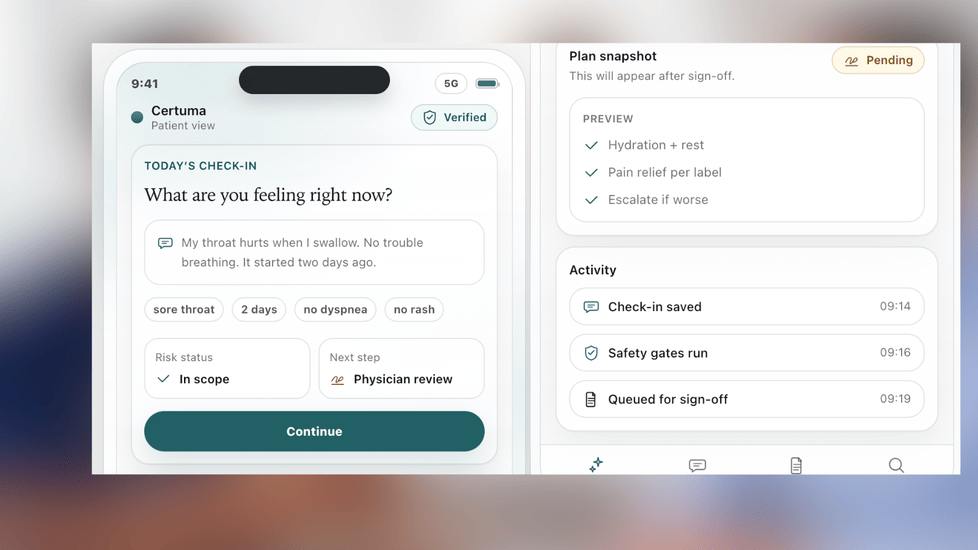
- AI 'Doctors' Are Coming: Startups are actively pursuing FDA approval for systems that can legally diagnose and prescribe.
- Filling the Gaps: Supporters say physician AI models could help address critical healthcare gaps across the country.
- What About Nurses? In an interesting twist, some say that while basic doctor tasks may be outsourced via AI, hands-on nursing care could be more difficult to replace.
With AI nurses 'agents' on deck and people turning to AI for medical advice, it was only a matter of time before AI 'doctors' entered the Internet. And healthcare startup Certuma is attempting to do just that with ambitions to create the first fully FDA-approved “AI doctor.”
Founded by serial entrepreneur Martin Varsavsky, Certuma is developing an AI system designed to diagnose common medical conditions and prescribe treatments, pending approval from the U.S. Food and Drug Administration.
Certuma says its AI doctor will help address a growing gap in healthcare access, with millions of patients facing barriers to primary care, particularly in rural and underserved communities where provider shortages are most severe.
How An AI Doctor Would Work
Certuma's AI doctor—which, by the way, has raised $10 million in capital—would function as a sort of "low-tier" physician, filtering out minor healthcare issues that can easily be dealt with, like a UTI or ear infection.
These conditions are considered “low risk” and typically follow standardized clinical guidelines, making them more suitable for algorithm-driven decision-making.
Varsavsky told Forbes that Certuma is a natural next step in the era of artificial intelligence, because people are already plugging their medical concerns into ChatGPT, without anywhere to go from there.
With an AI doctor, that 3 AM "Burning pee do I have a UTI?" search can garner an actual solution and a prescription sent to your pharmacy instantly. (Honestly, as a nurse who often knows exactly what's wrong with me, and my children, I don't hate this idea...)
Patient Safety Concerns Remain Front and Center
The challenge, of course, with allowing an AI bot to diagnose medical conditions and prescribe imaging or medication, is that only licensed medical providers can do that.
So, Varsavky is on a mission to get the FDA to allow Certuma to be recognized as a licensed medical provider, a tricky proposition made more challenging by the fact that not all doctors are licensed on a state, not federal, level.
Despite its potential, the concept of an AI doctor also raises significant safety concerns, such as patients misidentifying symptoms, or seemingly "minor" symptoms being part of a larger condition that could get missed.
Even common symptoms can conceal serious illnesses. A sore throat could indicate cancer; a headache could signal meningitis.
Step-by-Step Safeguards
To address these risks, Certuma says it is developing a multi-layered safety approach. The system combines generative AI with rule-based, deterministic models designed to flag red flags and avoid unsafe recommendations.
In early deployment, licensed physicians will review AI-generated decisions before they reach patients.
Some critics have pointed out that 'AI doctors' are nothing more than chatbots that then link patients to a teledoctor, so what are they really accomplishing?
Over time, however, Certuma says it aims to increase autonomy, with human clinicians focusing primarily on complex or unclear cases.
If you visit the Certuma website right now, you'll see that it dubs itself "doctor-vertified autotomous medicine" and says every decision it makes is auditable for safety purposes.
How Could an AI Doctor Affect Nurses?
The concept of an AI doctor has brought up interesting discussions on what it means to label AI healthcare professionals. If AI 'doctors' can exist, then surely, AI nurses can, right?
Well, maybe not. On LinkedIn, for example, nurses and doctors discussed that it could, in theory, be more disingenuous to label software "AI nurses" because nursing care can be so much harder to replace in a digital format.
An AI doctor may be theoretically trained to diagnose a simple UTI virtually and prescribe medications that can be sent digitally to the pharmacy, but can healthcare facilities in good faith really replace hands-on nursing care?
- "When it comes to AINurse - I object loudly based on the intent of the use… often they sell it without any engagement with nursing - but claim their scope," Rebecca Love RN, MSN, FIEL pointed out on LinkedIn.
Nurses and doctors, while working together, do have very different roles. It's a sweeping generalization, clearly, but we could argue that doctors usually prescribe the care, but nurses deliver it. And in a world driven by AI, the question we will soon see answered will be: which one is more replaceable?
- "Without getting into a lot of detail, this LLM/decisioning for low acuity care is next up on the wave of AI medical front. It seems weird and scary now (aka, frightening to think about), but it will become more normalized - soon," Rhonda J. Manns, MBA, BSN, RN, CCM, summed up.
🤔Nurses, what do you think? Are AI doctors a good idea or potentially risky for healthcare? Share your thoughts below.
If you have a nursing news story that deserves to be heard, we want to amplify it to our massive community of millions of nurses! Get your story in front of Nurse.org Editors now - click here to fill out our quick submission form today!