



Quiet Nurses Rarely Promote Change: Dr. Ernest Grant Q&A
Originally published on The Nursing Beat, August 24, 2024
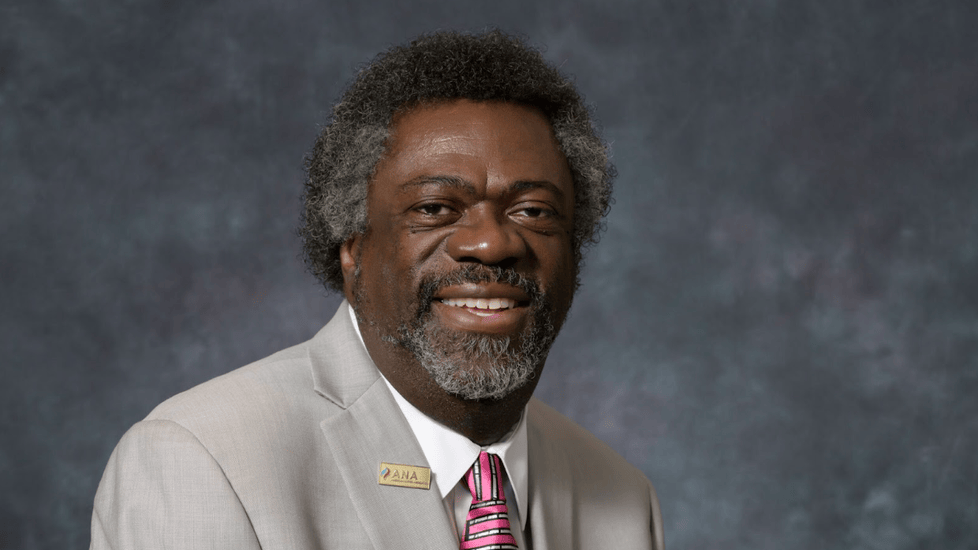
“My ambition was to drive a lime green 1968 Mercury Cougar,” Ernest Grant, PhD, RN, FAAN, reminisces. Grant was the 36th and first male president of the American Nurses Association (ANA), as well as the first Black male president. Grant envisioned that the path toward securing his dream car would involve becoming an anesthesiologist. His guidance counselor suggested nursing school in the meantime. He planned to work as a nurse while paying off medical school loans.
“I was from a very poor family, the youngest of seven kids growing up in the mountains of North Carolina. Everyone, regardless of skin color, was in a similar predicament,” he shares.
Somewhere along the way, though, he found a love for nursing and stuck with it. Read on to learn more about how Grant became an accomplished nurse leader and former ANA president.

Q: How Did You Become a Nurse?
A: My guidance counselor said I may not like nursing, so I should try the one-year nursing program at the community college. I did that. And probably about six weeks into that program, I really found out that nursing was my calling, and I completely forgot about medical school.
But, I knew a couple of things: First, I didn’t see many people who looked like me—as a six-foot-six African American, I stood out in 1976 when only about 3% of nurses in the U.S. were men. Second, I wanted to do more for the patients I cared for, so I decided to pursue a higher degree. I worked on my baccalaureate, then my master's, and eventually my doctorate, recognizing that the higher the degree, the more opportunities I would have to impact patient care, set nursing policy, and help drive change within the profession.
Later, I moved to the Durham area, and I had a little bit of training in intensive care because there was an RN shortage. When I moved to the area and was looking for a job, the burn center was one of the few places that allowed LPNs to work in the ICU setting. So I started working there.
"I decided to pursue a higher degree. I worked on my baccalaureate, then my master's, and eventually my doctorate, recognizing that the higher the degree, the more opportunities I would have to impact patient care, set nursing policy, and help drive change within the profession."
-Dr. Ernest Grant, Ph.D., RN, FAAN, former president of the American Nurses Association
Q: How Did You Get Started in Leadership?
A: As soon as I graduated with my baccalaureate degree, it was emphasized that if I was going to consider myself a professional nurse, I needed to join my professional nursing organization.
About three days after graduation, I was handed an application for the North Carolina Nurses Association. I was going to join anyway, but someone placed the form in my hand and insisted I not only join, but be an active member.
I joined, was placed on the membership committee, and did a good job with that. The next thing I knew, they asked if I’d like to chair the membership committee, and I agreed. That was the start of my leadership journey—from the encouragement of others who recognized my potential. This eventually led to serving on various committees at the national level within the ANA.
Popular Online Master of Science in Nursing (MSN) Programs

Chamberlain University is the #1 largest school of nursing with a community of more than 177,000 students, faculty, and alumni. Chamberlain offers BSN, MSN, NP and DNP programs online and has a long history of successfully delivering top quality education.
 CCNE
CCNE
 Online
 RN Required
Enrollment: Nationwide except CT, NY, RI

GCU's College of Nursing and Health Care Professions has a nearly 35-year tradition of preparing students to fill evolving healthcare roles as highly qualified professionals.
CCNE
Online
RN Required
Enrollment: Nationwide

Whether you’re taking the first steps toward a nursing degree, seeking to advance as a nurse or want to hone your craft with specialized study, there’s a path for you at Purdue Global’s School of Nursing. Our programs were designed so that you can easily balance your lives at home and work with school - without sacrificing the rigor and cutting-edge curriculum of a quality nursing education.
CCNE
Online
RN Required
Enrollment: Nationwide, but certain programs have state restrictions. Check with Purdue for details.

Earn your nursing degree from one of the largest nursing education providers in the U.S. Walden University’s BSN, MSN, post-master’s APRN certificate, and DNP programs are accredited by the Commission on Collegiate Nursing Education (CCNE). Get enhanced practicum support with our Practicum Pledge.
CCNE
Online
RN Required
Enrollment: Nationwide, excluding CT, ND, NY and RI. Certain programs have additional state restrictions. Check with Walden for details.

The Berkley School of Nursing at Georgetown University is one of the world’s leading academic and research institutions, and the university has been delivering graduate nursing programs in a distance-learning environment since 2011. The university's online programs allow students to learn from wherever they are while they pursue an accredited, mission-driven nursing education that will allow them to deliver high-quality care.
CCNE
RN Required
Enrollment: Nationwide, excluding NY and WA.
Q: Which Qualities Helped You Become a Leader?
A: I always questioned why things had to be done a certain way when there might be a better approach. Hearing “That’s the way we’ve always done it” never sat well with me, especially when I could see a different way that might be more beneficial. I was determined not to take no for an answer and always questioned why things were done the way they were. I’d ask if there were other approaches that could benefit both our patients and the nursing profession as a whole.
Q: What Advice Do You Have for Nurses Who Want to Become Leaders?
A: When I first started, a pivotal moment was joining my local nursing membership chapter. My professors had drilled into us the importance of being a professional nurse, which included joining your professional organization. It was a no-brainer that I would join my professional association and be an active member, not just have my name on the roll. That’s what I try to instill in the students I teach today. It’s not enough to complain about issues; you need to be an active participant in bringing about change.
It reminds me of that bumper sticker that says, “Well-behaved women rarely make history.” I’d put a spin on that and say, “Quiet nurses rarely promote change.” That’s what it will take—people standing up and becoming advocates.
Q: What’s It Like Being a Male in a Female-Dominated Profession?
A: Looking back, being a male in a female-dominated profession stands out to me. Often, people would say, “Oh, let’s get Ernie to do this,” or “Let’s get a male involved,” because there’s this stereotype that men are natural leaders, even in a female-dominated field.
I wouldn’t be where I am today without female nursing leadership and the trails they blazed. Many of my mentors were women who made it easier for me to advance. But the reality is that sometimes, just being a male leads people to assume I’d be a good fit for leadership roles, and they’d listen to me simply because of that.
This reflects a larger issue within the nursing profession—a profession dominated by women yet hindered by the way society treats women. Despite having respect, women in nursing often struggle to climb the ladder and secure a seat at the table where decisions about our profession are made. This needs to change. We must continue advocating for our right to be at the table where these critical decisions are made.
Q: In What Ways Has Nursing Made Positive Strides in Diversity, Equity, and Inclusion?
A: I was the first African American male and the first male in general to be elected president of the ANA. So, I’m the third African American to hold the office, but the first male to do so. When I was elected, the organization was 124 years old, which is pretty amazing considering it took that long for a male, let alone an African American male, to be elected president. I’d like to think that in some ways, I helped pave the way for improving diversity and inclusion in nursing.
During my tenure as president of the ANA, we launched the National Commission to address racism in nursing, which is crucial work that needs to continue. As the most trusted profession, we need to recognize that nurses come in all shapes, sizes, and colors, and we all take the same exam. Our qualifications shouldn’t be questioned based on our ethnicity or the school we attended.
We've made progress in promoting diversity in nursing, but there’s still work to be done.
Popular Online Master of Science in Nursing (MSN) Programs
Chamberlain University is the #1 largest school of nursing with a community of more than 177,000 students, faculty, and alumni. Chamberlain offers BSN, MSN, NP and DNP programs online and has a long history of successfully delivering top quality education.
CCNE
Online
RN Required
Enrollment: Nationwide except CT, NY, RI
GCU's College of Nursing and Health Care Professions has a nearly 35-year tradition of preparing students to fill evolving healthcare roles as highly qualified professionals.
CCNE
Online
RN Required
Enrollment: Nationwide
Whether you’re taking the first steps toward a nursing degree, seeking to advance as a nurse or want to hone your craft with specialized study, there’s a path for you at Purdue Global’s School of Nursing. Our programs were designed so that you can easily balance your lives at home and work with school - without sacrificing the rigor and cutting-edge curriculum of a quality nursing education.
CCNE
Online
RN Required
Enrollment: Nationwide, but certain programs have state restrictions. Check with Purdue for details.

Earn your nursing degree from one of the largest nursing education providers in the U.S. Walden University’s BSN, MSN, post-master’s APRN certificate, and DNP programs are accredited by the Commission on Collegiate Nursing Education (CCNE). Get enhanced practicum support with our Practicum Pledge.
CCNE
Online
RN Required
Enrollment: Nationwide, excluding CT, ND, NY and RI. Certain programs have additional state restrictions. Check with Walden for details.
The Berkley School of Nursing at Georgetown University is one of the world’s leading academic and research institutions, and the university has been delivering graduate nursing programs in a distance-learning environment since 2011. The university's online programs allow students to learn from wherever they are while they pursue an accredited, mission-driven nursing education that will allow them to deliver high-quality care.
CCNE
RN Required
Enrollment: Nationwide, excluding NY and WA.
Q: How Can Nursing Improve Its Diversity, Equity, and Inclusion?
A: Making education more accessible and equitable for minority nurses. This is one of the biggest barriers to achieving true equity in our profession.
I believe nursing should truly reflect the diversity of the people we care for. This means being more inclusive of minority nurses, whether they are male or from other ethnic backgrounds. It’s not just the right thing to do—it also leads to better outcomes for our patients. For example, as an African American, I understand the nuances of my culture and can connect with African American patients in ways that might encourage them to share things they wouldn’t with an all-White healthcare team. This connection allows for better advocacy and care.
Q: What’s Exciting for You in the World of Nursing Right Now?
A: There are a couple of initiatives that I'm particularly excited about.
I launched an online mentoring initiative on LinkedIn called Network of Black Male Nurse Leaders with four other Black male colleagues. It's designed specifically to support and mentor Black males in nursing. Out of the 5 million registered nurses in the United States, only about 1,700 are Black males, and the number in leadership is so small that it's almost negligible. We created this online support group to mentor young Black men in the profession. Our goal is to eventually host a National Summit next spring.
The second initiative I'm excited about is the upcoming summit organized by the Central Carolina Black Nurses Association, a local chapter of the National Black Nurses Association. We're collaborating with other minority nursing organizations in the Durham and Raleigh area, including Filipino, Indian, Native American, Nigerian, and Asian American Nurses Associations, to host a one-day summit next May during Nurses Month. This event will be an excellent opportunity for minority nursing groups to connect, share challenges, and find common ground to advance the profession for those who look like us.
Final Thoughts
So, after all that, did Grant ever get his lime green 1968 Mercury Cougar? “It’s still the car. I have lots of models of it but still haven’t gotten the real thing yet, but I intend to.” He’s realized some bigger dreams along the way.