Science · Regulation & defense
Urinary System and Fluid Balance
Estimated time includes reading and one quiz. Take the time you need.
Start here: key ideas
- Kidneys filter blood and adjust water, ions, wastes, and pH.
- Filtration enters the nephron; reabsorption returns useful material to blood.
- Secretion moves selected material from blood into the tubule.
- ADH conserves water; aldosterone increases sodium reabsorption.
What you’ll be able to do
- Trace blood, filtrate, and urine routes.
- Compare filtration, reabsorption, secretion, and excretion.
- Explain hormone, electrolyte, and pH control.
Follow fluid through a nephron and ask what moves into blood or toward urine.
Optional review
If you’d like to review the basics, visit Cardiovascular System. You can start this lesson without completing those first.
Blood route, filtrate route, urine route
Renal arteries bring blood to the kidneys. In each nephron, an afferent arteriole enters the glomerulus. Fluid filters into Bowman’s capsule. It then moves through the proximal tubule, loop of Henle, distal tubule, and collecting duct. Urine flows to the renal pelvis, ureter, bladder, and urethra. The ureter carries urine to the bladder; the urethra carries it out.
Blood leaves the glomerulus through the efferent arteriole, then enters capillaries around the tubule. This close blood supply receives reabsorbed material and provides substances for secretion. The glomerular route and tubular route run beside each other but carry different fluids.
Blood and filtrate follow different routes
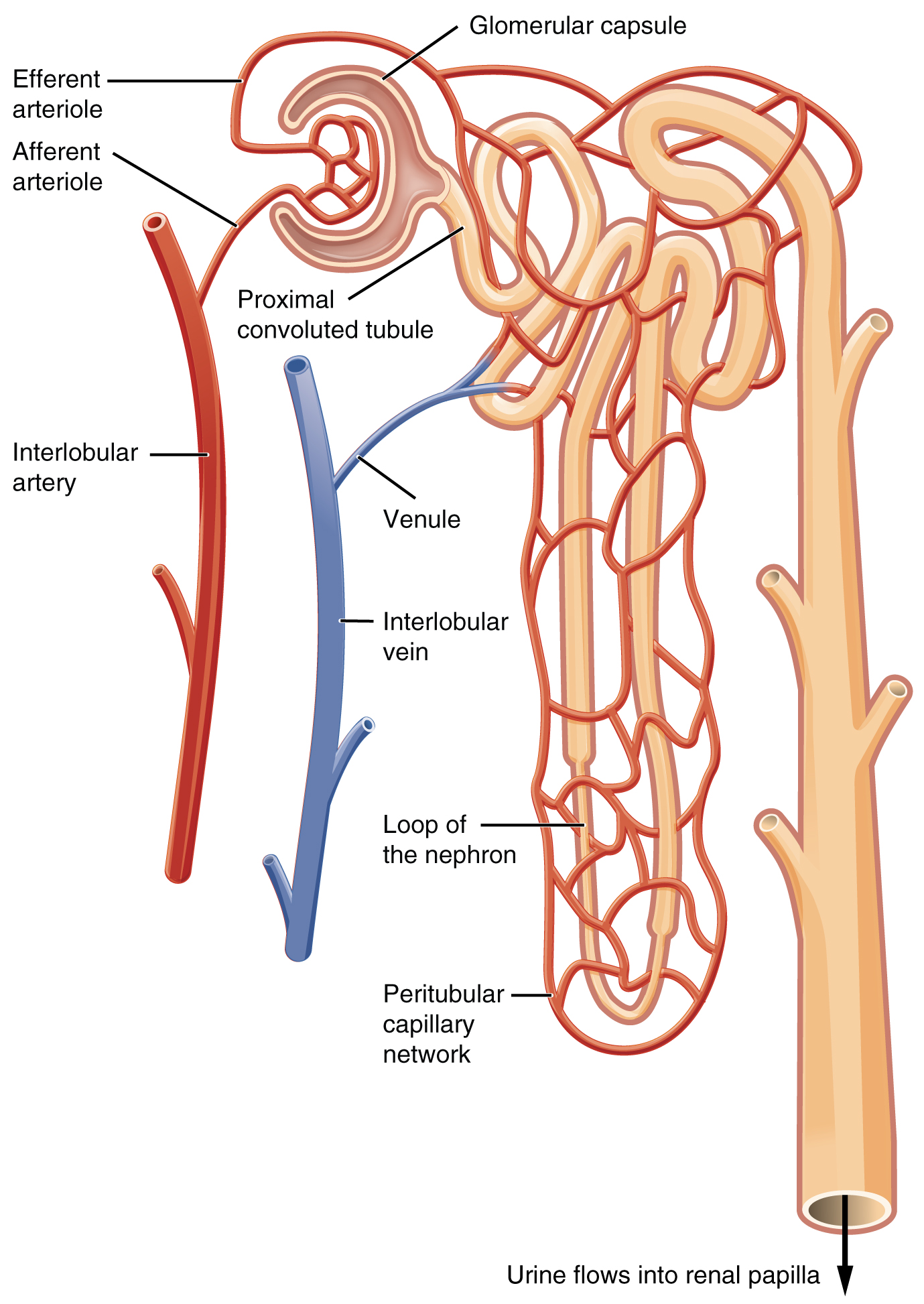
Follow two routes. Blood enters and leaves the filtering capillaries, called the glomerulus. Filtered fluid enters the capsule and moves along the kidney tubule. Nearby blood vessels exchange substances with that fluid. Fluid in the tubule is not whole blood.
Blood and filtrate follow different routes — OpenStax College, Anatomy & Physiology (2014 CC BY archive). CC BY 3.0. Original source image reproduced unchanged; explanatory caption added.

Three processes determine excretion
Filtration moves water and small solutes from glomerular blood into the nephron. Cells and most proteins stay in blood. Reabsorption returns needed water and solutes to blood. Secretion moves selected ions, drugs, and wastes from blood into the tubule. What remains is excreted as urine. Excretion = filtration − reabsorption + secretion.
Glucose is small enough to be filtered, but healthy tubules normally reabsorb nearly all of it. A substance can therefore enter filtrate without being excreted. Large proteins usually remain in blood; finding much protein in urine can mean the filtration barrier is damaged.
The balance expression tracks directions, not advanced kidney calculations. “Nitrogenous waste” refers to compounds such as urea, not elemental nitrogen.
Filtration, reabsorption, and secretion
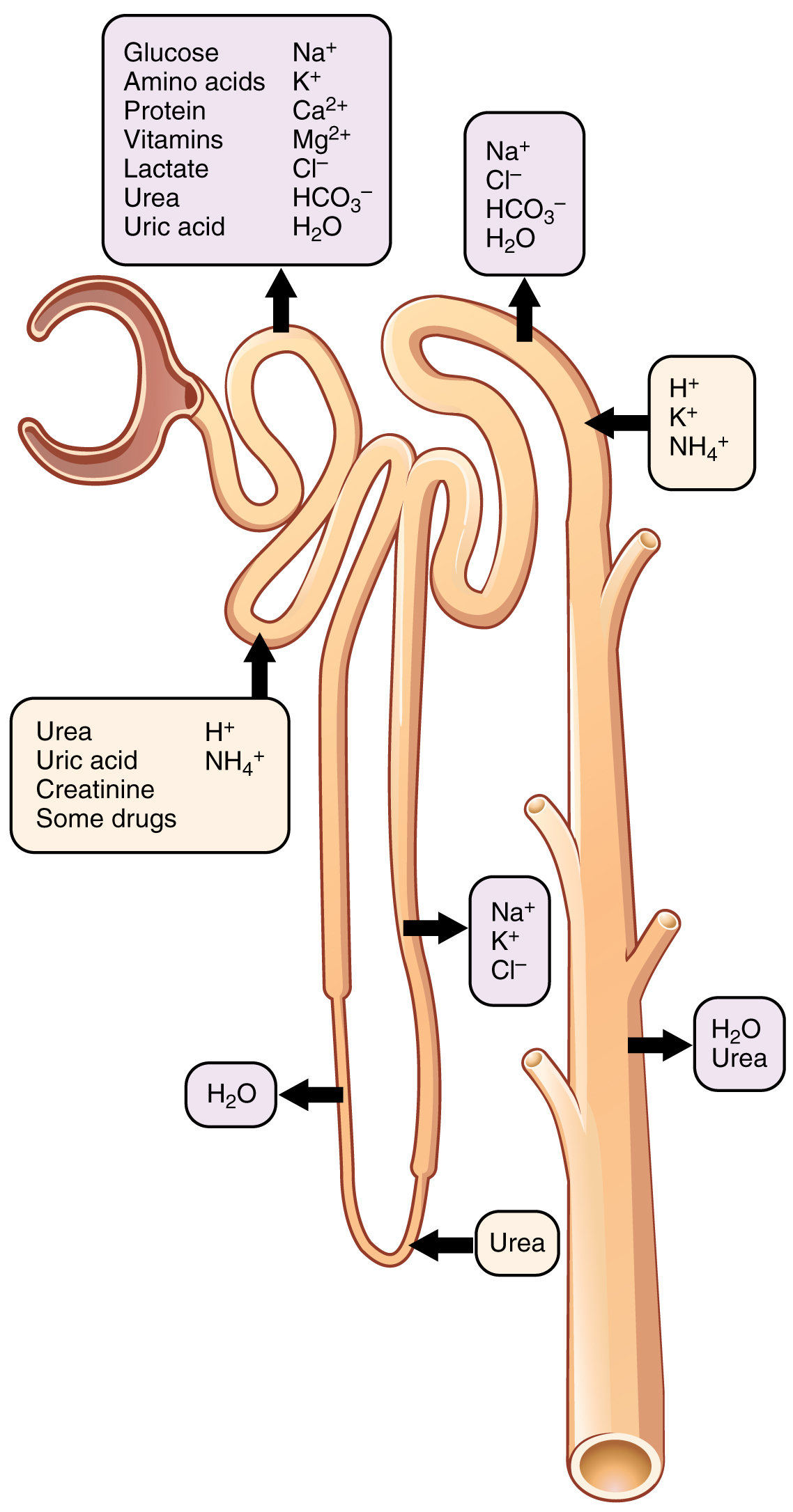
Filtration moves water and small substances from blood into the capsule. Reabsorption takes useful substances back to blood. Secretion adds selected substances from blood to the tubule. Excretion is what finally leaves as urine. The arrows summarize these directions; the blood compartment is not separately drawn.
Filtration, reabsorption, and secretion — OpenStax College, Anatomy & Physiology (2014 CC BY archive). CC BY 3.0. Original source image reproduced unchanged; explanatory caption added.

Nephron segments create controlled concentration
Supporting explanation: the loop and salt gradient
The proximal tubule reabsorbs most filtered nutrients, ions, and water. The descending loop allows water to leave. The ascending loop reabsorbs salts but is not permeable to water. Together, these limbs help create a salty medulla. The collecting duct uses this gradient to conserve water when ADH makes it more water-permeable.
The loop creates a salty area around the collecting duct. When ADH is high, water can leave the collecting duct and return to blood. When ADH is low, less water leaves, so a larger amount of dilute urine forms.
Hormones, electrolytes, and pH
ADH increases water reabsorption, producing less, more concentrated urine. Aldosterone increases sodium reabsorption and potassium secretion; water often follows sodium. Kidneys help control pH by secreting hydrogen ions and conserving or making bicarbonate. They also help regulate blood volume and pressure.
Worked example: After heavy sweating, blood volume falls and concentration rises. ADH increases water reabsorption. Aldosterone can increase sodium reabsorption, helping retain salt and water. Urine volume falls. These responses protect circulation, but drinking water replaces the fluid that was lost.
When blood volume is low, aldosterone helps the kidneys save sodium, and water follows. When volume is too high, the kidneys can release more sodium and water in urine. Over several days, kidneys can also help after carbon dioxide builds up by saving bicarbonate and excreting more acid.
Terms to remember
- nephron
- The kidney’s microscopic working unit.
- filtration
- Movement from glomerular blood into the nephron.
- reabsorption
- Movement from the tubule back to blood.
- secretion
- Movement from blood into the tubule.
- excretion
- Removal from the body in urine.
- ADH
- A hormone that increases water reabsorption.
- aldosterone
- A hormone that increases sodium reabsorption.
Your quick summary
- The glomerulus filters; tubules adjust the filtrate.
- Useful substances are reabsorbed, while selected wastes and ions can be secreted.
- ADH changes water reabsorption and urine concentration.
Lesson quiz
Check what you learned, then review the explanations. This quiz saves results on this device only. Sign in to save quiz results to your account.