Science · Cells, genes & microorganisms
Cell Structure, Membranes, and Transport
Estimated time includes reading and one quiz. Take the time you need.
Start here: key ideas
- All cells have a membrane, cytoplasm, DNA, and ribosomes.
- Eukaryotic cells have a nucleus and membrane-bound organelles.
- Cell membranes control what enters and leaves.
- Passive transport moves down a concentration gradient.
- Active transport uses energy to move substances.
What you’ll be able to do
- Identify major cell structures and their jobs.
- Compare prokaryotic, animal, and plant cells.
- Tell passive transport from active transport.
- Predict water movement across a membrane.
Learn the main cell parts, how cell types differ, and how materials cross the cell membrane.
Prokaryotic and eukaryotic cells share basics
A typical cell has a cell membrane, cytoplasm, DNA, and ribosomes. A prokaryotic cell, such as a bacterium, has no membrane-bound nucleus. Its DNA is in the cytoplasm. A eukaryotic cell has a nucleus and other membrane-bound structures.
Plant and animal cells are eukaryotic. Plant cells usually have a cellulose cell wall, chloroplasts, and one large central vacuole. Animal cells do not. As a cell grows, its volume grows faster than its surface area. This can make exchange across the membrane less efficient.
Use defining features, not size alone. DNA inside a nucleus identifies a eukaryote. DNA in a nucleoid with no membrane-bound organelles identifies a prokaryote. Ribosomes do not separate the groups because both have them.
A representative prokaryotic cell
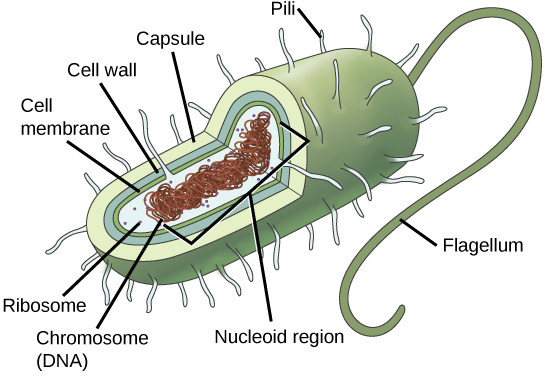
This bacterium has DNA but no nucleus around it. Ribosomes make proteins. The cell membrane controls what enters and leaves; the wall adds support. Not every bacterium has all the parts shown here.
A representative prokaryotic cell — OpenStax College, Biology (CC BY archive). CC BY 3.0. Original source image reproduced unchanged; explanatory caption added.

You've used your 1 free study guide
Your free topic allowance is shared across Reading, Math, Science and English. This first section is a preview. Unlock every study-guide
topic — full lessons, inline checks, the complete practice bank +
timed exam simulation — with a free trial.
Your one free topic stays free, always.
$0 today — card required to start your trial. Cancel anytime before day 3.
Already subscribed? Log in.