Science · Cells, genes & microorganisms
Biological Macromolecules and Enzymes
Estimated time includes reading and one quiz. Take the time you need.
Start here: key ideas
- Carbohydrates often provide quick energy.
- Lipids store energy and form membranes.
- Proteins perform many cell jobs.
- Nucleic acids store and carry genetic information.
- Enzymes speed reactions by lowering activation energy.
What you’ll be able to do
- Match each macromolecule group to its building blocks and jobs.
- Tell dehydration synthesis from hydrolysis.
- Explain enzyme specificity.
- Predict how temperature and pH can affect enzymes.
Compare the four major biological molecule groups and learn how enzymes speed reactions.
Optional review
If you’d like to review the basics, visit Cell Structure, Membranes, and Transport. You can start this lesson without completing those first.
Four macromolecule groups have characteristic roles
Four large molecule groups are important in cells. Carbohydrates include sugars and often provide quick energy. Lipids store long-term energy and form cell membranes. Proteins are made of amino acids and perform many jobs. Nucleic acids, DNA and RNA, are made of nucleotides and carry genetic information.
Structure supports function. For example, phospholipids have a water-loving end and a water-fearing end, so they form membrane layers.
Proteins do many jobs because amino-acid chains can fold into many shapes. Enzymes, receptors, antibodies, and some structural fibers are proteins. Shape matters: a receptor binds only signals that fit its binding region.
| Group | Typical building components | Selected roles |
|---|---|---|
| Carbohydrates | Monosaccharides | Immediate fuel; energy storage; structural support |
| Lipids | Often glycerol and fatty acids; not all are true polymers | Long-term energy storage; membranes; signaling |
| Proteins | Amino acids | Enzymes; receptors; transport; structure |
| Nucleic acids | Nucleotides | Store and transmit genetic information |
Common trap: a molecule’s group does not force it to have only one job. Carbohydrates can be structural, proteins can transport or signal, and lipids can form membranes. Also, lipids are grouped by shared properties and roles; not every lipid is a repeating-chain polymer.
Dehydration builds and hydrolysis separates
Cells join small units to build larger molecules. Dehydration synthesis removes water as a bond forms. Hydrolysis adds water to break a bond.
Digestion often uses hydrolysis. For example, a large carbohydrate can be split into smaller sugars by adding water across its bonds.
Dehydration and hydrolysis are opposite patterns. Building a protein joins amino acids while releasing water. Digesting a protein adds water as bonds are broken. The same logic applies to many biological polymers.
Energy depends on the overall reaction. Breaking one bond alone is not the whole story: all bonds broken and formed matter. ATP hydrolysis can supply energy for a coupled cellular process; hydrolysis does not always mean energy release.
Enzymes lower activation energy
An enzyme is a biological catalyst. It speeds a reaction by lowering the activation energy, the energy needed to start. The enzyme is not used up.
A reactant called the substrate binds to the enzyme’s active site. The fit is specific. If the active site changes shape, the substrate may not bind well.
Worked example. With an enzyme, a reaction reaches its products sooner because the activation barrier is lower. The starting materials and final equilibrium do not change. Without the enzyme, the same reaction may still occur more slowly.
Substrate binding and product release
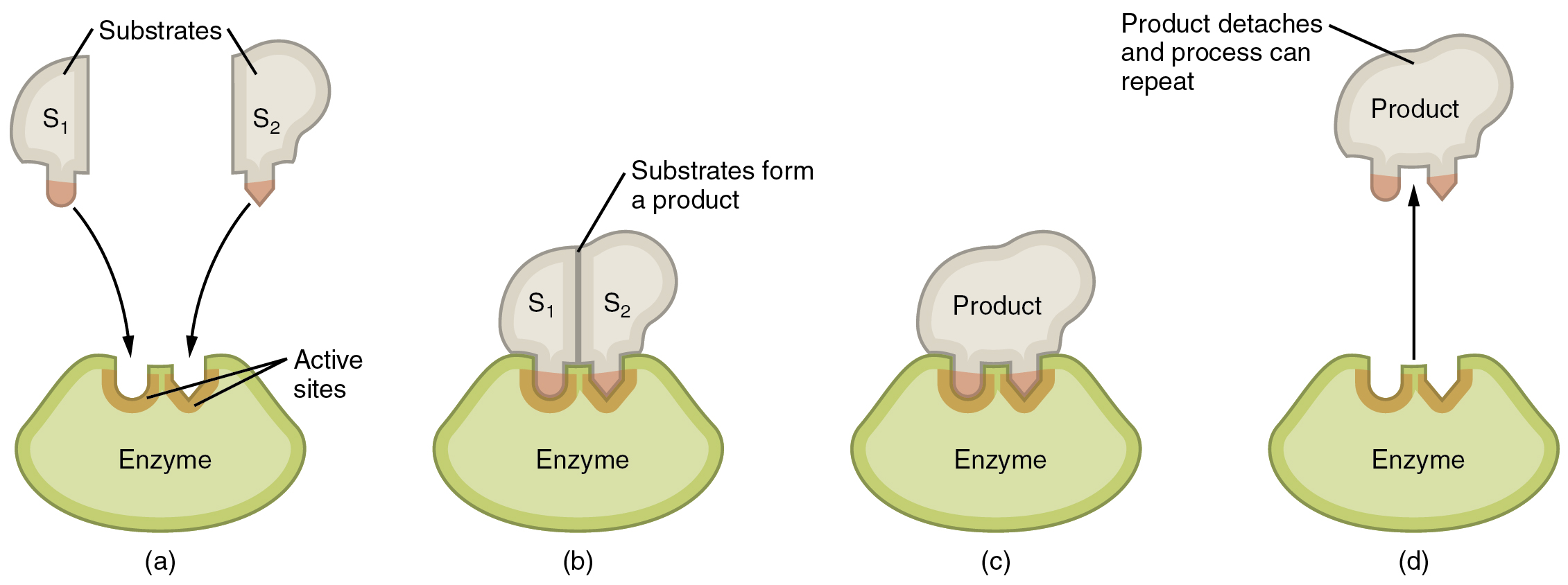
Reacting molecules bind at the enzyme’s active site. The enzyme lowers the energy needed to start the reaction. Products leave, and the enzyme can work again. Changing its shape can stop it working. It does not supply the reaction’s overall energy or change the final equilibrium balance.
Substrate binding and product release — OpenStax College, Anatomy & Physiology (2014 CC BY archive). CC BY 3.0. Original source image reproduced unchanged; explanatory caption added.

Conditions change enzyme activity
Temperature and pH affect enzyme shape and motion. Warming usually speeds reactions up to an enzyme’s best range. Extreme heat can unfold the enzyme, a change called denaturation.
Very high or low pH can also change enzyme shape. More substrate increases rate only until all active sites are busy. Enzymes change reaction speed, not the final equilibrium.
As substrate rises, reaction rate rises until most enzyme active sites are busy. At that point, extra substrate has little effect unless more enzyme is added. This is enzyme saturation.
A temporary pH change may reduce binding without permanently destroying the enzyme. Extreme heat is more likely to cause lasting denaturation.
Interpret enzyme data comparatively. Find the condition with the highest measured rate, then compare one changed variable at a time. A lower rate at extreme pH may reflect altered ionization or shape; recovery after returning to the original pH argues against permanent denaturation. A plateau as substrate rises supports active-site saturation when enzyme amount is fixed.
Terms to remember
- carbohydrate
- A molecule group that includes sugars and starches.
- lipid
- A mostly water-insoluble molecule used in membranes and energy storage.
- protein
- A chain of amino acids folded for a cell job.
- nucleic acid
- DNA or RNA, made of nucleotides.
- enzyme
- A catalyst used by living things.
- substrate
- The reactant that binds to an enzyme.
- activation energy
- The starting energy needed for a reaction.
Your quick summary
- Carbohydrates, lipids, proteins, and nucleic acids have different jobs.
- Dehydration joins units; hydrolysis splits them.
- Enzymes lower activation energy.
- An enzyme’s shape fits certain substrates.
- Extreme temperature or pH can reduce enzyme activity.
Lesson quiz
Check what you learned, then review the explanations. This quiz saves results on this device only. Sign in to save quiz results to your account.
You've got the concept — now drill it like the real TEAS
Unlock the full practice bank, timed full-length exam simulation, and practice across topics. Your free lesson and its lesson quiz stay available.
Unlock practice — free for 3 days$0 today; then $19.99/month after 3 days. Card required. Cancel before renewal to avoid a charge.