Science - TEAS Study Guide | Nurse.org
Menu
🎬
Watch First β€” The Scientific Method - Crash Course

Start with this short video, then scroll down for the full guide.

via Crash Course Watch on YouTube β†’

Scientific Method & Reasoning

Why This Matters for Nursing: Nursing is evidence-based. Understanding how studies are designed, why controls matter, and how to interpret results helps you evaluate treatments and apply research to patient care.

What You Need to Know

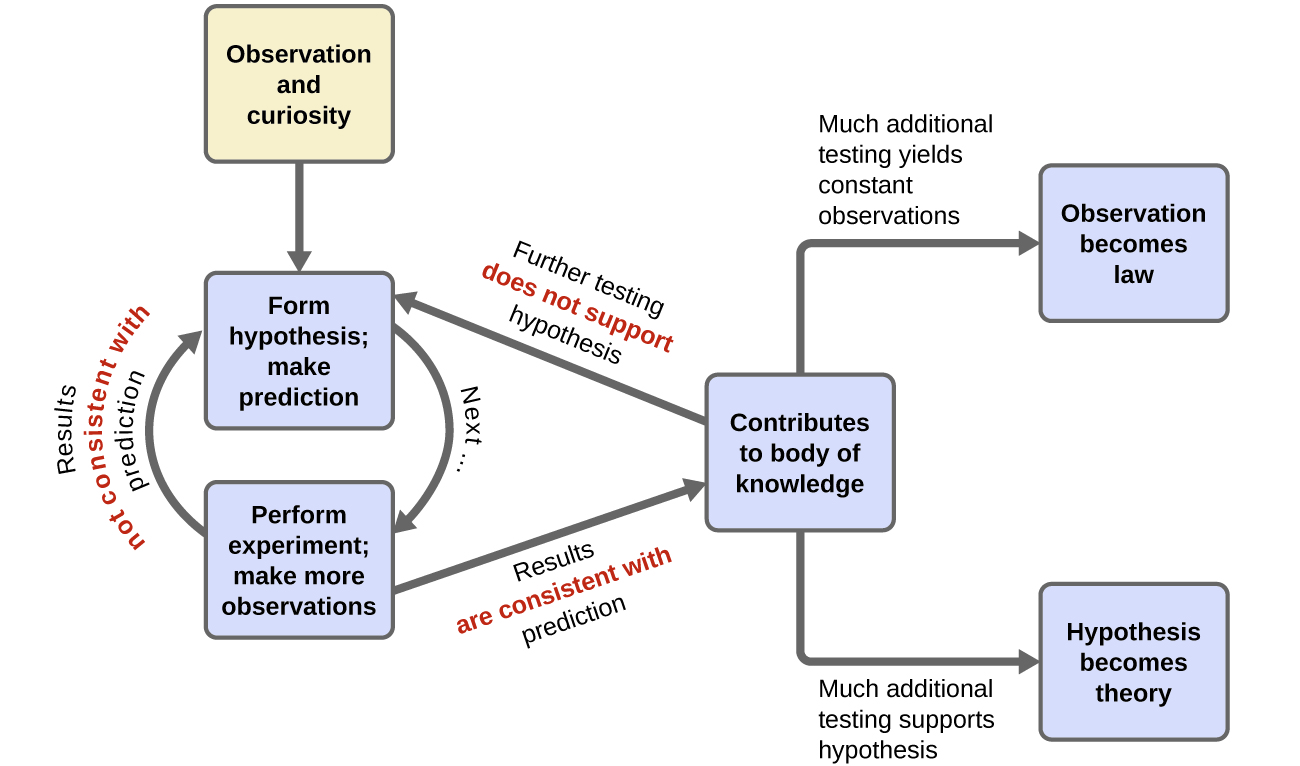
The scientific method is a systematic approach to understanding the world through observation, hypothesis, experimentation, and analysis.

The Steps

Step What It Is Example
1. Observation Notice something interesting "Patients in Room A heal faster"
2. Question Ask why "Does natural light affect healing?"
3. Hypothesis Propose an answer "Patients exposed to natural light heal faster"
4. Experiment Test the hypothesis Compare healing in lit vs. dark rooms
5. Data Collection Gather results Record healing times
6. Analysis Interpret data Calculate averages, compare groups
7. Conclusion Accept or reject hypothesis "Data supports the hypothesis"
8. Communication Share findings Publish in a journal
The Scientific Method β€” Flowchart 1. Observation Notice something interesting 2. Question Ask "why?" or "how?" 3. Hypothesis Testable prediction (If…then…) 4. Experiment Control & independent variables 5. Data Collection Gather quantitative & qualitative data 6. Analysis & Conclusion Accept or reject hypothesis 7. Communicate Results If rejected, revise & retest

🧠 Memory Trick

"Oh, Queen Harriet Eats Delicious Apple Cake Constantly"

Observation β†’ Question β†’ Hypothesis β†’ Experiment β†’ Data β†’ Analysis β†’ Conclusion β†’ Communication

Or simply: Observe, Question, Hypothesize, Test, Analyze, Conclude


Key Concepts

Hypothesis

A hypothesis is a testable prediction. It must be: - Testable β€” Can be proven right or wrong through experiment - Falsifiable β€” Possible to disprove (if wrong) - Specific β€” Clear about what's being tested

Good hypothesis: "Plants given 8 hours of light will grow taller than plants given 4 hours." Bad hypothesis: "Light is important for plants." (Too vague, not testable)

Variables

Type Definition Example
Independent What you CHANGE (the cause) Amount of light
Dependent What you MEASURE (the effect) Plant height
Controlled What you keep the SAME Water, soil type, temperature

Control Group

The control group receives no treatment (or standard treatment). It provides a baseline for comparison.

  • Experimental group: Gets the treatment being tested
  • Control group: Doesn't get the treatment

Types of Studies

Study Type Description Strength
Randomized Controlled Trial (RCT) Participants randomly assigned to groups Gold standard
Cohort Study Follows groups over time Good for long-term outcomes
Case-Control Study Compares those with/without condition Good for rare conditions
Case Study Detailed analysis of one case Generates hypotheses
Survey/Cross-sectional Snapshot at one time point Quick, inexpensive

✏️ Worked Examples

Example 1: Identify Variables

Study: "Researchers tested whether a new medication reduces blood pressure. Patients were randomly assigned to receive the medication or a placebo. Blood pressure was measured after 8 weeks."

Step 1 β€” Find the independent variable. Ask yourself: What did the researchers change on purpose? They gave some patients medication and others a placebo. The thing they changed = the medication. Independent variable: the medication (whether patients got it or not).

Step 2 β€” Find the dependent variable. Ask yourself: What did they measure to see if the change worked? They measured blood pressure after 8 weeks. Dependent variable: blood pressure.

Step 3 β€” Identify the groups. The experimental group gets the thing being tested β†’ patients who received the actual medication. The control group gets nothing (or a fake version) β†’ patients who received the placebo (a sugar pill that looks like the real thing). Controls are your comparison baseline β€” without them, you don't know if the medication actually did anything.

πŸ₯ Nursing connection: In clinical trials for new drugs, you'll hear about "placebo-controlled studies." Now you know exactly what that means β€” one group gets the drug, one group gets a fake pill, and we compare outcomes. This is why evidence-based medicine works.


Example 2: Step-by-Step Solution

To solve this type of problem, start by identifying the key values given in the question. Then apply the formula we covered above...

Step 1: Convert the mixed number to an improper fraction...

Step 2: Find the common denominator between the two fractions...

Keep reading β€” there's more to this guide

The worked examples and practice problems are the part that actually prepares you for the TEAS.

Unlock Full Guide β€” Free for 3 Days

$0 today β€’ Cancel anytime before your trial ends

πŸ€– AI Tutor

Loading...

πŸ‘‹ Hi! I'm your TEAS Tutor

Ask me anything about Math, Reading, Science, or English!

πŸ“ How do I convert fractions to decimals?
πŸ”¬ Explain arteries vs veins
✏️ What are the parts of speech?

Wait! Grab your free cheat sheet

Get the essential TEAS formulas, conversions, and must-know facts in one printable PDF.

πŸ“‹ FREE: TEAS Quick Reference Cheat Sheet

βœ“ Check your inbox! Your cheat sheet is on its way.

No spam. Unsubscribe anytime.