Science · Cells, genes & microorganisms
DNA, RNA, and Protein Synthesis
Estimated time includes reading and one quiz. Take the time you need.
Start here: key ideas
- DNA stores instructions in its base sequence.
- A gene is a DNA section used to make a functional product.
- Replication copies DNA.
- Transcription makes RNA from DNA.
- Translation uses mRNA codons to build a protein.
- A mutation can change a protein, but it may also have no effect.
What you’ll be able to do
- Relate DNA, genes, chromosomes, and proteins.
- Put replication, transcription, and translation in order.
- Use base-pair rules.
- Predict a simple effect of a DNA change.
Follow genetic information from DNA to RNA to protein, then see how DNA changes may affect a product.
Optional review
If you’d like to review the basics, visit Cell Structure, Membranes, and Transport. You can start this lesson without completing those first.
Genes are functional regions of DNA
DNA stores biological instructions in the order of four bases: A, T, C, and G. A gene is a section of DNA used to make a functional RNA or protein. A chromosome is one long DNA molecule packaged with proteins.
Many proteins affect cell structure or chemical reactions. This creates a common path: DNA information leads to RNA, and RNA helps direct protein production.
A DNA nucleotide has three parts: deoxyribose sugar, phosphate, and one nitrogen base. Nucleotides join into a sugar-phosphate backbone. The bases point inward and pair A–T and C–G. This pairing lets either strand guide a matching copy.
Keep levels distinct. A chromosome is a packaged DNA molecule containing many genes. A gene is a DNA region whose expression produces a functional RNA or contributes to a protein product. A codon is only three bases in mRNA. One chromosome is not one gene, and one codon is not a whole protein instruction.
DNA is packaged into chromosomes
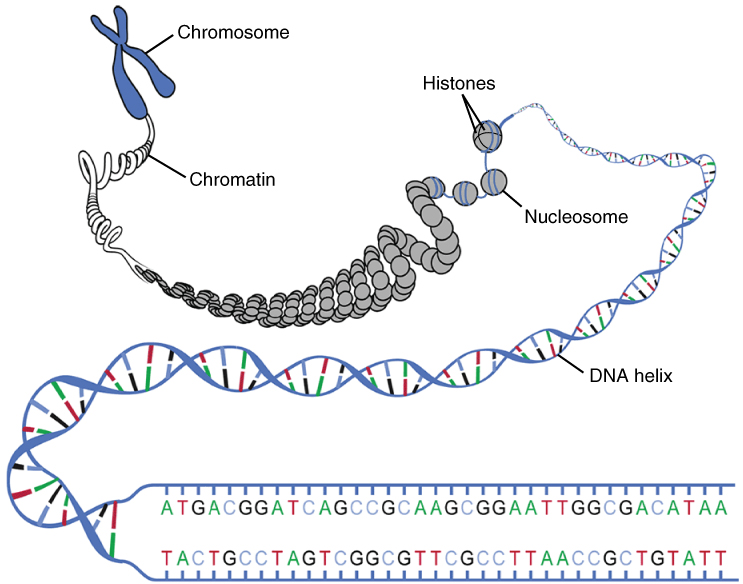
DNA is packed with proteins into chromosomes. A gene is a section of DNA with a job, not a different material. Once a chromosome is copied, its two matching halves are sister chromatids. Each half contains a DNA molecule.
DNA is packaged into chromosomes — OpenStax College, Anatomy & Physiology (2014 CC BY archive). CC BY 3.0. Original source image reproduced unchanged; explanatory caption added.

You've used your 1 free study guide
Your free topic allowance is shared across Reading, Math, Science and English. This first section is a preview. Unlock every study-guide
topic — full lessons, inline checks, the complete practice bank +
timed exam simulation — with a free trial.
Your one free topic stays free, always.
$0 today — card required to start your trial. Cancel anytime before day 3.
Already subscribed? Log in.