Science · Regulation & defense
Endocrine System and Hormonal Control
Estimated time includes reading and one quiz. Take the time you need.
Start here: key ideas
- Hormones travel in blood but affect only cells with matching receptors.
- Peptide hormones use surface receptors; steroid hormones usually use receptors inside cells.
- Negative feedback controls most hormone systems.
- Insulin lowers blood glucose; glucagon raises it.
What you’ll be able to do
- Match major glands, hormones, targets, and effects.
- Compare peptide and steroid signaling.
- Apply feedback to glucose, thyroid, stress, and water balance.
Learn a small set of hormone maps, then use feedback to predict what changes next.
Optional review
If you’d like to review the basics, visit Anatomical Orientation, Organization, and Homeostasis. You can start this lesson without completing those first.
Glands, hormones, targets, effects
Endocrine glands release hormones into blood. A hormone is a chemical message. Only a target cell with the matching receptor can respond. The pancreas releases insulin when blood glucose is high and glucagon when it is low. The thyroid releases thyroid hormone, which raises metabolic activity in many tissues. The parathyroid glands release PTH when blood calcium is low.
The hypothalamus connects nervous and endocrine control. It directs the pituitary. One pituitary signal, TSH, tells the thyroid to release thyroid hormone. Another, ACTH, tells the adrenal cortex to release cortisol during a longer stress response. The adrenal cortex also makes aldosterone, but aldosterone is controlled mainly by blood pressure, blood sodium, and blood potassium signals. The posterior pituitary releases ADH made by the hypothalamus; ADH helps the kidneys save water.
Separate synthesis from storage and release. Hypothalamic neurons synthesize ADH and oxytocin; their axons carry the hormones to the posterior pituitary, which stores and releases them. By contrast, the anterior pituitary synthesizes its own hormones in response to hypothalamic signals. For any endocrine question, identify source, release site, target, receptor location, and feedback effect as separate steps.
Hypothalamus and pituitary relationship
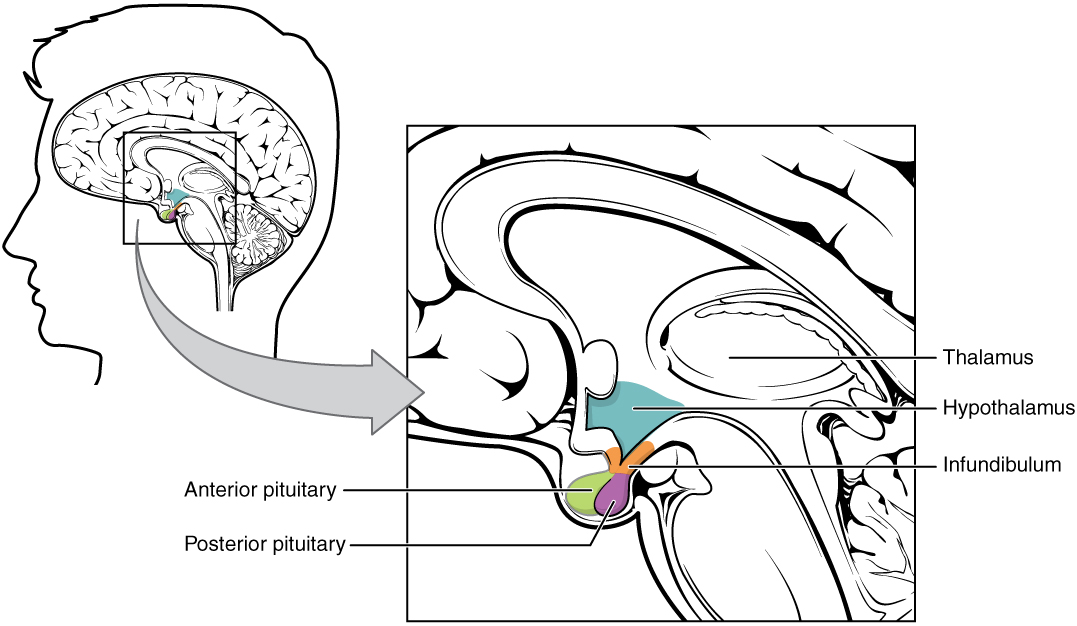
Find the hypothalamus above the pituitary. The hypothalamus helps control hormone release from the pituitary. They connect through a small stalk. The nearby thalamus is a different structure; do not confuse the two names.
Hypothalamus and pituitary relationship — OpenStax College, Anatomy & Physiology (2014 CC BY archive). CC BY 3.0. Original source image reproduced unchanged; explanatory caption added.

You've used your 1 free study guide
Your free topic allowance is shared across Reading, Math, Science and English. This first section is a preview. Unlock every study-guide
topic — full lessons, inline checks, the complete practice bank +
timed exam simulation — with a free trial.
Your one free topic stays free, always.
$0 today — card required to start your trial. Cancel anytime before day 3.
Already subscribed? Log in.