Science · Support & movement
Skeleton and Bone Structure
Estimated time includes reading and one quiz. Take the time you need.
Start here: key ideas
- The skeleton supports, protects, stores minerals, and helps movement.
- The axial skeleton forms the center; the appendicular skeleton includes limbs and girdles.
- Compact bone is dense; spongy bone has light internal supports.
- Bone is living tissue that is continually remodeled.
What you’ll be able to do
- Compare axial and appendicular bones.
- Identify basic bone structure and marrow.
- Explain remodeling and mineral storage.
Learn how bones are grouped, built, and renewed.
Optional review
If you’d like to review the basics, visit Anatomical Orientation, Organization, and Homeostasis. You can start this lesson without completing those first.
A framework that does more than hold you up
Bones do more than hold the body up. The skeleton gives support, protects organs, and provides levers for movement. Bones store calcium and phosphate. Red marrow makes blood cells, while yellow marrow mainly stores fat. These jobs connect the skeleton with the muscular, blood, and endocrine systems.
Protection depends on location: the skull protects the brain, vertebrae surround the spinal cord, and ribs protect the heart and lungs. Movement requires a team. Bones act as rigid levers, joints allow the levers to turn, and skeletal muscles pull on them through tendons.
Axial center and appendicular limbs
The axial skeleton forms the body’s central axis: skull, vertebral column, ribs, and sternum. It mainly supports and protects the brain, spinal cord, heart, and lungs. The appendicular skeleton includes the arms, legs, shoulder girdles, and pelvic girdle. It mainly supports movement. The sacrum is axial, but the hip bones are appendicular.
Use attachment as a clue. The shoulder girdle attaches the arms to the axial skeleton. The pelvic girdle attaches the legs. The vertebral column remains part of the axis even though it helps transfer forces to the pelvis.
Two divisions of the skeleton
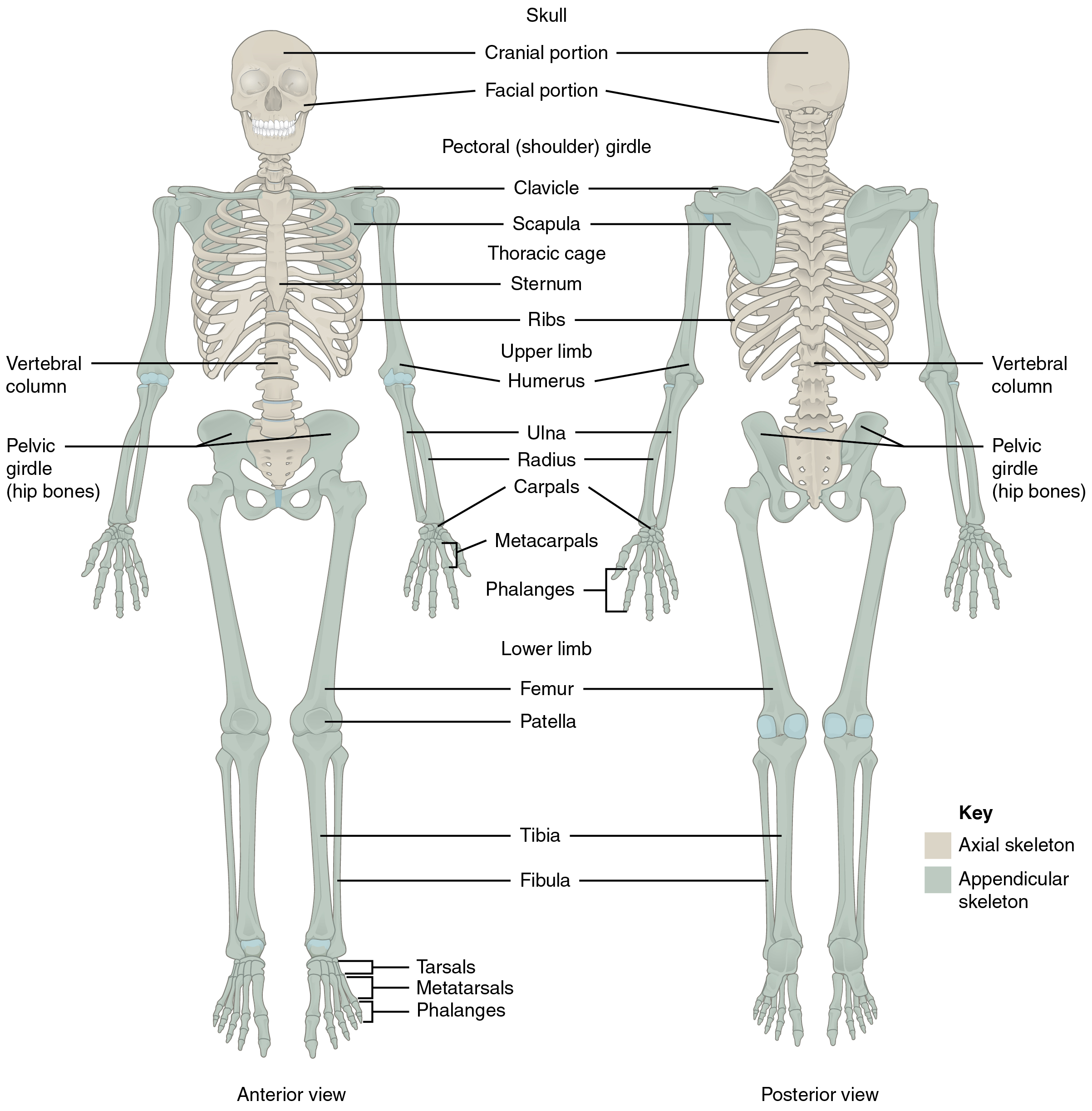
Axial means the center: skull, spine, ribs, and breastbone. Appendicular means limbs and the bones that attach them. The sacrum continues the spine, so it is axial. The hip bones beside it are appendicular. Use the written labels, not color alone. You do not need to memorize every hand and foot label in this figure.
Two divisions of the skeleton — OpenStax College, Anatomy & Physiology (2014 CC BY archive). CC BY 3.0. Original source image reproduced unchanged; explanatory caption added.

Dense outside, organized supports inside
Compact bone is the hard, dense outer tissue. Spongy bone has a lattice of thin supports inside. This design gives strength without too much weight. A long bone has a shaft called the diaphysis and ends called epiphyses. Cartilage covers joint surfaces. The periosteum covers most of the outside and carries vessels and nerves.
In a long bone, the shaft has a thick compact wall around a marrow cavity. The ends contain more spongy bone, which helps spread forces from several directions. Red marrow is common within spongy bone. Blood vessels enter bone because living bone cells need oxygen and nutrients.
Structure of a long bone
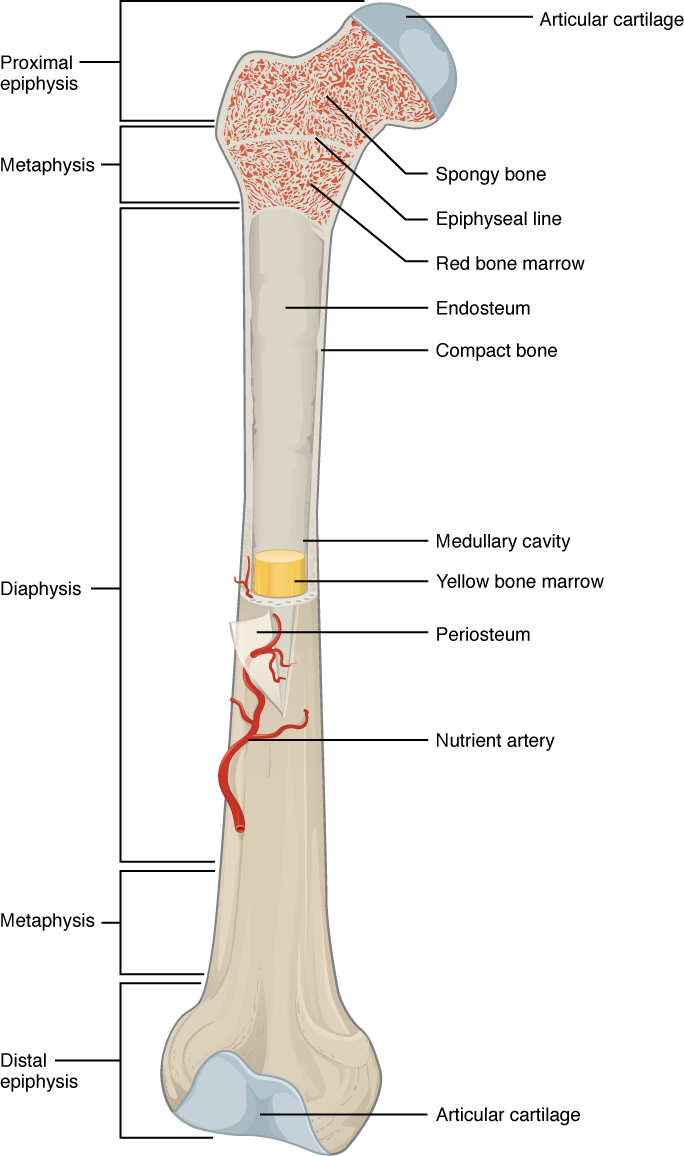
Find the outer covering (periosteum), dense wall (compact bone), and inner framework (spongy bone). This cutaway shows red marrow near the upper end and yellow marrow in the shaft. Marrow location varies by bone and age. The lower end is not cut open. Epiphysis means an end; diaphysis means the shaft.
Structure of a long bone — OpenStax College, Anatomy & Physiology (2014 CC BY archive). CC BY 3.0. Original source image reproduced unchanged; explanatory caption added.

Bone shape describes form, not size
Shape helps predict function. Long bones, such as the femur, act as levers. Short bones, such as wrist bones, provide stability with small movements. Flat bones, such as ribs, protect organs. Irregular bones, such as vertebrae, have complex shapes. A long bone is named for its shape, not its total size.
Shape does not tell whether a bone belongs to the axial or appendicular skeleton. For example, a rib is a flat axial bone, while the shoulder blade is a flat appendicular bone. First classify location, then classify shape.
Stored minerals connect bone to the whole body
Bone stores calcium, but blood also needs calcium for nerves and muscles. When blood calcium falls, hormones can increase bone breakdown and reduce calcium loss. When enough calcium is available, bone can store it. This balance protects blood function while keeping bone strong over time.
Parathyroid hormone helps raise low blood calcium by acting on bone, kidneys, and vitamin D pathways. Calcitonin can favor lower blood calcium, though its role in adult day-to-day control is smaller. The important idea is that bone mineral and blood calcium are linked, not stored in separate systems.
Bone is maintained throughout life
Bone changes throughout life. Osteoclasts remove old bone. Osteoblasts build new bone. Mature osteocytes maintain the surrounding tissue. This cycle is remodeling. Weight-bearing activity adds helpful stress, which can encourage stronger bone where support is needed.
Worked example: A small region of bone develops tiny stress damage. Osteoclasts remove the damaged matrix. Osteoblasts replace it with new matrix that later hardens with minerals. Balanced removal and building repair the area; too much removal over time weakens bone.
Remodeling is a coordinated balance: osteoclasts resorb mineralized matrix, whereas osteoblasts deposit new matrix; osteocytes maintain mature tissue. Mechanical loading and mineral needs can shift the balance. These cell roles matter more than memorizing every named bone feature: a question describing loss of matrix points toward resorption, not bone formation.
Cells that build, maintain, and resorb bone
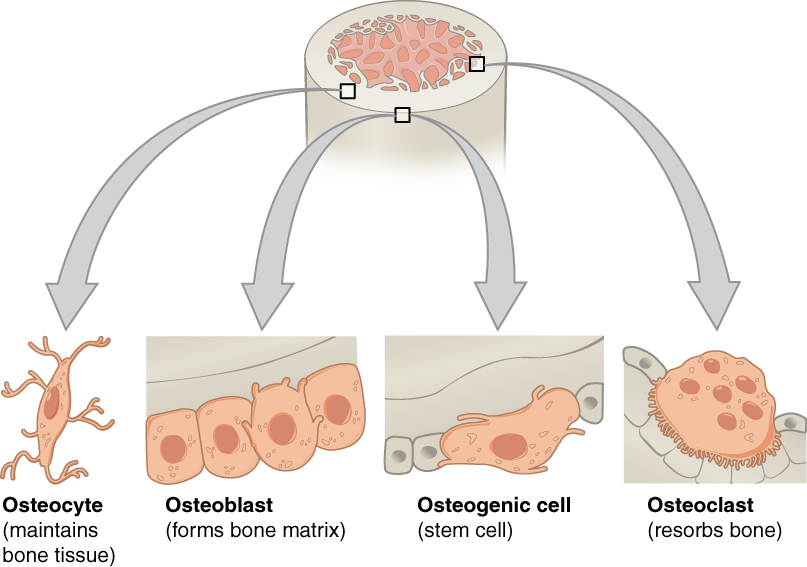
Osteoblasts build bone. Osteocytes maintain it. Osteoclasts break down old bone. Building and removal work together to renew bone. The extra osteogenic cell can produce osteoblasts; it is background detail. The arrows point to cells, not steps showing one cell becoming every other type.
Cells that build, maintain, and resorb bone — OpenStax College, Anatomy & Physiology (2014 CC BY archive). CC BY 3.0. Original source image reproduced unchanged; explanatory caption added.

Terms to remember
- axial skeleton
- Skull, vertebral column, and rib cage.
- appendicular skeleton
- Limbs and the shoulder and pelvic girdles.
- compact bone
- Dense outer bone tissue.
- spongy bone
- Porous bone tissue with internal supports.
- red marrow
- Tissue that makes blood cells.
- osteoblast
- A cell that builds bone.
- osteoclast
- A cell that breaks down bone.
Your quick summary
- The axial skeleton protects the central axis; the appendicular skeleton supports limb movement.
- Compact bone is dense, while spongy bone reduces weight and contains marrow spaces.
- Osteoblasts build bone, osteoclasts remove it, and osteocytes maintain it.
Lesson quiz
Check what you learned, then review the explanations. This quiz saves results on this device only. Sign in to save quiz results to your account.
You've got the concept — now drill it like the real TEAS
Unlock the full practice bank, timed full-length exam simulation, and practice across topics. Your free lesson and its lesson quiz stay available.
Unlock practice — free for 3 days$0 today; then $19.99/month after 3 days. Card required. Cancel before renewal to avoid a charge.