Science · Regulation & defense
Immune and Lymphatic Systems
Estimated time includes reading and one quiz. Take the time you need.
Start here: key ideas
- Innate defenses act quickly and broadly.
- Adaptive defenses target specific antigens and form memory.
- B cells make antibodies; cytotoxic T cells kill infected cells.
- The lymphatic system returns fluid and supports immune surveillance.
What you’ll be able to do
- Compare innate and adaptive defenses.
- Explain B cells, T cells, antibodies, and memory.
- Connect lymph flow, inflammation, and vaccination.
Start with barriers, then follow the response from rapid general defense to specific memory.
Optional review
If you’d like to review the basics, visit Anatomical Orientation, Organization, and Homeostasis. You can start this lesson without completing those first.
Innate defense responds first
Skin, mucus, cilia, tears, and stomach acid block entry. These are innate defenses: they act quickly and are not aimed at one exact germ. If tissue is damaged, inflammation increases local blood flow and vessel leakiness. Phagocytes can engulf microbes and debris. Fever can support defense, but neither inflammation nor fever identifies one specific antigen.
Innate cells recognize broad danger patterns. Neutrophils arrive quickly and engulf microbes. Macrophages engulf material and release signals. Natural killer cells can destroy abnormal cells without recognizing one unique antigen. Complement proteins can mark microbes, attract cells, and damage some microbial membranes.
B cells, T cells, and antibodies divide the work
Adaptive immunity targets a specific antigen. Helper T cells coordinate other immune cells. Cytotoxic T cells kill infected body cells. B cells can become plasma cells that release antibodies. Antibodies bind matching antigens, helping block or mark them. Memory B and T cells remain after the response and react faster on later exposure.
Antibody binding can block a virus from entering a cell, clump targets, or mark them for phagocytes. Antibodies work outside cells. Once a virus is reproducing inside a body cell, cytotoxic T cells can recognize and kill that infected cell. Helper T cells support both B-cell and cytotoxic-T-cell responses.
Do not treat antibodies, antibiotics, and cytotoxic cells as equivalents. Antibodies bind specific extracellular antigens; cytotoxic T cells recognize and kill infected body cells; antibiotics are medicines that act against susceptible bacteria and are not immune proteins. Innate defenses respond without prior exposure but do not create antigen-specific memory. Memory B and T cells explain the faster adaptive response after later exposure.
Lymphatic flow supports fluid balance and surveillance
Some fluid leaves blood capillaries and enters tissues. Lymphatic vessels collect the extra fluid as lymph and return it to the bloodstream. Lymph nodes filter lymph and bring antigens together with lymphocytes. The spleen filters blood and supports immune responses. The thymus is where T cells mature.
Lymph moves one way through vessels with valves and returns near the large veins of the chest. Skeletal-muscle movement helps push it. Afferent vessels bring lymph into a node; efferent vessels carry it away. Swollen nodes often reflect immune-cell activity, not that the node itself created the infection.
Lymphatic circulation and immune organs
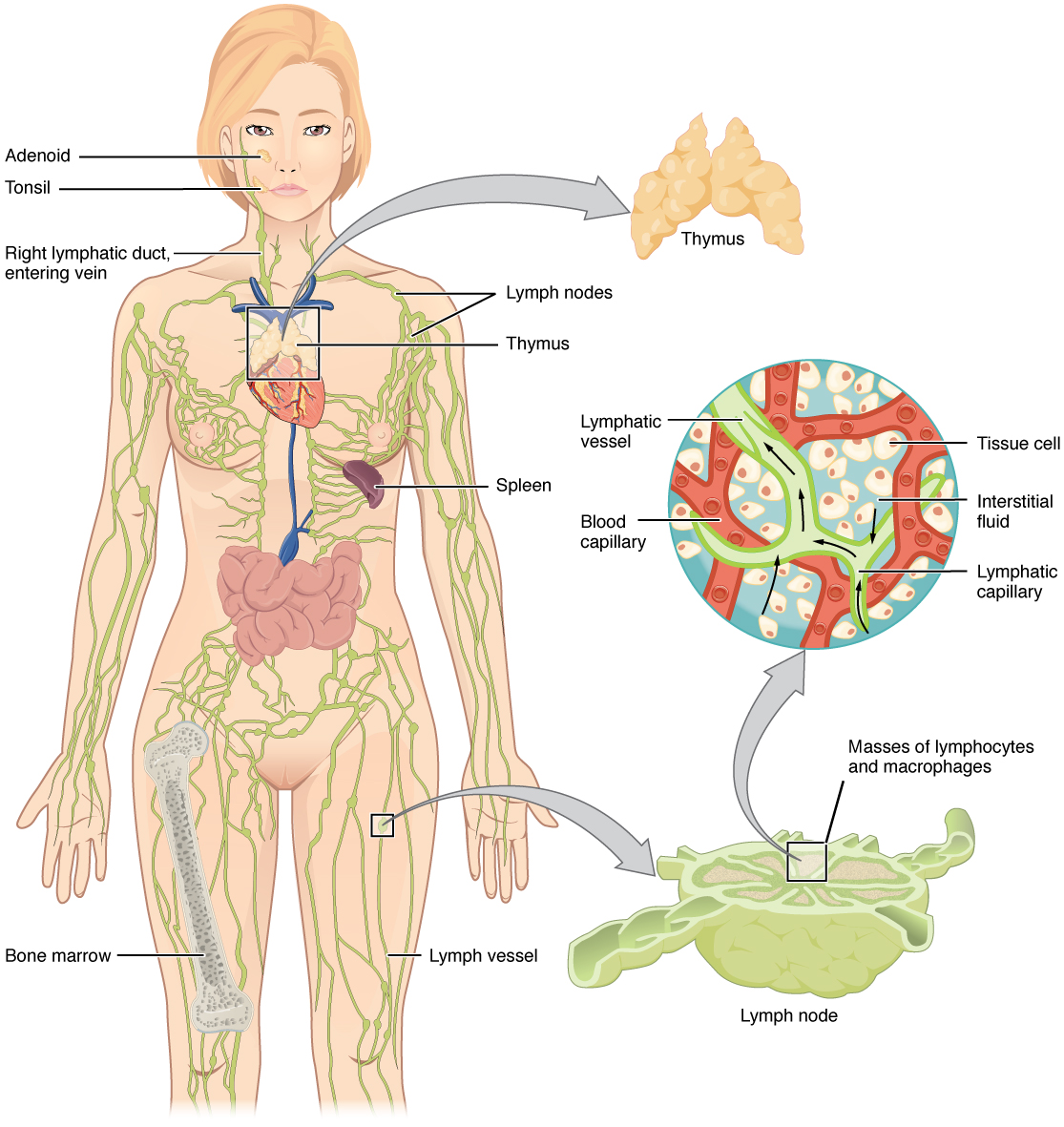
Lymph vessels collect extra fluid from tissues and return it to blood. Lymph nodes check that fluid for signs of infection. The spleen checks blood instead. The thymus helps T cells mature. This system does not have a separate heart pumping blood around it.
Lymphatic circulation and immune organs — OpenStax College, Anatomy & Physiology (2014 CC BY archive). CC BY 3.0. Original source image reproduced unchanged; explanatory caption added.

Trace a response from breach to memory
After a barrier breach, innate cells respond first. Some cells display antigen pieces to helper T cells. Matching B and T cells multiply. Plasma cells release antibodies, while cytotoxic T cells attack infected cells. When the threat falls, most active cells die, but memory cells remain. This explains why a second response can be faster.
Worked example: A splinter carries bacteria through skin. Inflammation and phagocytes respond within hours. A dendritic cell carries bacterial antigens to a lymph node. Matching helper T and B cells activate. Plasma cells make antibodies, and memory cells remain after the bacteria are cleared.
Vaccination prepares a faster later response
A vaccine presents a harmless form, piece, or instructions for making part of a pathogen antigen. It trains adaptive immunity without requiring the full disease. The body forms antibodies and memory cells. Vaccination does not create an instant barrier and does not guarantee that exposure can never occur; it prepares a faster, stronger response.
Active immunity develops when a person’s own immune system responds to infection or vaccination. It takes time but can form memory. Passive immunity transfers ready-made antibodies, such as maternal antibodies to an infant. It acts quickly but fades because the recipient did not make memory cells from that transfer.
A later response can be faster and stronger
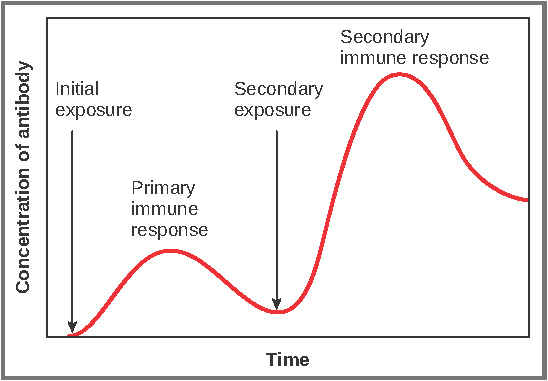
The first response takes time. Memory cells help the body respond faster and more strongly when it meets the same antigen again. The graph illustrates that pattern, not a guaranteed amount of protection.
A later response can be faster and stronger — OpenStax College, Anatomy & Physiology (2014 CC BY archive). CC BY 3.0. Original source image reproduced unchanged; explanatory caption added.

Terms to remember
- innate immunity
- Fast, general defense present before exposure.
- adaptive immunity
- Specific defense that develops memory.
- antigen
- A molecule recognized as a target by immune cells.
- antibody
- A protein made by plasma cells that binds an antigen.
- B cell
- A lymphocyte that can become an antibody-secreting plasma cell.
- T cell
- A lymphocyte that coordinates defense or kills infected cells.
- lymph node
- A structure that filters lymph and houses immune cells.
Your quick summary
- Barriers and inflammation are innate defenses.
- Adaptive responses are specific and can create memory cells.
- Vaccines expose the immune system to a safe form or part of an antigen.
Lesson quiz
Check what you learned, then review the explanations. This quiz saves results on this device only. Sign in to save quiz results to your account.
You've got the concept — now drill it like the real TEAS
Unlock the full practice bank, timed full-length exam simulation, and practice across topics. Your free lesson and its lesson quiz stay available.
Unlock practice — free for 3 days$0 today; then $19.99/month after 3 days. Card required. Cancel before renewal to avoid a charge.