Science · Body foundations
Cardiovascular System
Estimated time includes reading and one quiz. Take the time you need.
Start here: key ideas
- The right heart sends blood to the lungs; the left heart sends blood to the body.
- Valves keep blood moving one way.
- Arteries carry blood away, veins carry blood back, and capillaries exchange materials.
- The heart’s electrical system coordinates contraction.
What you’ll be able to do
- Trace blood through the heart, lungs, and body.
- Explain how conduction, pressure, and valves work together.
- Compare arteries, veins, and capillaries.
- Match blood components with oxygen transport, defense, clotting, and fluid transport.
Trace one drop of blood through two circuits, then match each structure to its job.
Optional review
If you’d like to review the basics, visit Anatomical Orientation, Organization, and Homeostasis. You can start this lesson without completing those first.
Two circuits, one continuous route
Start with one big loop. Blood from the body enters the right heart. The right heart sends it to the lungs. Blood then enters the left heart. The left heart sends it back to the body. An atrium is an upper chamber that receives blood. A ventricle is a lower chamber that pumps blood out. The ventricles have thicker walls because they push blood away from the heart. The left ventricle is thickest because it pumps through the whole body.
Now add the exact route: body → venae cavae → right atrium → tricuspid valve → right ventricle → pulmonary valve → pulmonary arteries → lung capillaries → pulmonary veins → left atrium → mitral valve → left ventricle → aortic valve → aorta → body. In the lungs, blood releases carbon dioxide and gains oxygen. The septum separates the two sides of the heart.
The heart-to-lung route is the pulmonary circuit. The heart-to-body route is the systemic circuit. Arteries always carry blood away from the heart, and veins always carry blood toward it. That rule is about direction, not oxygen. Pulmonary arteries carry low-oxygen blood to the lungs, while pulmonary veins carry oxygen-rich blood to the heart.
Trace the pulmonary and systemic circuits
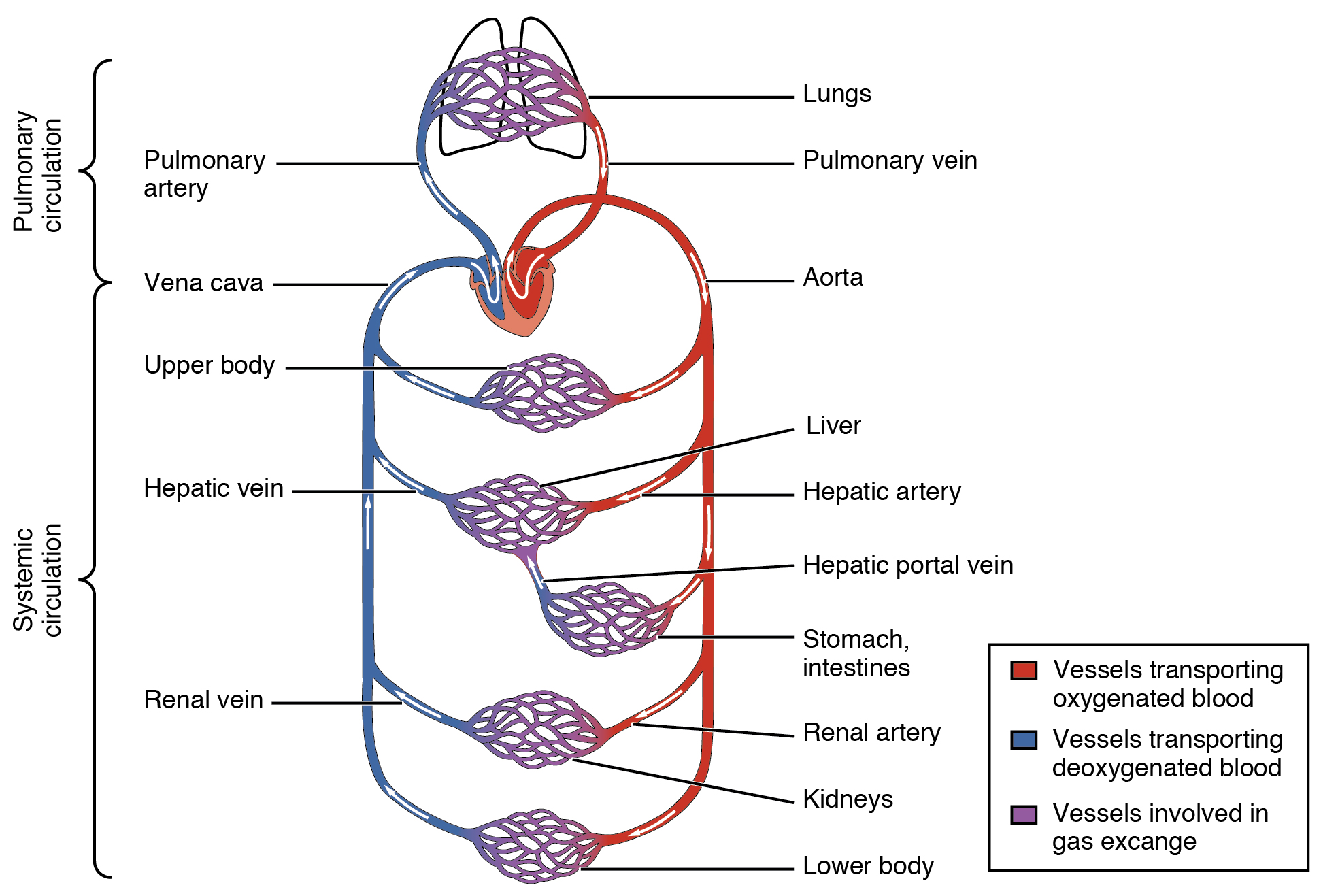
Start with the big loop: body → right heart → lungs → left heart → body. Then find the chambers and vessels along that route. Arteries carry blood away from the heart; veins bring it back. Those names describe direction, not oxygen content.
Trace the pulmonary and systemic circuits — OpenStax College, Anatomy & Physiology (2014 CC BY archive). CC BY 3.0. Original source image reproduced unchanged; explanatory caption added.

Conduction, contraction, pressure, and valves
The sinoatrial node starts the normal electrical signal. The atria contract first. The signal pauses at the atrioventricular node, then travels through the ventricles so they contract from the bottom upward. During systole, contraction raises pressure and pushes blood out. During diastole, chambers relax and fill. Valves open when pressure behind them is greater and close when pressure reverses.
The conduction system controls timing; it does not provide the blood. The SA node fires, the atria squeeze, and blood enters the ventricles. The AV-node delay lets the ventricles finish filling. Ventricular contraction then raises pressure. The tricuspid and mitral valves close first, preventing flow into the atria. When ventricular pressure exceeds artery pressure, the pulmonary and aortic valves open.
Do not confuse filling with atrial contraction. During ventricular diastole, ventricular pressure falls and the atrioventricular valves open; most ventricular filling is passive. Atrial systole adds the final portion. During ventricular systole, rising ventricular pressure closes the atrioventricular valves before semilunar valves open. Thus pressure differences move blood and valve position prevents backflow; a valve does not actively push blood.
Structure fits the job
Arteries carry blood away under higher pressure, so they have thick, elastic walls. Veins return blood under lower pressure. Their wide spaces and valves help return blood. Capillaries have walls only one cell thick. Their slow flow and thin walls allow gases, nutrients, and wastes to move between blood and tissues.
Arterioles adjust resistance by changing diameter. Narrowing raises resistance and reduces downstream flow; widening lowers resistance and can increase it. Veins hold much of the blood volume and use skeletal-muscle squeezing and breathing pressure to aid return. Exchange across capillaries depends on thin walls and short diffusion distance.
| Component | Main function |
|---|---|
| Red blood cells | Hemoglobin carries oxygen. |
| White blood cells | Defend against pathogens and other threats. |
| Platelets | Cell fragments that help form a plug and support clotting. |
| Plasma | Liquid carrying blood cells, nutrients, hormones, wastes and dissolved proteins, including clotting proteins. |
Exchange between arterial and venous flow
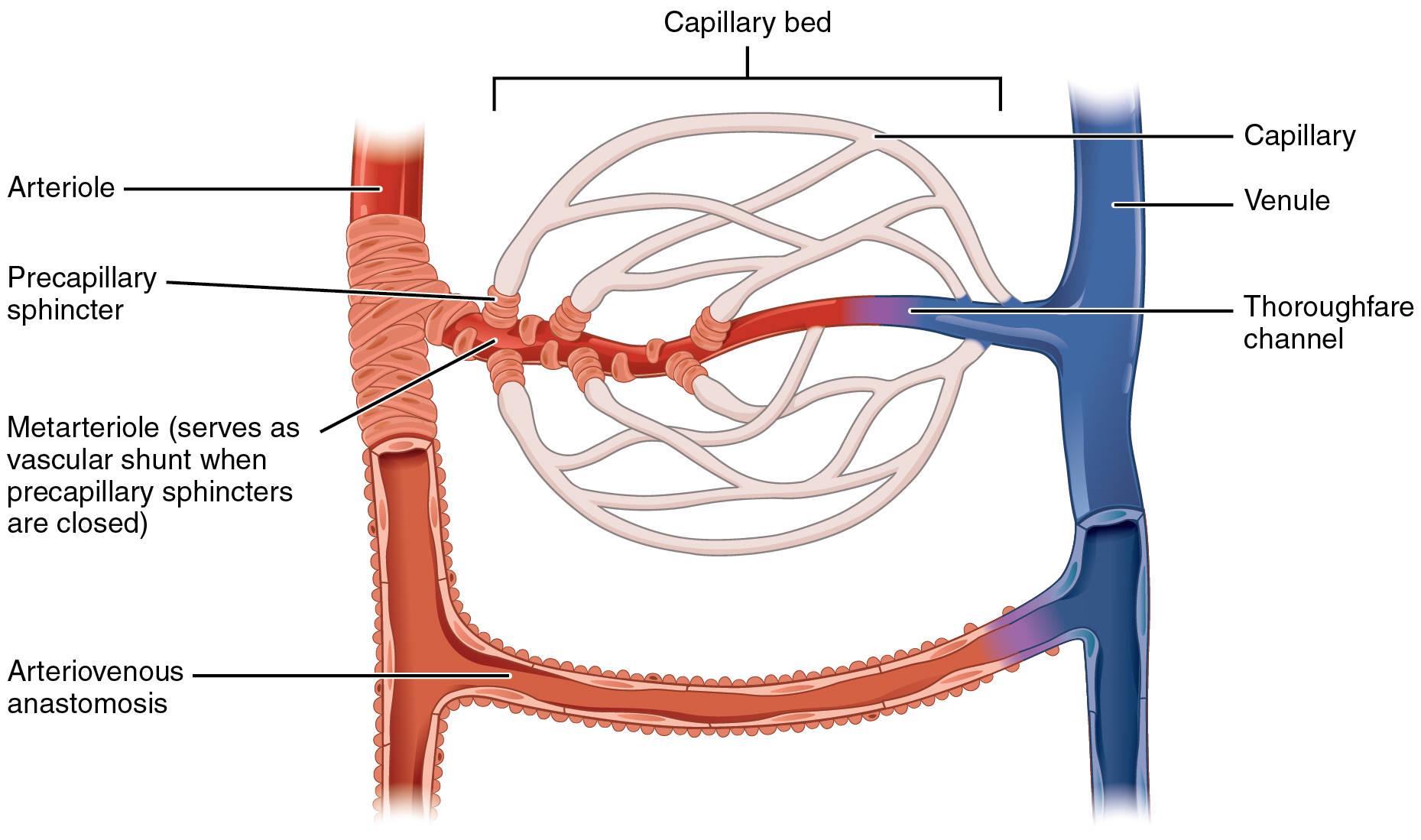
Follow the small artery (arteriole) into the capillary network, then out through a small vein (venule). Thin capillary walls allow exchange with nearby tissues. Muscle around small vessels controls blood flow. The extra named channels are background detail, not a list to memorize.
Exchange between arterial and venous flow — OpenStax College, Anatomy & Physiology (2014 CC BY archive); micrographs: Regents of the University of Michigan Medical School © 2012. CC BY 3.0. Original source image reproduced unchanged; explanatory caption added.

Match route, pressure, and exchange
Trace direction before oxygen level. A blockage before a chamber reduces its filling; a weak ventricle lowers flow after it. During exercise, heart rate and contraction force rise so muscles receive more oxygen. Local arterioles can widen to send more blood to active tissue. The respiratory system loads oxygen, and the cardiovascular system transports it.
Worked example: Trace one red blood cell leaving the right ventricle. It passes through the pulmonary valve and pulmonary artery to a lung capillary. It releases carbon dioxide and binds oxygen. It returns through a pulmonary vein to the left atrium, crosses the mitral valve, enters the left ventricle, and leaves through the aorta. The names artery and vein follow direction, even in the lung circuit.
Blood pressure is greatest in arteries and falls through the circulation. If a valve leaks, some blood moves backward and less moves forward. If the left ventricle weakens, blood can back up toward the lungs. If the right ventricle weakens, blood can back up in body veins.
Cardiac output is blood pumped per minute: heart rate × stroke volume. Stroke volume is blood pumped per beat. Capillary flow slows because capillaries have a very large combined cross-sectional area, allowing exchange time.
Supporting heart structures and sounds
The first heart sound accompanies closure of the tricuspid and mitral valves at the start of ventricular systole. Papillary muscles help keep these valves from turning backward. Purkinje fibers spread the electrical signal through ventricular muscle. Use these mechanisms when supplied in a scenario; prioritize blood flow, pressure and valve function.
Terms to remember
- atrium
- An upper heart chamber that receives blood.
- ventricle
- A lower heart chamber that pumps blood out.
- artery
- A vessel carrying blood away from the heart.
- vein
- A vessel carrying blood toward the heart.
- capillary
- A tiny vessel where exchange occurs.
- systole
- The contraction phase of a heart chamber.
- diastole
- The relaxation and filling phase.
Your quick summary
- Right heart to lungs; left heart to body.
- Pressure opens valves forward and closes them against backward flow.
- Capillaries have thin walls for exchange.
- Red cells carry oxygen; white cells defend; platelets help clot; plasma carries cells and dissolved substances.
Lesson quiz
Check what you learned, then review the explanations. This quiz saves results on this device only. Sign in to save quiz results to your account.
You've got the concept — now drill it like the real TEAS
Unlock the full practice bank, timed full-length exam simulation, and practice across topics. Your free lesson and its lesson quiz stay available.
Unlock practice — free for 3 days$0 today; then $19.99/month after 3 days. Card required. Cancel before renewal to avoid a charge.