Science · Cells, genes & microorganisms
Cell Cycle, Mitosis, and Meiosis
Estimated time includes reading and one quiz. Take the time you need.
Start here: key ideas
- Interphase prepares a cell to divide.
- DNA is copied during S phase.
- Mitosis makes two genetically similar body cells.
- Meiosis makes four cells with half the chromosome number.
- Crossing over and independent assortment create variation.
What you’ll be able to do
- Put the main cell-cycle stages in order.
- Explain what checkpoints do.
- Compare the products of mitosis and meiosis.
- Explain how meiosis creates variation.
Learn how cells prepare for division and how mitosis differs from meiosis.
Optional review
If you’d like to review the basics, visit Cell Structure, Membranes, and Transport. You can start this lesson without completing those first.
The cell cycle prepares and controls division
The cell cycle is the ordered path from one cell division to the next. During interphase, the cell grows in G1, copies DNA in S phase, and prepares to divide in G2. DNA copying makes two sister chromatids joined together.
Checkpoints pause the cycle if DNA is damaged or the cell is not ready. These checks help prevent damaged DNA from passing to new cells.
Supporting detail: nondividing cells
Some cells leave the active cycle and enter G0. They perform normal jobs without preparing to divide. Some can return to the cycle after a signal; others remain in G0 for a long time.
Worked example. If DNA damage is found before S phase, a checkpoint can pause division before the damaged DNA is copied.
The cell cycle
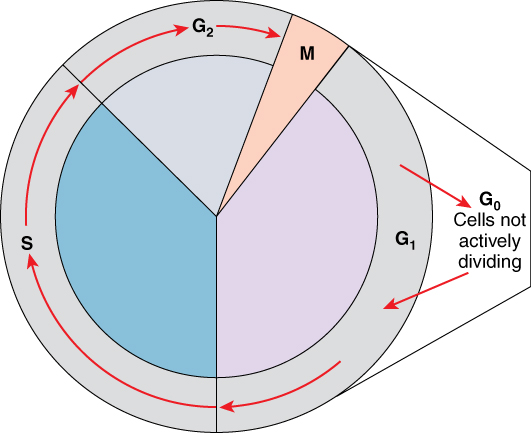
G1: grow. S: copy DNA. G2: prepare to divide. Mitosis separates the copied chromosomes; cytokinesis splits the cell. G0 means the cell is not preparing to divide. Remember: DNA is copied before mitosis, not during it.
The cell cycle — OpenStax College, Anatomy & Physiology (2014 CC BY archive). CC BY 3.0. Original source image reproduced unchanged; explanatory caption added.

Mitosis preserves chromosome sets
Mitosis divides one nucleus into two matching nuclei. In prophase, chromosomes condense. In metaphase, they line up in the middle. In anaphase, sister chromatids separate. In telophase, new nuclei form. Cytokinesis then splits the cell.
Mitosis makes two daughter cells with the same chromosome number as the parent. It supports growth, repair, and cell replacement.
Supporting detail: attachment checkpoint
The spindle checkpoint acts during metaphase. It checks that chromosomes are attached before sister chromatids separate. If attachment fails, separation pauses. This helps each new cell receive one copy of every chromosome.
Read division diagrams by chromosome behavior, not cell count alone. Alignment of duplicated chromosomes one by one indicates metaphase of mitosis. Separation of sister chromatids indicates anaphase. Chromosome number is counted by centromeres: DNA replication doubles DNA amount and creates sister chromatids, but it does not double the chromosome count.
Meiosis reduces ploidy and creates variation
A diploid cell has two chromosome sets. A haploid cell has one set.
Meiosis makes sex cells. DNA is copied once, but the cell divides twice. Homologous chromosome pairs separate in meiosis I. Sister chromatids separate in meiosis II.
The result is four cells with half the original chromosome number. Crossing over swaps DNA between homologous chromosomes. Independent assortment mixes which parental chromosomes enter each cell.
Homologous chromosomes carry the same kinds of genes but can have different alleles. During meiosis I, homologs pair and may cross over. Their random orientation at the middle causes independent assortment. Both processes make genetically different sex cells.
No second round of DNA replication occurs between meiosis I and II.
Compare outcomes and chromosome behavior
Mitosis makes two genetically similar cells for growth and repair. Meiosis makes four genetically different cells for sexual reproduction. Mitosis has one division. Meiosis has two.
Chromosome number stays the same after mitosis but is cut in half after meiosis. Fertilization later joins two sex cells and restores the full chromosome number.
Worked example. A diploid cell starts with two chromosome sets. After meiosis I, two cells each have one set, but every chromosome still has two sister chromatids. After meiosis II, chromatids separate and four haploid cells remain.
| Feature | Mitosis | Meiosis |
|---|---|---|
| DNA replication before process | Once | Once |
| Nuclear divisions | One | Two |
| First structures separated | Sister chromatids | Homologous chromosomes |
| Typical products | Two cells; chromosome number retained | Four haploid cells; varied |
Common trap: “duplicated chromosome” does not mean a homologous pair. A duplicated chromosome contains two sister chromatids copied from one chromosome; homologs are the maternal and paternal versions carrying the same gene locations.
Mitosis and meiosis compared
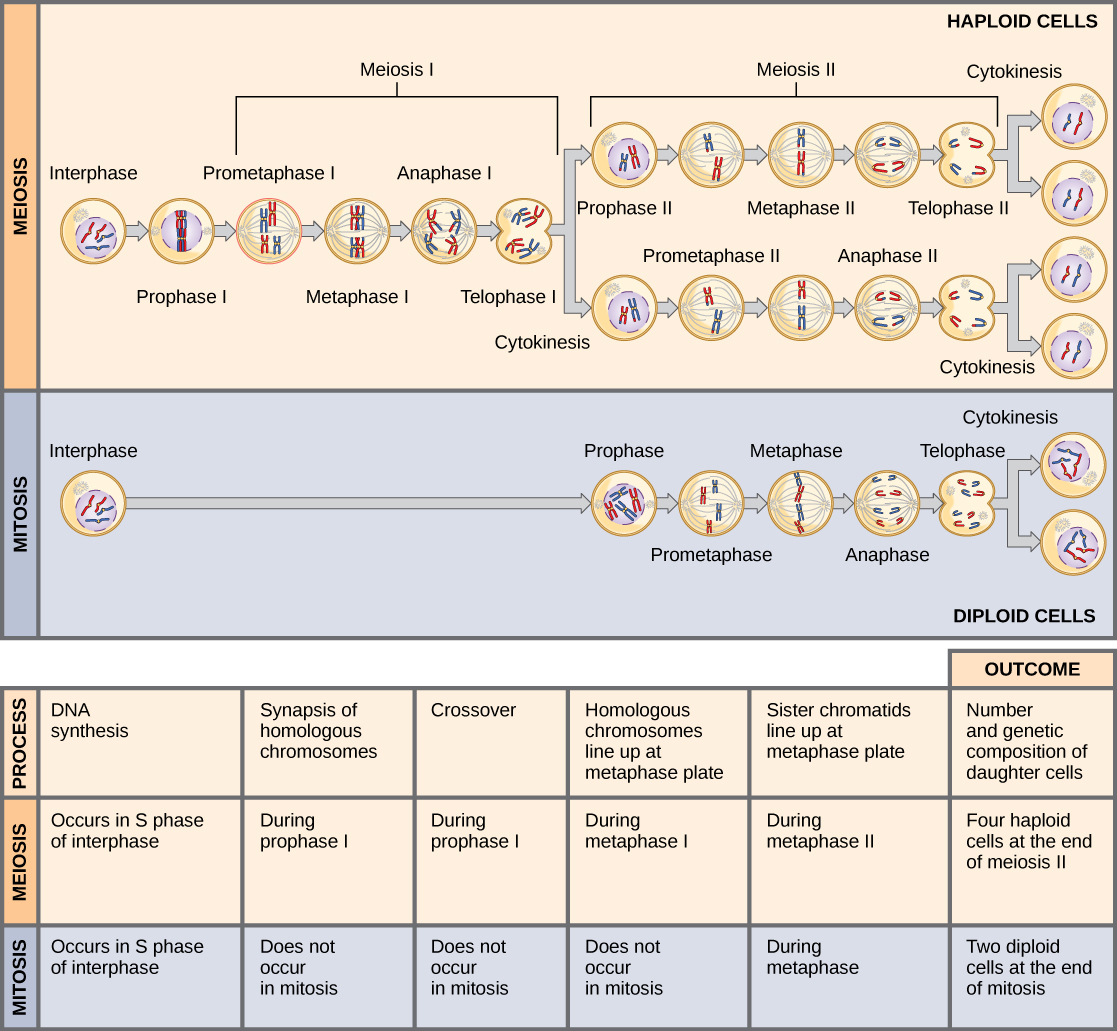
Mitosis makes two cells with the same number of chromosome sets as the starting cell. Meiosis makes four cells with half as many sets. Matching chromosomes separate first in meiosis; their copied halves separate next. The drawing uses just a few chromosomes so you can follow them.
Mitosis and meiosis compared — OpenStax College, Biology (CC BY archive). CC BY 3.0. Original source image reproduced unchanged; explanatory caption added.

Terms to remember
- cell cycle
- The ordered stages of cell growth and division.
- interphase
- The growth and DNA-copying part of the cell cycle.
- mitosis
- Nuclear division that keeps the chromosome number the same.
- meiosis
- Division that makes sex cells with half the chromosome number.
- chromosome
- A packaged DNA molecule.
- checkpoint
- A stop where the cell checks whether it is ready to continue.
- diploid
- Having two sets of chromosomes.
- haploid
- Having one set of chromosomes.
Your quick summary
- Interphase includes G1, S, and G2.
- DNA is copied during S phase.
- Mitosis makes two similar cells.
- Meiosis makes four cells with half the chromosome number.
- Crossing over and independent assortment increase variation.
Lesson quiz
Check what you learned, then review the explanations. This quiz saves results on this device only. Sign in to save quiz results to your account.
You've got the concept — now drill it like the real TEAS
Unlock the full practice bank, timed full-length exam simulation, and practice across topics. Your free lesson and its lesson quiz stay available.
Unlock practice — free for 3 days$0 today; then $19.99/month after 3 days. Card required. Cancel before renewal to avoid a charge.