Math · Geometry & data
Geometry: Perimeter, Area, and Volume
Estimated time includes reading and one quiz. Take the time you need.
Start here: key ideas
- Perimeter measures a boundary; area covers a region; volume fills a solid.
- Use radius, perpendicular height and compatible units in the appropriate formula.
- Split composite figures or subtract cutouts, without counting shared interior edges.
- Arc length is a fraction of the full circumference.
- Cones and pyramids have one-third the volume of matching cylinders and prisms.
What you’ll be able to do
- Distinguish boundary length, flat area, and three-dimensional volume.
- Calculate perimeter, circumference, arc length, and areas of common figures.
- Find volumes of prisms, cylinders, cones, pyramids, and spheres.
- Decompose composite, curved, and shaded diagrams and preserve correct units.
First decide what is being measured; then mark only the dimensions that belong in the formula.
Name the quantity first
Perimeter is distance around a flat figure; circumference is a circle's perimeter. Both use linear units. Area covers a flat region and uses square units. Volume fills a solid and uses cubic units.
Scroll the table sideways if needed.
| Clue | Measure | Units |
|---|---|---|
| border, fence, trim | perimeter/circumference | linear |
| cover, tile, shaded region | area | square |
| fill, capacity, space inside | volume | cubic |
Use this routine: name the quantity, copy the formula, label dimensions, substitute, calculate, and attach units.
Use a perpendicular height
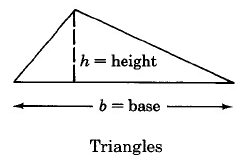
The height used in A = b × h ÷ 2 is the perpendicular distance to the base, not a sloping side. A triangle covers half the area of a matching base-by-height rectangle.
Use a perpendicular height — Denny Burzynski and Wade Ellis, Jr. / OpenStax CNX, via Mathematics LibreTexts. CC BY. Source image reproduced unchanged.
You've used your 1 free study guide
Your free topic allowance is shared across Reading, Math, Science and English. This first section is a preview. Unlock every study-guide
topic — full lessons, inline checks, the complete practice bank +
timed exam simulation — with a free trial.
Your one free topic stays free, always.
$0 today — card required to start your trial. Cancel anytime before day 3.
Already subscribed? Log in.