Math · Ratios & measurement
Ratios and Proportions
Estimated time includes reading and one quiz. Take the time you need.
Start here: key ideas
- A ratio compares two quantities in a stated order.
- Equivalent ratios multiply or divide both quantities by the same nonzero number.
- A proportion states that two ratios are equal.
- A relationship is proportional only when its unit ratio stays constant.
What you’ll be able to do
- Write ratios in equivalent forms while keeping units in the same order.
- Solve proportions by scaling and verify them with cross-products.
- Recognize when two quantities are not proportional.
A ratio compares two quantities in a stated order. Equivalent ratios multiply or divide both quantities by the same nonzero number.
Optional review
If you’d like to review the basics, visit Fractions: Operations and Mixed Numbers. You can start this lesson without completing those first.
Keep the comparison and units in order
A ratio is a comparison by division. “3 red tubes for every 5 blue tubes” can be written 3 to 5, 3:5, or 3/5. The order matters because 3/5 describes red compared with blue, while 5/3 describes blue compared with red. Include units when they differ: 120 miles/3 hours, not just 120/3.
A part-to-part ratio compares categories. With 2 red and 3 blue tubes, red:blue is 2:3. A part-to-whole ratio compares a category with the total: red:all is 2:(2+3)=2:5.
To simplify a ratio, divide both terms by the same common factor. For 18:24, divide both by 6 to get 3:4. Simplifying does not change the comparison.
Build equivalent ratios
Two equivalent ratios describe the same relationship. Apply one scale factor to both entries. If 2 cups of rice serve 5 people, multiplying both by 3 gives 6 cups for 15 people.
Scroll the table sideways if needed.
| Cups | People | Scale from 2:5 |
|---|---|---|
| 2 | 5 | ×1 |
| 4 | 10 | ×2 |
| 6 | 15 | ×3 |
Equivalent ratios preserve the comparison
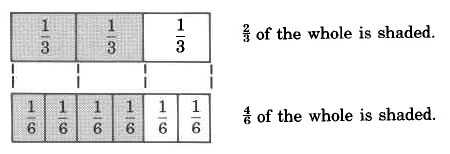
Multiplying both terms of 2:3 by 2 gives 4:6. The figure shows the same fraction of a whole; the table above applies the same scaling rule to two compared quantities.
Equivalent ratios preserve the comparison — Denny Burzynski and Wade Ellis, Jr. / OpenStax CNX, via Mathematics LibreTexts. CC BY. Source image reproduced unchanged.
Solve and verify proportions
A proportion is an equation between two ratios. Worked example 1: Four notebooks cost $10. At the same price, what do 14 cost? Set 4/10 = 14/x with matching notebook and dollar positions. Scaling 4 to 14 uses 3.5, so x = 10 × 3.5 = $35. Verify: 4x = 10(14), so 4(35)=140.
Worked example 2: A mixture uses 3 mL concentrate for 8 mL water. For 20 mL water, 3/8 = c/20. Cross-products give 8c=60, so c=7.5 mL. Cross-products verify equality; the ratio meaning explains why the equation was arranged that way.
Test before using a proportion
A proportional relationship has one constant of proportionality. Divide corresponding output by input in several rows. The pairs (2,6), (4,12), and (5,15) all have y/x=3. The pairs (2,7) and (4,13) do not: 7/2 differs from 13/4. A fixed starting charge often creates a nonproportional relationship because doubling the input does not double the total.
Label corresponding ratio positions before calculating. A sentence such as “cups per serving equals cups per serving” checks that meanings and units stay aligned. A check cannot repair a reversed setup.
Scaling is fastest when one quantity is an obvious multiple; algebra is useful when it is not. Both work because the numerator and denominator are changed by the same nonzero factor.
Test proportionality with several pairs. A $5 starting fee plus $2 per mile is not proportional: one mile costs $7, but two miles cost $9, so total cost per mile is not constant. A proportional graph passes through the origin.
Finally check direction. If servings increase in a proportional recipe, every ingredient must increase. A smaller ingredient result signals an inverted scale factor.
When units differ inside a ratio, do not simplify the numbers until the units are compatible. A comparison of 2 feet to 8 inches becomes 24 inches to 8 inches, or 3:1.
Terms to remember
- ratio
- A comparison of two quantities by division.
- equivalent ratios
- Ratios that name the same comparison.
- proportion
- An equation stating that two ratios are equal.
- scale factor
- The multiplier that changes one equivalent ratio into another.
- cross-product
- A product made from diagonally opposite terms of a proportion.
- constant of proportionality
- The unchanged unit rate in a proportional relationship.
Your quick summary
- A ratio compares two quantities in a stated order.
- Equivalent ratios multiply or divide both quantities by the same nonzero number.
- A proportion states that two ratios are equal.
- A relationship is not proportional when equivalent input ratios do not produce one constant output ratio.
Lesson quiz
Check what you learned, then review the explanations. This quiz saves results on this device only. Sign in to save quiz results to your account.
You've got the concept — now drill it like the real TEAS
Unlock the full practice bank, timed full-length exam simulation, and practice across topics. Your free lesson and its lesson quiz stay available.
Unlock practice — free for 3 days$0 today; then $19.99/month after 3 days. Card required. Cancel before renewal to avoid a charge.