Math · Numbers, fractions & decimals
Fractions: Operations and Mixed Numbers
Estimated time includes reading and one quiz. Take the time you need.
Start here: key ideas
- Add or subtract only after naming equal-size parts.
- Multiply numerators and denominators, then simplify.
- Divide by multiplying by the reciprocal.
- Convert mixed numbers before multiplying or dividing.
- Estimate before accepting an answer.
What you’ll be able to do
- Find common denominators and simplify.
- Multiply, divide, and convert mixed numbers.
- Estimate to test reasonableness.
Use denominator meaning to choose the operation, then simplify and estimate.
Fractions name equal parts
A denominator tells how many equal parts make one whole; a numerator tells how many parts are selected. Equivalent fractions name the same quantity, such as 1/2 and 3/6. Multiply or divide numerator and denominator by the same nonzero number to rename without changing value. A fraction is simplified when numerator and denominator share no factor greater than 1.
Different pieces, same amount
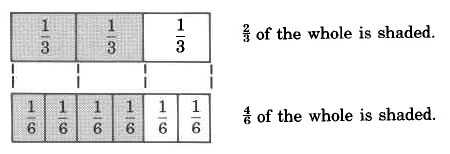
The shaded amounts are equal: 2/3 = 4/6. Cutting each third into two pieces doubles both the number of shaded pieces and the total number of pieces, without changing the amount.
Different pieces, same amount — Denny Burzynski and Wade Ellis, Jr. / OpenStax CNX, via Mathematics LibreTexts. CC BY. Source image reproduced unchanged.
You've used your 1 free study guide
Your free topic allowance is shared across Reading, Math, Science and English. This first section is a preview. Unlock every study-guide
topic — full lessons, inline checks, the complete practice bank +
timed exam simulation — with a free trial.
Your one free topic stays free, always.
$0 today — card required to start your trial. Cancel anytime before day 3.
Already subscribed? Log in.