Math · Numbers, fractions & decimals
Fractions, Decimals, and Percents
Estimated time includes reading and one quiz. Take the time you need.
Start here: key ideas
- Fraction to decimal means numerator divided by denominator.
- Decimal to percent moves the decimal two places right.
- Percent to decimal moves it two places left.
- Write percent over 100, then simplify.
What you’ll be able to do
- Convert among fractions, decimals, and percents.
- Recall benchmark equivalents.
- Choose a useful representation for comparison.
Treat fraction, decimal, and percent as three names for one quantity.
Optional review
If you’d like to review the basics, visit Fractions: Operations and Mixed Numbers, Decimals and Place Value Operations. You can start this lesson without completing those first.
One amount, three names
A percent is a ratio per hundred. The statements 3/4, 0.75, and 75% are equivalent: they name the same point on the number line. A benchmark is a familiar equivalent used for quick comparison: 1/2=0.5=50%, 1/4=0.25=25%, and 3/4=0.75=75%.
Percent means divide by 100
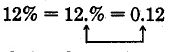
12% means 12 out of 100. Dividing 12 by 100 gives 0.12. Think about the hundredths meaning rather than memorizing a direction alone.
Percent means divide by 100 — Denny Burzynski and Wade Ellis, Jr. / OpenStax CNX, via Mathematics LibreTexts. CC BY. Source image reproduced unchanged.
You've used your 1 free study guide
Your free topic allowance is shared across Reading, Math, Science and English. This first section is a preview. Unlock every study-guide
topic — full lessons, inline checks, the complete practice bank +
timed exam simulation — with a free trial.
Your one free topic stays free, always.
$0 today — card required to start your trial. Cancel anytime before day 3.
Already subscribed? Log in.