Math · Ratios & measurement
Measurement Systems and Unit Conversions
Estimated time includes reading and one quiz. Take the time you need.
Start here: key ideas
- A conversion factor equals one, so it changes units without changing the amount.
- Arrange conversion factors so unwanted units cancel.
- Metric prefixes follow powers of ten.
- Between systems, use the supplied factor and keep US liquid units distinct from Imperial units.
- Area and volume require squaring or cubing the entire length conversion.
What you’ll be able to do
- Convert within metric and customary systems.
- Use conversion factors so unwanted units cancel.
- Apply conversion factors correctly to squared and cubed units.
- Convert length, mass and capacity between customary and metric units using supplied factors.
A conversion factor equals one, so it changes units without changing the amount. Arrange conversion factors so unwanted units cancel.
Optional review
If you’d like to review the basics, visit Ratios and Proportions. You can start this lesson without completing those first.
Know the relationships
A conversion factor can be written in either direction because its numerator and denominator are equal amounts.
Scroll the table sideways if needed.
| Quantity | Metric relationships | Customary relationships |
|---|---|---|
| Length | 1 km = 1,000 m; 1 m = 100 cm | 1 ft = 12 in; 1 yd = 3 ft; 1 mi = 5,280 ft |
| Mass/weight | 1 kg = 1,000 g; 1 g = 1,000 mg | 1 lb = 16 oz |
| Capacity | 1 L = 1,000 mL | 1 gal = 4 qt; 1 qt = 2 pt; 1 pt = 2 cups |
Cancel units through a conversion chain
Dimensional analysis makes the unit plan visible. Worked example 1: Convert 5.5 feet to inches: 5.5 ft × (12 in/1 ft)=66 in. Feet cancel, leaving inches. If the unwanted unit does not cancel, flip the factor before calculating.
For several steps, keep chaining. To convert 2.5 hours to seconds: 2.5 hr × (60 min/1 hr) × (60 s/1 min)=9,000 s. Each intermediate unit cancels.
Use place value in metric conversions
Metric prefixes change by powers of ten. Moving from a larger unit to a smaller unit creates more units, so the number grows: 3.2 L = 3,200 mL. Moving from milligrams to grams makes the number smaller: 750 mg = 0.750 g. A magnitude check catches reversed movement.
Kilograms to grams
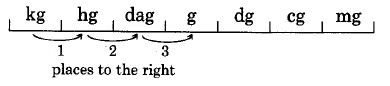
Each step toward a smaller metric unit multiplies the number by 10. Three steps from kilograms to grams multiply by 1,000. The intermediate labels mean hectogram (hg) and decagram (dag); you do not need to use them to calculate 1 kg = 1,000 g.
Kilograms to grams — Denny Burzynski and Wade Ellis, Jr. / OpenStax CNX, via Mathematics LibreTexts. CC BY. Source image reproduced unchanged.
Convert between customary and metric units
A conversion between systems changes the unit family, not the physical amount. Use the factor supplied in the question. Write it so the starting unit cancels; then check whether the new number should be larger or smaller.
Scroll the table sideways if needed.
| Quantity | Example relationship |
|---|---|
| Length | 1 inch = 2.54 centimeters |
| Mass | 1 kilogram ≈ 2.2 pounds |
| Capacity | 1 US liquid gallon ≈ 3.785 liters |
Worked length example: 18 in × (2.54 cm / 1 in) = 45.72 cm. Inches cancel. In the reverse direction, 50.8 cm × (1 in / 2.54 cm) = 20 in.
Worked mass example: A 132 lb load has mass approximately 132 lb × (1 kg / 2.2 lb) = 60 kg. For 7 kg, use the opposite orientation: 7 × 2.2 = 15.4 lb. Do not multiply by 2.2 when converting pounds to kilograms.
Worked capacity example: 2 US gal × (3.785 L / US gal) = 7.570 L, or about 7.57 L. In reverse, 11.355 L ÷ 3.785 = 3 US gal using the stated factor. US and Imperial gallons are different units: do not interchange their factors. Use US fluid ounces when a US-volume factor is supplied; a fluid ounce measures volume, not ounce mass.
Precision: keep extra digits during the calculation and round the final answer as requested. An approximate factor gives an approximate result; adding decimal places cannot make that factor exact.
Square or cube the whole factor
Square units measure area, and cubic units measure volume. Worked example 2: Since 1 ft=12 in, 1 ft²=(12 in)²=144 in². Therefore 3 ft²=432 in². For volume, 1 ft³=(12 in)³=1,728 in³. Multiplying only by 12 would convert one dimension, not the entire area or volume.
Start with the given amount and multiply by factors. In 72 in×(1 ft/12 in)=6 ft, inches cancel. A factor facing the wrong way leaves unwanted units, exposing the error.
Convert before adding: 3 feet plus 18 inches is 36 inches plus 18 inches, or 54 inches—not 21 of either unit.
When a problem supplies an approximate cross-system equality, use its stated precision and label the result approximate.
Imagine every dimension changing units. A 2 ft by 3 ft rectangle becomes 24 in by 36 in, or 864 in². This agrees with 6 ft²×144 in²/ft² and shows why multiplying area by only 12 fails.
A larger named unit requires fewer units for the same amount. Therefore centimeters to meters should make the number smaller, while meters to centimeters should make it larger. Use this direction check before accepting a decimal shift.
Conversion does not change physical quantity. If a conversion makes a person’s mass thousands of kilograms or a room only millimeters long, review the factor orientation and powers.
Terms to remember
- conversion factor
- A ratio of equal measurements that equals one.
- dimensional analysis
- A method that multiplies by conversion factors and cancels units.
- metric system
- A base-ten measurement system.
- customary system
- The U.S. system using units such as inches, feet, pounds, and gallons.
- square unit
- A unit for area formed by multiplying two lengths.
- cubic unit
- A unit for volume formed by multiplying three lengths.
Your quick summary
- A conversion factor equals one, so it changes units without changing the amount.
- Arrange conversion factors so unwanted units cancel.
- Metric prefixes follow powers of ten.
- For squared or cubed measurements, square or cube the entire linear conversion factor.
- Between systems, use the stated factor, cancel the old unit, and round only the final result. US and Imperial liquid units are not interchangeable.
Lesson quiz
Check what you learned, then review the explanations. This quiz saves results on this device only. Sign in to save quiz results to your account.
You've got the concept — now drill it like the real TEAS
Unlock the full practice bank, timed full-length exam simulation, and practice across topics. Your free lesson and its lesson quiz stay available.
Unlock practice — free for 3 days$0 today; then $19.99/month after 3 days. Card required. Cancel before renewal to avoid a charge.