Science · Support & movement
Muscles and Contraction
Estimated time includes reading and one quiz. Take the time you need.
Start here: key ideas
- Skeletal, cardiac, and smooth muscle have different locations and controls.
- A sarcomere shortens when actin slides past myosin.
- Calcium exposes binding sites, and ATP powers cross-bridge cycling.
- Motor units and opposing muscles control force and movement.
What you’ll be able to do
- Compare the three muscle tissue types.
- Explain how a sarcomere contracts.
- Connect motor units and opposing muscles to movement.
Follow a muscle signal from the motor neuron to force and relaxation.
Optional review
If you’d like to review the basics, visit Skeleton and Bone Structure, Joints and Movement. You can start this lesson without completing those first.
Three tissues, three control patterns
Skeletal muscle attaches to bones, is striated, and is usually under voluntary control. Cardiac muscle forms the heart, is striated, and contracts without conscious control. Its branched cells connect through intercalated discs. Smooth muscle is in hollow organs and vessels. It lacks visible striations and moves materials or changes tube width automatically.
Structure fits each job. Skeletal fibers can produce quick, directed movement. Cardiac cells connect electrically so the heart contracts as a coordinated pump. Smooth muscle contracts more slowly and can maintain pressure or move material for long periods, as in blood vessels and intestines.
From whole muscle to fibers
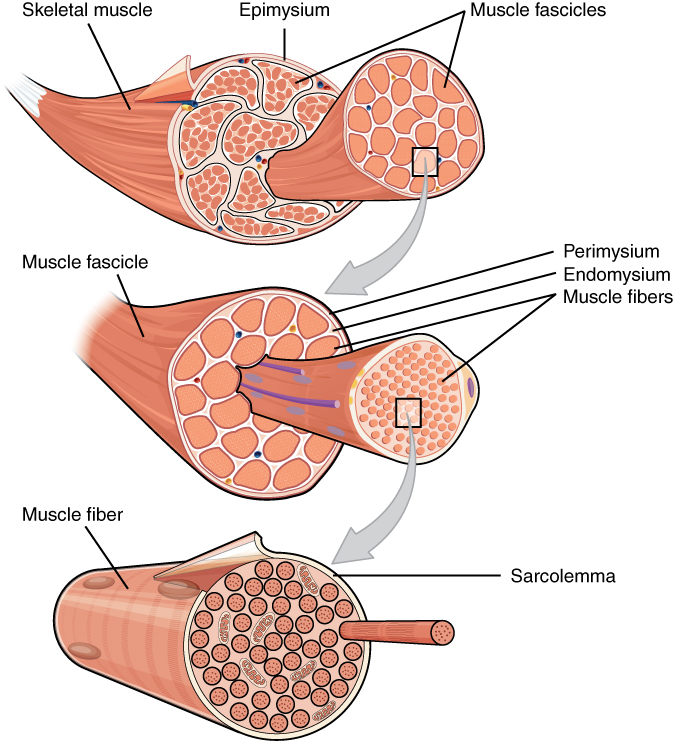
Read from large to small: whole muscle → bundles → muscle cells (fibers) → myofibrils → repeating units called sarcomeres. The extra labels for tissue coverings help locate parts; they are not a required name list.
From whole muscle to fibers — OpenStax College, Anatomy & Physiology (2014 CC BY archive). CC BY 3.0. Original source image reproduced unchanged; explanatory caption added.

Filaments slide; they do not shrink
A muscle fiber contains myofibrils made of repeating sarcomeres. Each sarcomere contains thin actin and thick myosin filaments. During contraction, myosin heads pull actin inward. The filaments slide; they do not shrink. The sarcomere becomes shorter, so the whole muscle fiber can shorten.
Optional diagram labels: sarcomere bands
Z discs mark each sarcomere’s ends. As actin slides inward, the Z discs move closer and the overlap between actin and myosin increases. The A band, which matches thick-filament length, stays the same. The I band and H zone become smaller. These changes show sliding rather than shrinking filaments.
Diagram guide: muscle → bundle (fascicle) → muscle cell (fiber) → myofibril → sarcomere. Follow the repeating units; the essential mechanism is increased overlap of actin and myosin, not shortening of the filaments.
Filaments slide rather than shrink
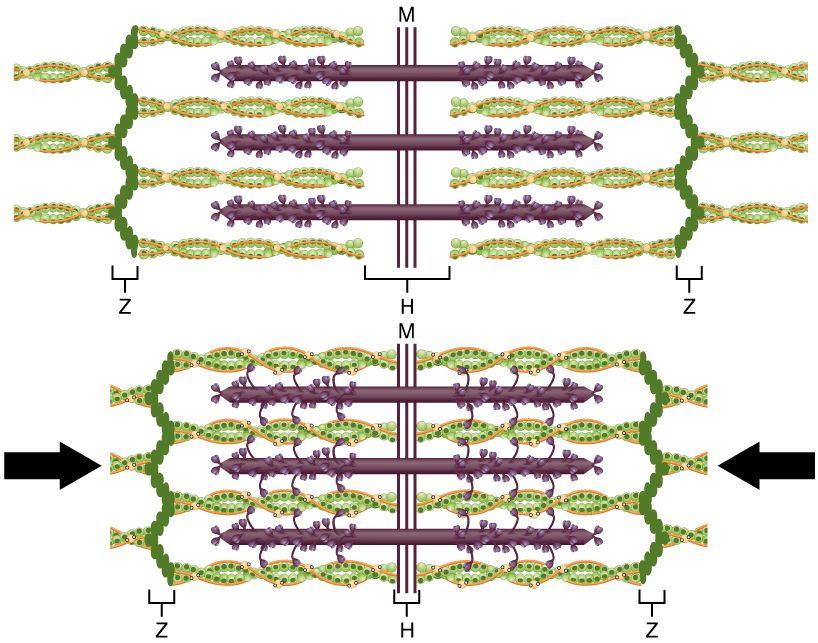
The actin and myosin filaments slide past each other. They do not get shorter. Their increased overlap pulls the ends (Z discs) closer together, shortening the sarcomere. The band labels show that change; focus on sliding, not shrinking filaments.
Filaments slide rather than shrink — OpenStax College, Anatomy & Physiology (2014 CC BY archive). CC BY 3.0. Original source image reproduced unchanged; explanatory caption added.

From motor neuron to relaxation
A motor neuron releases acetylcholine at the neuromuscular junction. The muscle membrane carries the signal inward. The sarcoplasmic reticulum releases calcium. Calcium exposes binding sites on actin. Myosin binds and pulls, using ATP. ATP also lets myosin release and reset. When stimulation stops, calcium is pumped back into storage and the fiber relaxes.
Calcium binds troponin, causing tropomyosin to move away from actin’s binding sites. A myosin head can then attach, pull, release when ATP binds, and reset after ATP is split. Without ATP, myosin cannot release normally. Without calcium, the binding sites stay covered.
Worked example: A toxin blocks calcium release from storage. The nerve signal and muscle action potential can still occur, but actin binding sites stay covered. Few cross-bridges form, so contraction is weak. The failure occurs after the electrical signal but before filament pulling.
After signaling, an enzyme breaks down acetylcholine at the neuromuscular junction. Its name, acetylcholinesterase, is a supporting label for this signal-ending function.
Motor units and opposing actions
A motor unit is one motor neuron and its muscle fibers. Activating more motor units usually increases force. Muscles can only pull, so they often work in opposing pairs. During elbow flexion, the biceps is the main agonist and the triceps is the antagonist. Their roles reverse during extension.
Worked example: Lifting an empty cup needs little force, so the nervous system activates fewer motor units. Lifting a full bucket requires more force, so it recruits more motor units and increases their firing. If the opposing muscle contracts strongly too, movement slows because the two pulls resist each other.
Muscle pulls produce joint movement
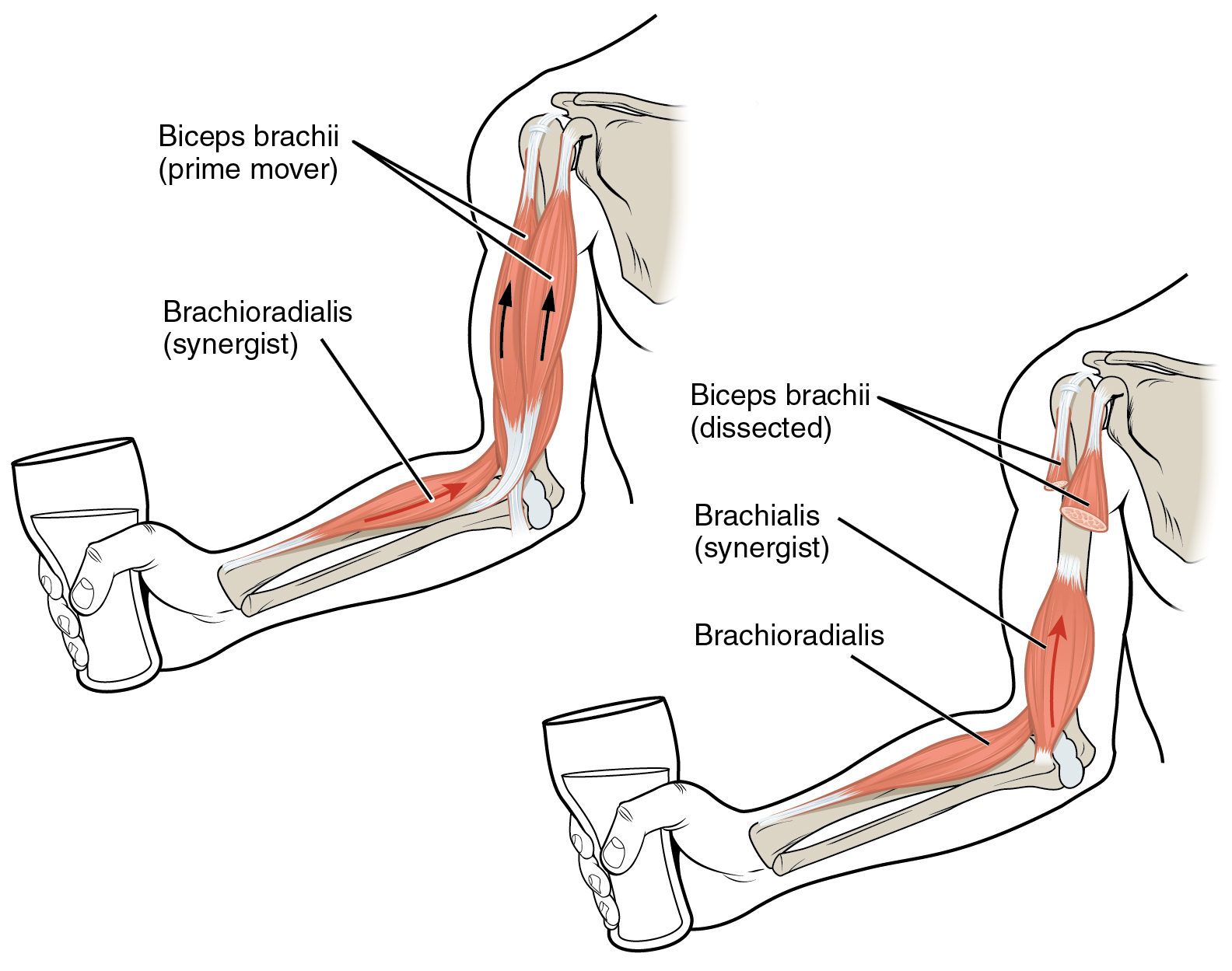
These muscles work together to bend the elbow. Which one contributes most changes with forearm position. You do not need to memorize every helper muscle in this figure. Remember the main rule: muscles pull; they do not push.
Muscle pulls produce joint movement — OpenStax College, Anatomy & Physiology (2014 CC BY archive). CC BY 3.0. Original source image reproduced unchanged; explanatory caption added.

Terms to remember
- sarcomere
- The repeating contractile unit in skeletal and cardiac muscle.
- actin
- The thin filament in a sarcomere.
- myosin
- The thick filament whose heads pull actin.
- motor unit
- One motor neuron and all muscle fibers it controls.
- agonist
- The main muscle producing a movement.
- antagonist
- A muscle that opposes the movement.
- ATP
- The direct energy source for muscle cycling and release.
Your quick summary
- Skeletal muscle is voluntary; cardiac and smooth muscle are involuntary.
- Actin and myosin slide past each other; the filaments do not shorten.
- Calcium and ATP are both required for normal contraction.
Lesson quiz
Check what you learned, then review the explanations. This quiz saves results on this device only. Sign in to save quiz results to your account.
You've got the concept — now drill it like the real TEAS
Unlock the full practice bank, timed full-length exam simulation, and practice across topics. Your free lesson and its lesson quiz stay available.
Unlock practice — free for 3 days$0 today; then $19.99/month after 3 days. Card required. Cancel before renewal to avoid a charge.