Science · Support & movement
Joints and Movement
Estimated time includes reading and one quiz. Take the time you need.
Start here: key ideas
- A joint is where two or more bones meet.
- Fibrous, cartilaginous, and synovial joints differ in structure.
- Synovial joints contain fluid and cartilage for smooth movement.
- Muscles pull on bones across joints to create movement.
What you’ll be able to do
- Classify the three structural joint types.
- Identify parts of a synovial joint.
- Use movement and lever terms in examples.
Connect joint structure with the amount and type of movement it allows.
Optional review
If you’d like to review the basics, visit Skeleton and Bone Structure. You can start this lesson without completing those first.
Structure and mobility are related, not identical
A joint is where bones meet. Fibrous joints use dense connective tissue and allow little or no movement, as in skull sutures. Cartilaginous joints join bones with cartilage and allow limited movement, as between vertebrae. Synovial joints have a fluid-filled cavity and usually allow the most movement, as at the knee. Structure predicts movement, but the categories are not perfect synonyms for fixed, slightly movable, and freely movable.
Do not judge a joint only by its location. Ask what connects the bones and whether a cavity is present. Dense fibers point to a fibrous joint, cartilage between bones points to a cartilaginous joint, and a capsule around a fluid space points to a synovial joint.
Synovial joints also differ by shape. A hinge joint mainly bends and straightens, as at the elbow. A pivot joint allows rotation, as in the upper neck. A ball-and-socket joint moves in many planes and rotates, as at the shoulder and hip.
The synovial membrane lining the joint capsule produces synovial fluid, which lubricates the moving surfaces.
A low-friction, stabilized cavity
In a synovial joint, smooth articular cartilage covers bone ends. Synovial fluid reduces friction. A capsule surrounds the space. Ligaments connect bone to bone and add stability. Tendons connect muscle to bone and carry the muscle’s pull. A torn ligament affects joint stability; it is not the same as a torn tendon.
Cartilage has little direct blood supply, so it repairs slowly. Bursae are small fluid-filled sacs that reduce rubbing near some joints. Menisci are cartilage pads that improve fit and spread force in joints such as the knee. These structures support smooth motion but do not create the muscle force.
Keep connective structures distinct. A ligament joins bone to bone and helps stabilize a joint; a tendon joins muscle to bone and transmits muscle force. Articular cartilage reduces friction and distributes load at bone ends, while synovial fluid lubricates the joint cavity. A movement problem caused by a torn tendon is therefore not the same as joint instability from a torn ligament.
Structures of a synovial joint
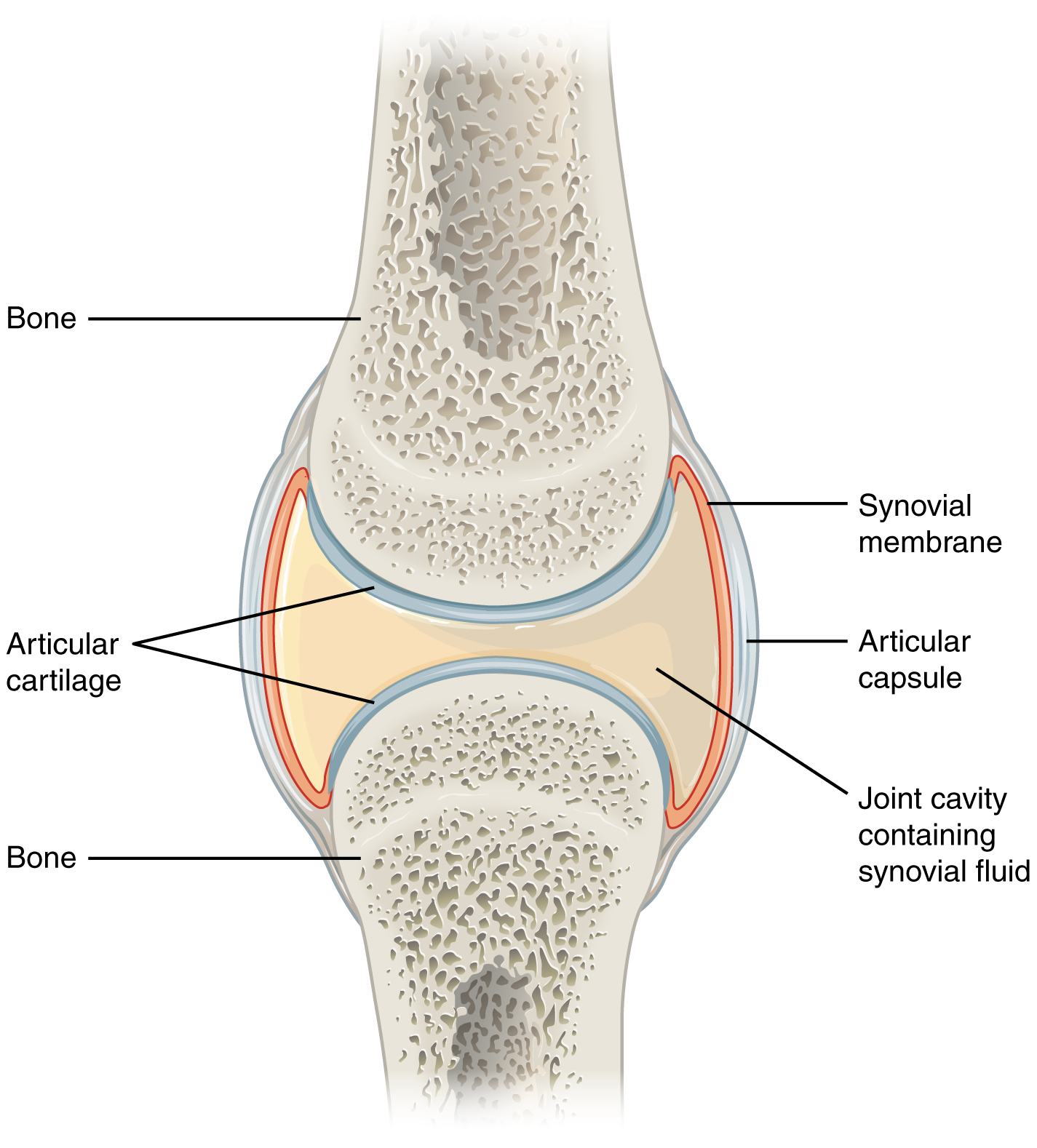
Cartilage covers the bone ends where they meet. Synovial fluid reduces rubbing. The inner lining makes that fluid. The outer capsule holds the joint together.
Structures of a synovial joint — OpenStax College, Anatomy & Physiology (2014 CC BY archive). CC BY 3.0. Original source image reproduced unchanged; explanatory caption added.

Name the change in angle or direction
Flexion decreases a joint angle, such as bending the elbow. Extension increases the angle. Abduction moves a part away from the midline; adduction brings it back. Rotation turns a bone around its long axis. Circumduction makes a cone-shaped path by combining movements.
Use anatomical position as the reference. Moving the arm sideways away from the trunk is abduction; bringing it back is adduction. Turning the palm upward is supination, and turning it downward is pronation. Plantar flexion points the toes down; dorsiflexion brings them toward the shin.
Joint shape constrains movement
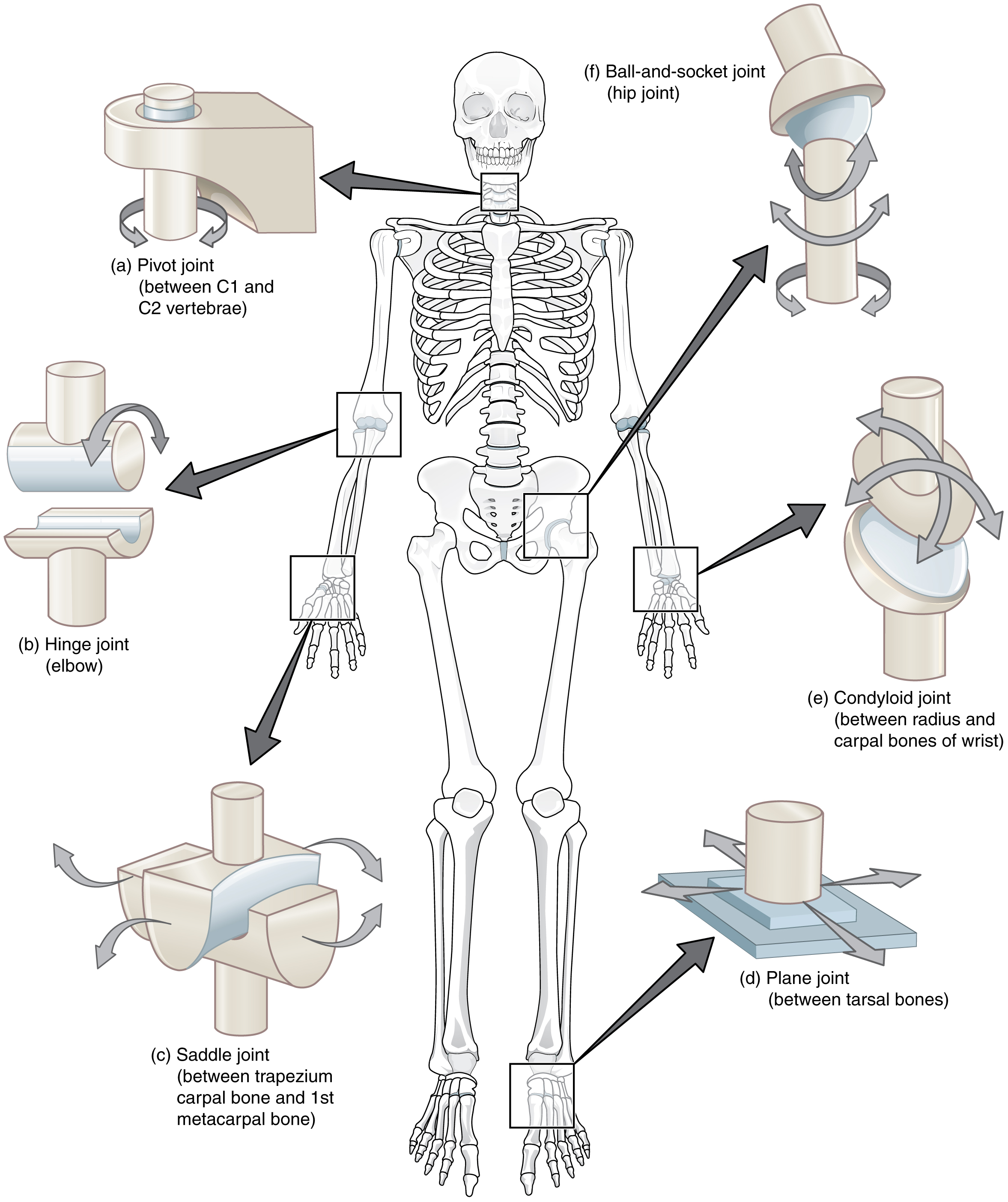
Shape helps determine movement. A hinge bends and straightens. A pivot allows turning. A ball-and-socket allows movement in several directions. These examples are synovial joints. Do not use them to assume every other joint is completely immovable.
Joint shape constrains movement — OpenStax College, Anatomy & Physiology (2014 CC BY archive). CC BY 3.0. Original source image reproduced unchanged; explanatory caption added.

Force, fulcrum, load, and range
A bone acts as a lever. A joint is the fulcrum, muscle force is the effort, and the body part or object is the load. Most body levers favor speed and range of motion rather than force. Moving a weight farther from a joint increases the turning demand, so the muscle must create more force.
Worked example: Hold a book close to your elbow, then hold it at arm’s length. The book weighs the same, but the longer distance from the elbow creates a larger turning effect. The elbow flexors must pull harder. This shows why load position changes effort.
Terms to remember
- joint
- A place where bones meet.
- ligament
- A band connecting bone to bone.
- tendon
- A cord connecting muscle to bone.
- synovial joint
- A freely movable joint with a fluid-filled cavity.
- flexion
- Movement that decreases a joint angle.
- extension
- Movement that increases a joint angle.
- lever
- A rigid bar that turns around a fulcrum.
Your quick summary
- Fibrous joints move least; synovial joints usually move most.
- Cartilage, fluid, ligaments, and tendons have different jobs.
- Flexion closes an angle; extension opens it.
Lesson quiz
Check what you learned, then review the explanations. This quiz saves results on this device only. Sign in to save quiz results to your account.
You've got the concept — now drill it like the real TEAS
Unlock the full practice bank, timed full-length exam simulation, and practice across topics. Your free lesson and its lesson quiz stay available.
Unlock practice — free for 3 days$0 today; then $19.99/month after 3 days. Card required. Cancel before renewal to avoid a charge.