Science · Cells, genes & microorganisms
Microorganisms, Disease, and Transmission
Estimated time includes reading and one quiz. Take the time you need.
Start here: key ideas
- Bacteria are cells; viruses are not cells.
- Fungi and protozoa are eukaryotes.
- A pathogen causes disease, but many microbes are harmless or helpful.
- Disease spreads through a chain of connected steps.
- Antibiotics treat bacteria, not viruses.
- Resistance becomes common when resistant microbes survive and reproduce.
What you’ll be able to do
- Compare bacteria, viruses, fungi, and protozoa.
- Explain the chain of infection.
- Choose prevention steps for a route of spread.
- Explain basic antibiotic resistance.
Compare major microbe groups, trace disease spread, and connect prevention or treatment to the correct target.
Optional review
If you’d like to review the basics, visit Immune and Lymphatic Systems. You can start this lesson without completing those first.
Microbial groups differ in cellular organization
Bacteria are single-celled prokaryotes. Viruses are not cells and must use a host cell to reproduce. Fungi are eukaryotes such as yeasts and molds. Protozoa are single-celled eukaryotes.
These groups differ in structure, so one treatment does not work for all of them. Antibiotics target bacterial features and do not kill viruses.
Bacteria reproduce by cell division. Viruses cannot reproduce independently; their genetic material enters a host cell and directs the host to make viral parts. Fungi differ from bacteria in cell type and chemistry. Many fungal walls contain chitin, a tough material. Molds grow as tiny threads called hyphae. Many protozoa move through water or hosts.
| Category | Cellular organization | Replication clue |
|---|---|---|
| Bacterium | Prokaryotic cell | Can divide independently under suitable conditions |
| Virus | Acellular | Requires a host cell to make new viral particles |
| Fungus | Eukaryotic; yeast may be unicellular, molds multicellular | Own cellular reproduction |
| Protozoan | Single-celled eukaryote | Own cellular reproduction, often within a host life cycle |
| Helminth | Multicellular animal parasite | Life cycle may include microscopic eggs or larvae |
“Microbe” is a practical umbrella term here, not a claim that every member is a microscopic cellular organism. Viruses are acellular, and adult helminths may be visible even though microscopic stages are important in disease.
A bacteriophage is a virus that infects bacteria
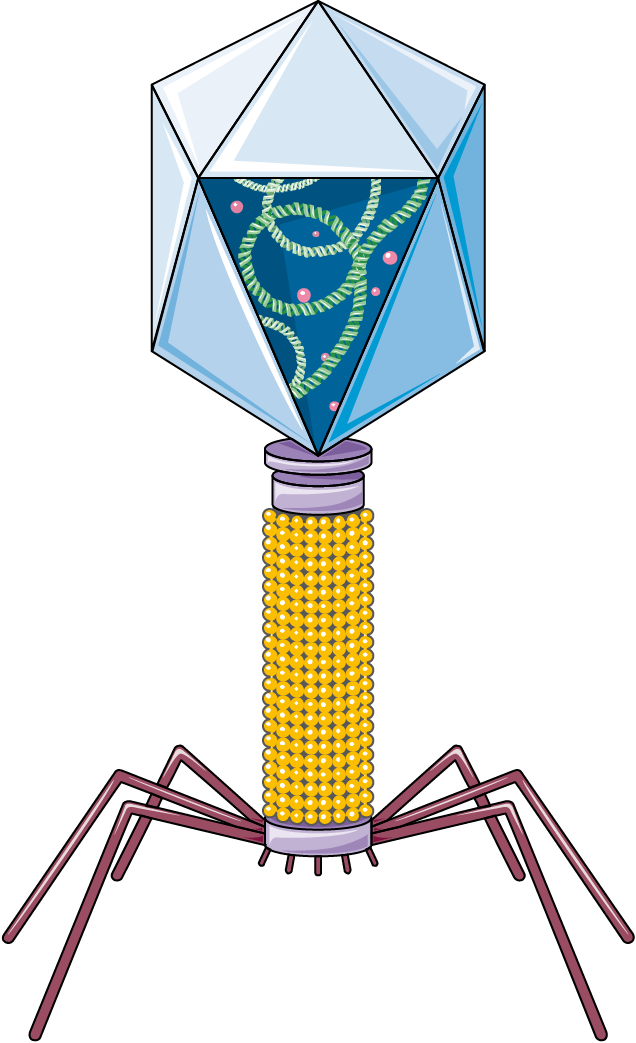
This is a bacteriophage: a virus that infects bacteria. Its head holds genetic material; its tail and fibers help it attach. Other viruses can have different shapes and hosts. A virus must use a host cell to make more viruses.
A bacteriophage is a virus that infects bacteria — Servier Medical Art by Servier. CC BY 4.0. Source image reproduced unchanged; explanatory caption added.
You've used your 1 free study guide
Your free topic allowance is shared across Reading, Math, Science and English. This first section is a preview. Unlock every study-guide
topic — full lessons, inline checks, the complete practice bank +
timed exam simulation — with a free trial.
Your one free topic stays free, always.
$0 today — card required to start your trial. Cancel anytime before day 3.
Already subscribed? Log in.