Science · Regulation & defense
Integumentary System and Thermoregulation
Estimated time includes reading and one quiz. Take the time you need.
Start here: key ideas
- The epidermis is the outer barrier; the dermis supports it.
- Skin limits water loss and blocks many hazards.
- Sweat and skin blood vessels help control temperature.
- Hair, nails, and glands are skin appendages.
What you’ll be able to do
- Compare the epidermis and dermis.
- Explain barrier, sensation, and vitamin D roles.
- Explain temperature control and appendage functions.
Connect each skin layer and structure with its job.
Optional review
If you’d like to review the basics, visit Anatomical Orientation, Organization, and Homeostasis. You can start this lesson without completing those first.
Epidermis and dermis have different jobs
The epidermis is the thin outer layer. It has no blood vessels. Its keratin-filled cells make a tough, water-resistant barrier, and melanocytes make melanin. The deeper dermis contains connective tissue, blood vessels, nerves, sensory receptors, hair follicles, and glands. Below the skin, the hypodermis contains fat and connective tissue that cushion and insulate.
Epidermal cells are made in the deepest epidermal layer and move upward as they mature. Near the surface they flatten, fill with keratin, and die. They are eventually shed. Because epidermis lacks vessels, nutrients diffuse to it from vessels in the dermis.
Skin layers and appendages
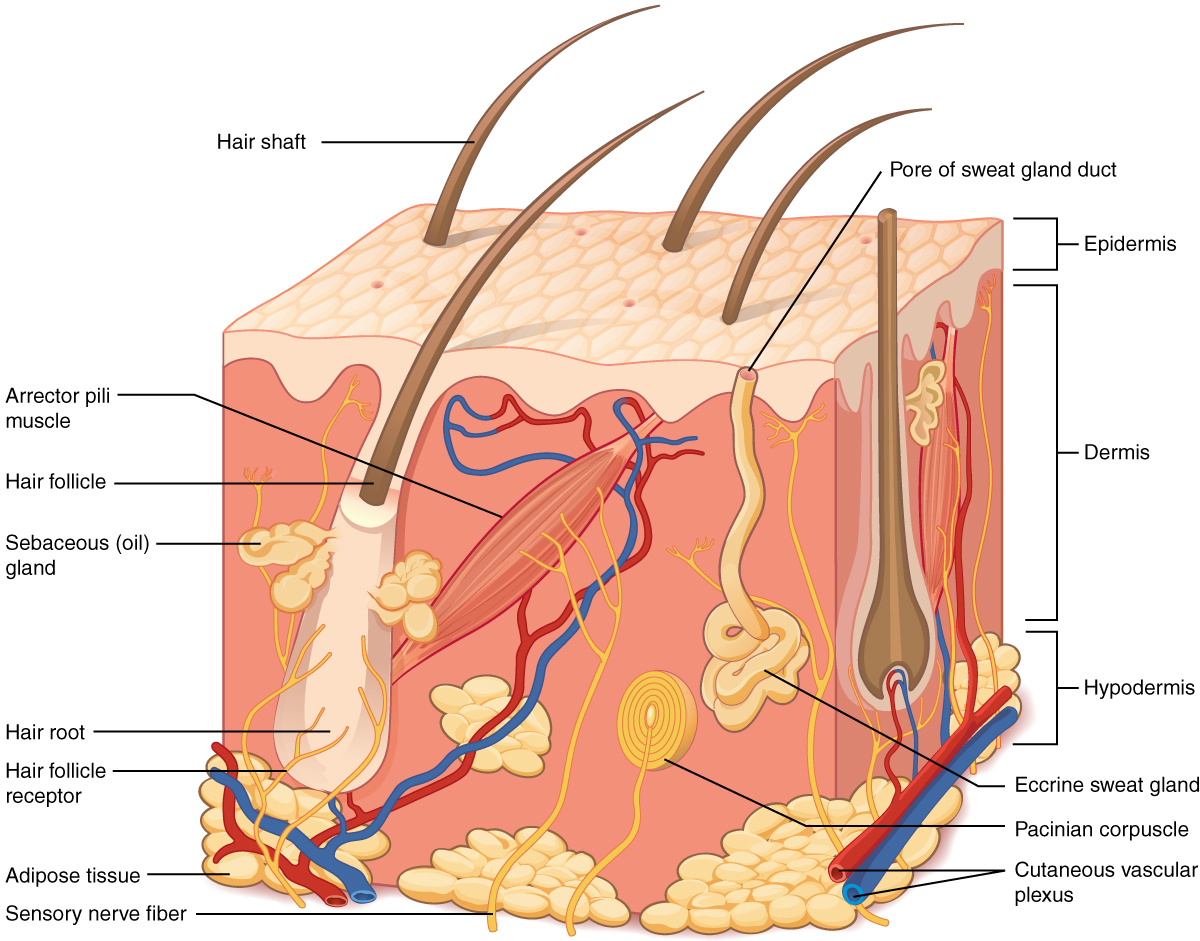
The epidermis is the outer barrier and has no blood vessels. The dermis beneath it contains blood vessels, nerves, and glands. The fatty hypodermis lies below the skin itself. Sweat evaporation and changes in skin blood flow help control heat loss.
Skin layers and appendages — OpenStax College, Anatomy & Physiology (2014 CC BY archive). CC BY 3.0. Original source image reproduced unchanged; explanatory caption added.

You've used your 1 free study guide
Your free topic allowance is shared across Reading, Math, Science and English. This first section is a preview. Unlock every study-guide
topic — full lessons, inline checks, the complete practice bank +
timed exam simulation — with a free trial.
Your one free topic stays free, always.
$0 today — card required to start your trial. Cancel anytime before day 3.
Already subscribed? Log in.