Science · Body foundations
Anatomical Orientation, Organization, and Homeostasis
Estimated time includes reading and one quiz. Take the time you need.
Start here: key ideas
- Anatomical position gives everyone the same body map.
- Directional terms compare one body part with another.
- Cells form tissues, tissues form organs, and organs form systems.
- Negative feedback reverses a change to keep conditions stable.
What you’ll be able to do
- Use body directions, planes, and cavities.
- Put cells, tissues, organs, and systems in order.
- Explain how negative feedback supports homeostasis.
Use one standard body map, then follow how the body detects and corrects change.
A shared map for the body
Picture a person standing upright, facing forward, with palms forward. This is anatomical position. It keeps directions consistent. Superior means toward the head; inferior means toward the feet. Anterior means front; posterior means back. Medial means toward the midline; lateral means away from it. On a limb, proximal means closer to the attachment and distal means farther away. The elbow is proximal to the wrist.
A sagittal plane divides left and right. A frontal plane divides front and back. A transverse plane divides upper and lower parts. The dorsal cavity holds the brain and spinal cord. The ventral cavity includes the chest and abdominopelvic cavities.
Superficial means near the body surface, while deep means farther inside. Cavities also give location. The cranial cavity holds the brain, and the vertebral cavity holds the spinal cord. The thoracic cavity is above the diaphragm. The abdominal and pelvic cavities are below it. These words can be combined without changing their meanings when a person sits or lies down.
ATI focus—read relations from the subject, not the viewer: In a front-facing diagram, the subject’s right appears on the viewer’s left. Direction words compare two structures: the thumb is lateral to the little finger in anatomical position, while the skin is superficial to muscle. Reserve proximal and distal mainly for positions along a limb. A regional label may narrow location, but regions are supporting vocabulary; prioritize planes and relational terms over memorizing long region lists.
Directional terms in anatomical position
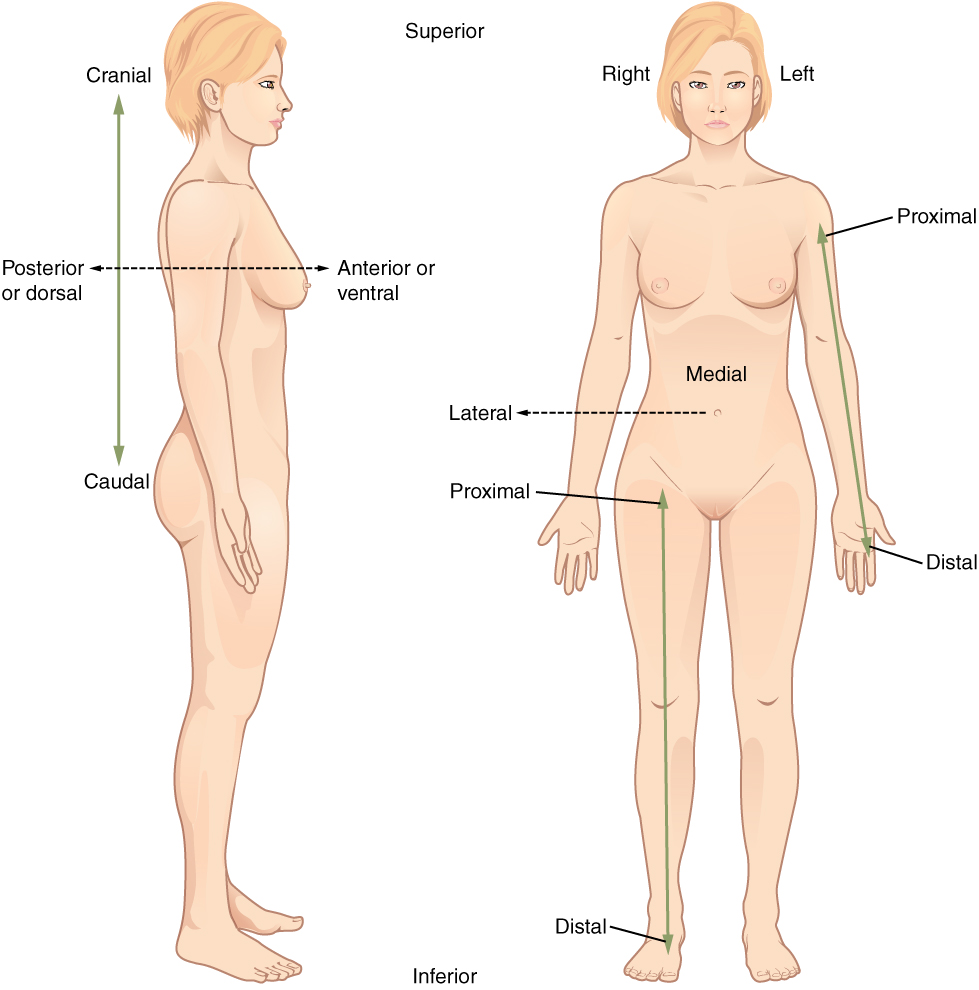
Use the pictured person’s right and left, not yours. Medial means toward the center line; lateral means away. Proximal is nearer where a limb attaches; distal is farther away. The elbow is distal to the shoulder but proximal to the wrist.
Directional terms in anatomical position — OpenStax College, Anatomy & Physiology (2014 CC BY archive). CC BY 3.0. Original source image reproduced unchanged; explanatory caption added.

Three anatomical planes
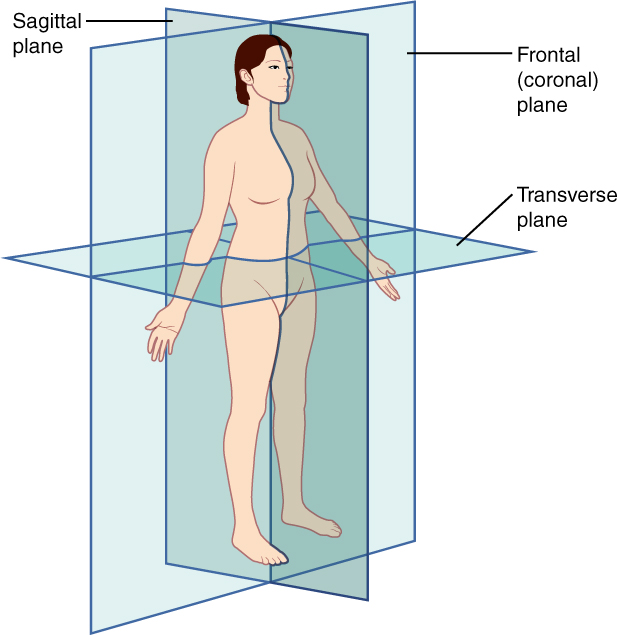
Sagittal separates left and right. Frontal separates front and back. Transverse separates top and bottom. Midsagittal means equal left and right halves. These are imaginary cuts used to describe the body.
Three anatomical planes — OpenStax College, Anatomy & Physiology (2014 CC BY archive). CC BY 3.0. Original source image reproduced unchanged; explanatory caption added.

You've used your 1 free study guide
Your free topic allowance is shared across Reading, Math, Science and English. This first section is a preview. Unlock every study-guide
topic — full lessons, inline checks, the complete practice bank +
timed exam simulation — with a free trial.
Your one free topic stays free, always.
$0 today — card required to start your trial. Cancel anytime before day 3.
Already subscribed? Log in.