Science · Scientific investigation
Data, Evidence, and Scientific Explanations
Estimated time includes reading and one quiz. Take the time you need.
Start here: key ideas
- An observation is directly measured or noticed.
- An inference is an interpretation of observations.
- A conclusion answers the question using evidence.
- A trend describes an overall pattern, not every point.
- Variation and uncertainty limit confidence.
- Strong reasoning explains why evidence supports a claim.
What you’ll be able to do
- Tell observation from inference and conclusion.
- Describe a trend without ignoring variation.
- Judge whether evidence supports a claim.
- Connect claims, evidence, and reasoning.
Separate observations from interpretations, read trends with uncertainty, and build evidence-based explanations.
Optional review
If you’d like to review the basics, visit Experimental Design and the Scientific Method. You can start this lesson without completing those first.
Separate what was seen from what it may mean
An observation states what was directly measured or noticed: “The liquid temperature rose from 20°C to 28°C.” An inference interprets that fact: “A reaction may have released heat.”
A conclusion answers the study question using the results. Keep these steps separate so an interpretation is not presented as a direct measurement.
Use neutral wording for observations. “Five plants were 2 cm taller” reports data. “The treatment made plants healthier” adds an interpretation unless health was directly defined and measured.
Read patterns with variation
A trend is an overall pattern. A graph may generally rise even if one point falls. Describe the direction, size, units, and any important exception.
Repeated measurements often vary. Error bars or ranges show uncertainty or spread. Large overlap can make a difference less convincing, but the meaning depends on what the bars represent.
Worked example. Group A averages 12 cm and Group B averages 15 cm, but both groups range from 8 to 19 cm. The averages differ, yet the large overlap shows substantial variation. Report both the difference and the uncertainty.
Read the legend before interpreting error bars: they might show range, standard deviation or uncertainty in a mean. Overlap of ranges alone neither proves equal effects nor is a formal test of a difference. Report what the data show, sample size and variability; do not invent a significance claim.
Accuracy and precision answer different questions
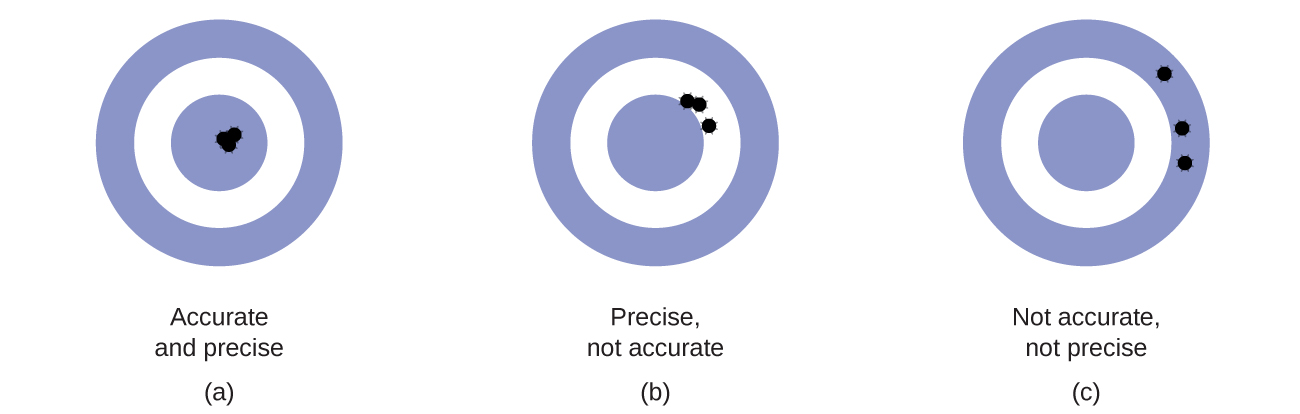
The center stands for the correct value. Marks close together show precision: repeat measurements agree. Marks near the center show accuracy: measurements are close to the correct value. A tight group away from the center is precise but not accurate. This is a comparison, not actual student data.
Accuracy and precision answer different questions — OpenStax College, Chemistry (CC BY archive). CC BY 3.0. Original source image reproduced unchanged; explanatory caption added.

Claim, evidence, reasoning
A clear explanation has a claim, evidence, and reasoning. The claim answers the question. Evidence gives relevant data. Reasoning explains why the data support the claim.
Do not claim more than the design supports. An association supports a relationship, but a controlled experiment is usually needed to support causation.
Claim: fertilizer increased average height. Evidence: treated plants averaged 15 cm and controls averaged 12 cm. Reasoning: fertilizer was the main planned difference, so the higher average supports the claim. If groups also received different water, the reasoning is weakened by a confound.
Terms to remember
- observation
- Information directly measured or noticed.
- inference
- An interpretation based on observations.
- conclusion
- A judgment that answers the study question.
- trend
- An overall pattern in data.
- uncertainty
- The range of reasonable doubt in a measurement or result.
- claim
- A statement that evidence may support or oppose.
- evidence
- Relevant data used to evaluate a claim.
Your quick summary
- Observations are directly measured or noticed.
- Inferences interpret observations.
- Conclusions answer the question.
- Trends are overall patterns.
- Variation affects confidence.
- Evidence must be relevant to the claim.
Lesson quiz
Check what you learned, then review the explanations. This quiz saves results on this device only. Sign in to save quiz results to your account.
You've got the concept — now drill it like the real TEAS
Unlock the full practice bank, timed full-length exam simulation, and practice across topics. Your free lesson and its lesson quiz stay available.
Unlock practice — free for 3 days$0 today; then $19.99/month after 3 days. Card required. Cancel before renewal to avoid a charge.