Science · Chemistry foundations
Chemical Bonds, Formulas, and Molecules
Estimated time includes reading and one quiz. Take the time you need.
Start here: key ideas
- Ionic bonds follow electron transfer and attraction between ions.
- Covalent bonds share electrons.
- Hydrogen bonds are weaker attractions between molecules or molecule parts.
- Subscripts in formulas show atom ratios.
- Bonding affects properties such as melting point and conductivity.
What you’ll be able to do
- Compare ionic, covalent, and hydrogen interactions.
- Count atoms in a chemical formula.
- Relate bond type to basic properties.
Learn three important bond types, read formulas, and connect bonding to material properties.
Optional review
If you’d like to review the basics, visit Atoms, Elements, Ions, and the Periodic Table. You can start this lesson without completing those first.
Transfer, sharing, and attractions
Atoms bond through their valence electrons. In an ionic bond, one atom transfers electrons and charged ions attract. Sodium can lose an electron to become Na+, while chlorine gains one to become Cl−.
In a covalent bond, atoms share electrons. Water is a covalent molecule. A hydrogen bond is a weaker attraction between a partly positive hydrogen and a nearby partly negative region.
Electron transfer creates ions before ionic attraction holds them together. Electron sharing holds atoms together inside a covalent molecule. Hydrogen bonds act between partly charged regions and are weaker than the covalent bonds inside a water molecule.
An ionic solid is a lattice
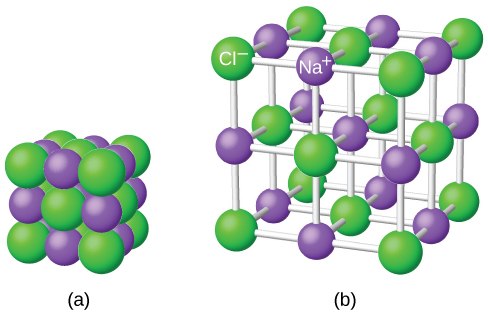
Losing or gaining electrons makes charged particles called ions. Opposite charges attract. Here, sodium and chloride ions form a repeating solid pattern. NaCl tells you their 1:1 ratio. Plus and minus signs identify the charges as well as the colors.
An ionic solid is a lattice — OpenStax College, Chemistry (CC BY archive). CC BY 3.0. Original source image reproduced unchanged; explanatory caption added.

You've used your 1 free study guide
Your free topic allowance is shared across Reading, Math, Science and English. This first section is a preview. Unlock every study-guide
topic — full lessons, inline checks, the complete practice bank +
timed exam simulation — with a free trial.
Your one free topic stays free, always.
$0 today — card required to start your trial. Cancel anytime before day 3.
Already subscribed? Log in.