Math · Numbers, fractions & decimals
Positive and Negative Numbers: Calculating and Comparing
Estimated time includes reading and one quiz. Take the time you need.
Start here: key ideas
- Positive and negative values can be whole numbers, fractions, or decimals.
- Farther right means greater on a number line.
- Absolute value is distance from zero, so it is nonnegative.
- For unlike signs, subtract magnitudes and keep the sign of the larger magnitude.
What you’ll be able to do
- Compare positive and negative whole numbers, fractions, and decimals.
- Calculate with signed numbers.
- Use absolute value to find distance from zero.
- Solve changes across zero.
Place numbers first; then let direction and distance explain signs.
Positive, negative, and zero
Numbers can be positive, negative, or zero. Integers have no fractional part, such as −3, 0, and 5. Fractions and decimals can also be negative. On a number line, numbers farther right are greater: −0.25 is greater than −0.8. You will compare these values, calculate with them, and interpret changes such as a temperature rising from −3°C to 5°C.
Position, order, and distance
A number line turns comparison into position: a number farther right is greater. This rule explains why −2 > −7. Although 7 has the larger digit, −7 lies farther left. Between −1 and 0, −0.25 lies to the right of −0.8, so −0.25 is greater.
An opposite has the same distance from zero but the other sign. The opposite of −6 is 6. Absolute value is distance from zero, so |−6| = 6 and |6| = 6. Distance cannot be negative. Do not replace a negative number with its absolute value unless the problem actually uses absolute-value bars.
Distance from zero
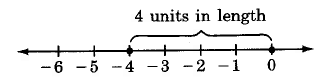
Absolute value measures distance, not direction. The point −4 is four units from zero, so |−4| = 4. The minus sign locates the point to the left; the distance itself is nonnegative.
Distance from zero — Denny Burzynski and Wade Ellis, Jr. / OpenStax CNX, via Mathematics LibreTexts. CC BY. Source image reproduced unchanged.
Operate with signed numbers
For addition with the same sign, add magnitudes and keep the sign: −4 + (−3) = −7. For unlike signs, subtract the smaller magnitude from the larger and keep the sign belonging to the larger magnitude: −9 + 5 = −4. Rewrite subtraction as addition of the opposite: 6 − (−2) = 6 + 2 = 8.
For multiplication and division, equal signs give a positive result and different signs give a negative result. This sign rule does not apply to addition. Estimate the direction: adding a negative should move left; subtracting a negative should move right.
Worked examples
Worked example 1: Order −3/2, −0.4, and 1/4. Convert −3/2 to −1.5. On the line, −1.5 is left of −0.4, which is left of 0.25. Therefore −3/2 < −0.4 < 1/4.
Worked example 2: Evaluate −7 − (−10) + 2. Change subtraction to addition: −7 + 10 + 2. The first two terms give 3; then 3 + 2 = 5. A movement check agrees: start at −7, move 10 right, then 2 right.
A reliable way to reason
When several signs appear, separate the job into two questions: what operation is being performed, and what direction should the answer have? Parentheses make that distinction visible. In −4−(−9), the first negative belongs to 4, the middle symbol is subtraction, and the last negative belongs to 9. Rewriting subtraction as addition of the opposite produces −4+9. Now the unlike-sign addition rule gives 5. This is safer than memorizing a phrase without seeing which sign does what.
Magnitude means size without direction. It explains why −12+7 is negative: 12 is the larger magnitude, so the negative direction wins; 12−7 gives magnitude 5. Magnitude also supports an error check. If two negative numbers are added, the result must be farther left than either starting number. If a negative is subtracted, the result must move right. For a real situation, attach meaning to zero. An elevation of −3 meters is below the reference, while a change of +5 meters is upward. The new elevation is 2 meters, not 8 meters, because the signs describe position and change rather than two unsigned distances.
Terms to remember
- integer
- A number with no fractional part, such as −3, 0, or 5.
- rational number
- A number writable as a fraction of integers with a nonzero denominator; integers and terminating or repeating decimals are examples.
- opposite
- A number the same distance from zero on the other side.
- absolute value
- A number’s distance from zero.
- magnitude
- Size without regard to sign.
Your quick summary
- Compare values by their position on the number line.
- Compare positions before comparing digit size.
- Treat subtraction as adding the opposite, then check direction.
- Absolute value is distance from zero, so it is nonnegative even when the original number is negative.
Lesson quiz
Check what you learned, then review the explanations. This quiz saves results on this device only. Sign in to save quiz results to your account.